


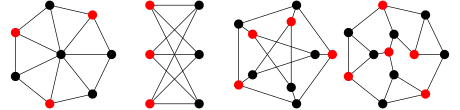
An independent vertex set of a graph  , also known as a stable set, is a subset
of the vertices such that no two vertices
in the subset are joined by an edge
of
 .
The figure above shows independent sets consisting of two subsets
for a number of graphs (the wheel
graph
 ,
utility graph
 , Petersen graph, and
Frucht graph).
Any independent vertex set is an irredundant set (Burger et al. 1997, Mynhardt and Roux 2020).
The polynomial whose coefficients give the number of independent vertex sets of each cardinality
in a graph  is known as its independence
polynomial.
A set of vertices is an independent vertex set iff its complement set forms a vertex cover (Skiena 1990, p. 218). The counts of vertex covers and independent vertex sets in a graph are therefore the same.
The empty set is trivially an independent vertex set since it contains no vertices, and therefore no edge endpoints.
A maximum independent vertex set is an independent vertex set of a graph containing the largest possible number of vertices for the given graph, and the cardinality of this set is called the independence number of the graph.
An independent vertex set that cannot be enlarged to another independent vertex set by adding a vertex is called a maximal independent vertex set.
In the Wolfram Language, the command FindIndependentVertexSet[g][[1]]
can be used to find a maximum independent
vertex set, and FindIndependentVertexSet[g,
Length /@ FindIndependentVertexSet[g], All] to find all
maximum independent vertex sets.
Similarly, FindIndependentVertexSet[g,
Infinity] can be used to find a maximal
independent vertex set, and FindIndependentVertexSet[g,
Infinity, All] to find all maximal
independent vertex sets. To find all independent vertex sets in the Wolfram
Language, enumerate all vertex subsets  and select those for which IndependentVertexSetQ[g,
s] is true.
Independent vertex set counts for some families of graphs are summarized in the following table. The index of each value list in the table starts at 1. An X indicates that the family in that row is not defined for the corresponding parameter value.
| graph family | OEIS | number independent vertex sets |
antiprism
graph for  | X, X, 10, 21, 46, 98, 211, 453, 973, 2090, ... | |
 bishop graph | A201862 | 2, 9, 70, 729, 9918, 167281, ... |
 black bishop graph | 2, 3, 10, 27, 114, 409, 2066, ... | |
 -folded cube graph | X, 3, 5, 31, 393, ... | |
grid
graph  for  | A006506 | X, 7, 63, 1234, 55447, 5598861, ... |
grid
graph  for  | X, 35, 70633, ... | |
 -halved
cube graph | 2, 3, 5, 13, 57, ... | |
 -Hanoi graph | 4, 52, 108144, ... | |
hypercube
graph  | A027624 | 3, 7, 35, 743, 254475, 19768832143, ... |
 king
graph | A063443 | 2, 5, 35, 314, 6427, ... |
 knight
graph | A141243 | 2, 16, 94, 1365, 55213, ... |
 -Möbius
ladder | A182143 | X, X, 15, 33, 83, 197, 479, 1153, 2787, ... |
 -Mycielski graph | 2, 3, 11, 103, 7407, ... | |
odd
graph  | 2, 4, 76, ... | |
prism graph  for  | A051927 | X, X, 13, 35, 81, 199, 477, 1155, 2785, ... |
 queen graph | 2, 5, 18, 87, 462, ... | |
 rook graph | A002720 | 2, 7, 34, 209, 1546, 13327, 130922, ... |
 -Sierpiński gasket
graph | 4, 14, 440, ... | |
 -triangular graph | X, 2, 4, 10, 26, 76, 232, 764, ... | |
 -web graph for  | X, X, 68, 304, 1232, 5168, 21408, ... | |
 white bishop graph | 1, 3, 7, 27, 87, 409, 1657, ... |
Many families of graphs have simple closed forms for counts of independent vertex sets, as summarized in the following table.
Here,  is a Fibonacci number,
 is a Lucas number,
 is a Laguerre
polynomial,
 is the golden ratio, and
 ,
 ,
 are the roots of
 .


 -


