


A Mycielski graph  is a triangle-free graph with chromatic
number
is a triangle-free graph with chromatic
number  belonging to the following recursively constructed family. Set
  and
and  . For
. For  , retain the vertices
  and edges
of
and edges
of  ,
add a new vertex
,
add a new vertex  for each
  , and add one more vertex
  . Join
  to every vertex adjacent
to
to every vertex adjacent
to  in
in  ,
and join
,
and join  to every
  to obtain
  (Jarnicki et al. 2016, §5).
For example, triangle-free graphs with chromatic number  include the Grötzsch
graph (11 vertices), Chvátal
graph (12 vertices), 13-cyclotomic
graph (13 vertices), Clebsch
graph (16 vertices), quartic
vertex-transitive graph Qt49 (16 vertices), Brinkmann graph (21 vertices),
Foster cage (30 vertices),
Robertson-Wegner graph (30 vertices),
and Wong graph (30 vertices).
The graph
include the Grötzsch
graph (11 vertices), Chvátal
graph (12 vertices), 13-cyclotomic
graph (13 vertices), Clebsch
graph (16 vertices), quartic
vertex-transitive graph Qt49 (16 vertices), Brinkmann graph (21 vertices),
Foster cage (30 vertices),
Robertson-Wegner graph (30 vertices),
and Wong graph (30 vertices).
The graph  is the Grötzsch graph,
which is the smallest of these examples.
is the Grötzsch graph,
which is the smallest of these examples.
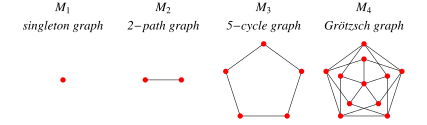
The first few Mycielski graphs are illustrated above and summarized in the table below.


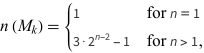
The  -Mycielski
graph has vertex count
-Mycielski
graph has vertex count
 |
(1)
|
giving the sequence of vertex counts for  ,
2, ... of 1, 2, 5, 11, 23, 47, 95, 191, 383, 767, ... (OEIS A083329),
and edge count
,
2, ... of 1, 2, 5, 11, 23, 47, 95, 191, 383, 767, ... (OEIS A083329),
and edge count
 |
(2)
|
where  and
and  .
.
Mycielski graphs are implemented in the Wolfram Language as FromEntity[Entity["Graph",
 "Mycielski", n]],
and precomputed properties for small Mycielski graphs are implemented as GraphData[
"Mycielski", n]],
and precomputed properties for small Mycielski graphs are implemented as GraphData[ "Mycielski", n
 ].
].
 is Hamilton-connected
for all
is Hamilton-connected
for all  except
  (Jarnicki et al. 2016).
de Grey (2026) constructed a unit-distance embedding of the 4-Mycielski (Grötzsch graph)
in three dimensions and attempted to construct one for the 5-Mycielski graph in his
construction of 5-chromatic, triangle-free,
unit-distance graph in  , though ended up using a different graph on 31 vertices
(the 31-de Grey graph).
, though ended up using a different graph on 31 vertices
(the 31-de Grey graph).
The fractional chromatic number of the Mycielski graph  is given by
  and
and
 |
(3)
|
(Larsen et al. 1995), giving the sequence for  , 3, ... of 2, 5/2, 29/10, 941/290,
969581/272890, ... (OEIS A073833 and A073834).
, 3, ... of 2, 5/2, 29/10, 941/290,
969581/272890, ... (OEIS A073833 and A073834).

 With 61 Vertices." Geombinatorics 35,
2026.House of Graphs. Mycielski Graphs.
With 61 Vertices." Geombinatorics 35,
2026.House of Graphs. Mycielski Graphs.