


A Venn diagram is a schematic diagram used in logic and set theory to depict collections of sets and their relationships.
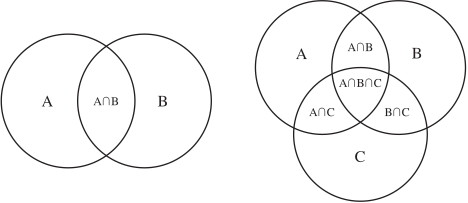
The Venn diagrams on two and three sets are illustrated above. The order-two diagram (left) consists of two intersecting circles, producing four regions
corresponding to membership in  ,
,  ,
,
 , or neither set.
Here,
, or neither set.
Here,  denotes the intersection of sets
  and
and  , and
, and  denotes their set difference.
The order-three diagram (right) consists of three symmetrically placed mutually intersecting circles comprising
a total of eight regions. The regions
labeled  ,
,
 , and
, and  consist of members which are only in one set
and no others. The three regions labeled
consist of members which are only in one set
and no others. The three regions labeled  ,
,  , and
, and  consist of members which are in two sets but not the third. The region
  consists
of members which are simultaneously in all three. The exterior region represents membership in none of the sets.
An intersection such as
consists
of members which are simultaneously in all three. The exterior region represents membership in none of the sets.
An intersection such as  includes the central region
  as well.
In general, an order- Venn diagram is a collection of
  Jordan curves in the plane,
any two of which intersect in finitely many points,
such that
Jordan curves in the plane,
any two of which intersect in finitely many points,
such that
1. The curves partition the plane into  connected regions, and
2. Each subset  of
of  corresponds to a unique nonempty region formed by the
intersection of the interiors
of the curves in
corresponds to a unique nonempty region formed by the
intersection of the interiors
of the curves in  and the exteriors of the curves
not in
and the exteriors of the curves
not in  (Ruskey and Weston 2005).
Since there are  (the binomial coefficient) ways to pick
  members from a total of
  , the number of regions in an order-
 Venn diagram is
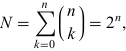 |
where the region outside the diagram is included in the count.
A Venn diagram is called simple if exactly two curves pass through each point of intersection.
It is called symmetric if its  curves are successive images of
one curve under rotation through
curves are successive images of
one curve under rotation through
 radians
about a common point, giving
radians
about a common point, giving  -fold rotational symmetry
(Ruskey et al. 2006). Simplicity of the diagram is an additional condition
beyond simplicity of its individual Jordan curves.
-fold rotational symmetry
(Ruskey et al. 2006). Simplicity of the diagram is an additional condition
beyond simplicity of its individual Jordan curves.
For  , a symmetric order-
 Venn diagram exists iff
  is prime. Henderson (1963) gave
a proof of the necessity of primality, but his argument had a gap: it assumed without
justification that the regions other than the innermost
and outermost occur in orbits of size
is prime. Henderson (1963) gave
a proof of the necessity of primality, but his argument had a gap: it assumed without
justification that the regions other than the innermost
and outermost occur in orbits of size  under rotation. Wagon and Webb
(2008) repaired this step using the Jordan curve
theorem. Griggs et al. (2004) proved the converse by constructing symmetric
Venn diagrams for every prime
under rotation. Wagon and Webb
(2008) repaired this step using the Jordan curve
theorem. Griggs et al. (2004) proved the converse by constructing symmetric
Venn diagrams for every prime  ; their construction does not in general produce simple diagrams.
The region of intersection of the three circles  in the order-three Venn diagram
in the special case of the center of each being located
at the intersection of the other two is a geometric
shape known as a Reuleaux triangle.
in the order-three Venn diagram
in the special case of the center of each being located
at the intersection of the other two is a geometric
shape known as a Reuleaux triangle.
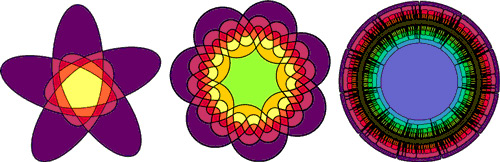
The left figure above shows an order-five Venn diagram due to Grünbaum (1975), while the sevenfold rosette in the middle is Ruskey's order-seven diagram called "Victoria" (Ruskey and Weston 2005). The right figure shows a non-simple symmetric order-11 Venn diagram drawn by Mark Weston (Ruskey et al. 2006, Fig. 2(c)).
Hamburger (2002) constructed the first symmetric order-11 Venn diagram, which was non-simple. The first simple symmetric order-11 Venn diagram was found by Mamakani and Ruskey (2012), who also constructed a simple symmetric order-13 diagram (Mamakani and Ruskey 2014). Dzoba (2026) constructed simple symmetric diagrams of orders 17, 19, and 23, extending the previously known largest order of 13. His preprint supplies machine-checkable certificates for four order-17, nine order-19, and five order-23 diagrams and reports formal verification in Lean 4 of one order-17 and one order-19 diagram. The order-23 certificates had not received completed Lean verification in that version. These certificates and formal builds have not been independently rechecked here. According to Dzoba (2026), Claude (Anthropic) and Codex (OpenAI) developed the search and verification code under his direction.
In Season 4 episode "Power" of the television crime drama NUMB3RS, mathematical genius Charles Eppes constructs a Venn diagram to determine suspects who match a particular description and have a history of violence.
