


The halved cube graph  is the graph distance graph at distance 2
of the
is the graph distance graph at distance 2
of the  -hypercube graph
  . Its vertex set is
  , with two vertices adjacent iff their graph distance in
 is exactly 2.
 is the disjoint
union of two isomorphic connected
components on
is the disjoint
union of two isomorphic connected
components on  vertices, each of which is called a halved
  -cube graph, half cube graph, the halved
  -cube, or sometimes the
  -demi-cube graph (Steinerberger 2023). The most common notation
for each component is
-demi-cube graph (Steinerberger 2023). The most common notation
for each component is  (Godsil 2004), and it is also written
  . The slash in
  denotes restriction to one parity
class, thereby halving the vertex set, not replacing the dimension
denotes restriction to one parity
class, thereby halving the vertex set, not replacing the dimension  by
by  to form the hypercube graph
  . In the distance-2 notation of
Luo et al. (2026),
. In the distance-2 notation of
Luo et al. (2026),
 |
One copy contains the even-weight vectors and the other contains the odd-weight vectors. Steinerberger (2023)
uses the notation  .
.
The halved  -cube
graph can also be defined on the even-weight vectors in
-cube
graph can also be defined on the even-weight vectors in
 , where two such vectors
are adjacent iff their
sum has weight two (Godsil 2004), or as the 2nd graph
power (i.e., the graph square) of
, where two such vectors
are adjacent iff their
sum has weight two (Godsil 2004), or as the 2nd graph
power (i.e., the graph square) of  , where
  denotes the
  -hypercube graph.
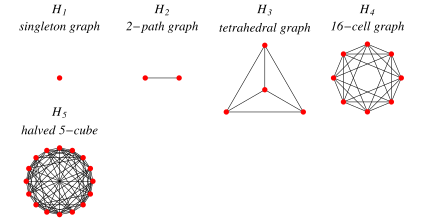
Embeddings for small-order halved graphs are illustrated above and special cases are summarized in the table below.
 | name |
| 1 | singleton graph  |
| 2 | path graph  |
| 3 | tetrahedral graph  |
| 4 | 16-cell graph  |
| 5 | graph complement of the Clebsch graph |
The 5-halved cube graph is the graph complement of the Clebsch graph. It has Lovász
number  (Fung 2011, p. 34). Note that Brouwer et al. (1989, pp. 104 and
224) confusingly use the term "Clebsch graph" to refer to the halved 5-cube
graph instead of the folded 5-cube graph meant
by other authors.
(Fung 2011, p. 34). Note that Brouwer et al. (1989, pp. 104 and
224) confusingly use the term "Clebsch graph" to refer to the halved 5-cube
graph instead of the folded 5-cube graph meant
by other authors.
The 6-halved cube graph is a distance-regular graph with intersection array  , and therefore also a Taylor
graph.
, and therefore also a Taylor
graph.
The chromatic numbers of the  -halved cube graphs for
  , 5, ... are 4, 8, 8, 8, 8, 13 or 14, [13, 15],
  ,
,  , ... (Godsil 2004, p. 67; typos corrected). Brouwer
agrees that
, ... (Godsil 2004, p. 67; typos corrected). Brouwer
agrees that  has chromatic number 4 and gives its independence
number as 5.
has chromatic number 4 and gives its independence
number as 5.
Luo et al. (2026) proved that the quantum chromatic number of the  -halved cube graph is
 |
when  is a prime power satisfying
  , when
  for a positive integer
  , or when
  and
and  and
and 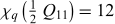 are odd prime powers. In
particular,
are odd prime powers. In
particular, 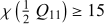 while
while  ,
giving a strict quantum-classical separation.
,
giving a strict quantum-classical separation.
The independence numbers of the  -halved cube graphs for
  , 2, ... are 1, 1, 1, 2, 2, 4, 8, 16, 20, 40, 72, 144, ...,
where values for
, 2, ... are 1, 1, 1, 2, 2, 4, 8, 16, 20, 40, 72, 144, ...,
where values for  to 12 are from Godsil (2004, p. 67). This sequence appears identical to the
error-correcting coding function
to 12 are from Godsil (2004, p. 67). This sequence appears identical to the
error-correcting coding function  (OEIS A005864;
E. W. Weisstein, Dec. 31, 2015).
(OEIS A005864;
E. W. Weisstein, Dec. 31, 2015).
The domination numbers of  -halved cube graphs for
  , 2, ... are 1, 1, 1, 2, 2, 2, 4, 7, 12, ..., which agrees
with OEIS A029866 for known terms (E. Weisstein,
Aug. 31, 2016).
, 2, ... are 1, 1, 1, 2, 2, 2, 4, 7, 12, ..., which agrees
with OEIS A029866 for known terms (E. Weisstein,
Aug. 31, 2016).
