


A complete tripartite graph is the  case of a complete
k-partite graph. In other words, it is a tripartite graph (i.e., a set of graph vertices decomposed
into three disjoint sets such that no two graph
vertices within the same set are adjacent)
such that every vertex of each set
of graph vertices is adjacent
to every vertex in the other two sets.
If there are
case of a complete
k-partite graph. In other words, it is a tripartite graph (i.e., a set of graph vertices decomposed
into three disjoint sets such that no two graph
vertices within the same set are adjacent)
such that every vertex of each set
of graph vertices is adjacent
to every vertex in the other two sets.
If there are  ,
,
 ,
and
,
and  graph vertices in the three sets,
the complete tripartite graph (sometimes also called a complete trigraph) is denoted
graph vertices in the three sets,
the complete tripartite graph (sometimes also called a complete trigraph) is denoted
 .
.
Special classes are summarized in the following table.
 | special class |
 |  -fan graph -fan graph |
 |  -fan graph -fan graph |
 |  -cone graph -cone graph |
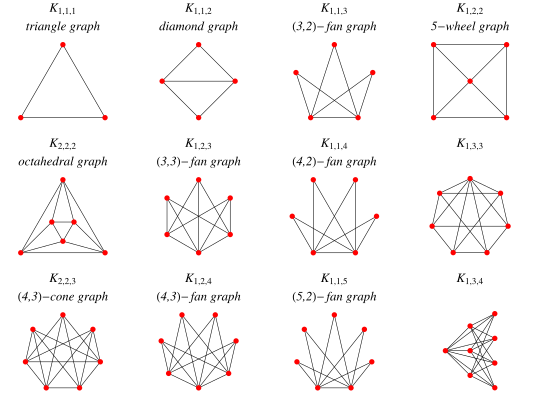
Some special cases are summarized in the following table, some of which are illustrated above.
 | name |  |
| 3 | triangle graph |  |
| 4 | diamond graph |  |
| 5 | (3,2)-fan graph |  |
| 5 | 5-wheel graph |  |
| 6 | octahedral graph |  |
| 6 | (3,3)-fan graph |  |
| 6 | (4,2)-fan graph |  |
| 7 | (4,3)-cone graph |  |
| 7 | (4,3)-fan graph |  |
| 7 | (5,2)-fan graph |  |
| 8 | (4,4)-cone graph |  |
| 8 | (5,3)-fan graph |  |
| 9 | 9-circulant graph  |  |
| 9 | (4,5)-cone graph |  |
| 12 | circulant
graph  |  |
| 15 | circulant
graph  |  |
The number of Hamiltonian cycles in the graph  can be efficiently computed using a general complete
k-partite graph recurrence (Horák
and Tovarek 1979). A closed-form formula is also known (submitted as a problem, 2025).
can be efficiently computed using a general complete
k-partite graph recurrence (Horák
and Tovarek 1979). A closed-form formula is also known (submitted as a problem, 2025).

 -Partite Graphs." Math. Slovaca 29, 43-47,
1979.
-Partite Graphs." Math. Slovaca 29, 43-47,
1979.