


The folded  -cube
graph, perhaps better termed "folded hypercube graph," is a graph
obtained by merging vertices of the
 -hypercube graph
 that are antipodal, i.e., lie at a distance
 (the graph diameter of
 ). Brouwer et al. 1989 (p. 222) use the
notation
 for the folded
 -cube
graph.
For  , the folded
 -cube graph is regular of
degree
 . It has
 vertices,
 edges, and diameter
 . The chromatic
number is 2 for
 even and 4 for
 odd (Sokolová 1987, Blokhuis et al. 2007). Godsil (2006) observes that
the independence number of the folded
 -cube graph
 is given by
 |
(1)
|
a result which follows from Cvetkovic's eigenvalue bound to establish an upper bound and a direct construction of the independent set by looking at vertices at an odd (resp., even) distance from a fixed vertex when n is odd (resp., even) (S. Wagon, pers. comm.).
Folded cube graphs are distance-regular and distance-transitive. The  -folded cube graph contains the Möbius
ladder
 as a subgraph for
 and so is not unit-distance.
For even  , the folded
 -cube graph is bipartite,
and either of its halved graphs is a halved
folded cube graph. Equivalently, a halved
folded cube graph is obtained by identifying complementary vertices
in a halved cube graph of dimension
 (Chan 2020, p. 772).
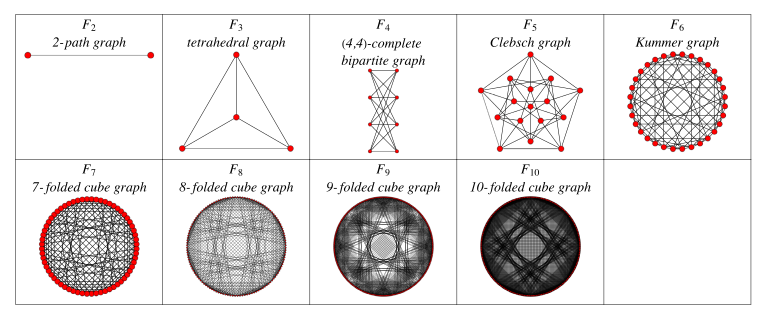
The following table summarizes special cases.
 | folded  -cube graph |
| 2 | 2-path graph  |
| 3 | tetrahedral graph  |
| 4 | complete bipartite graph  |
| 5 | Clebsch graph |
| 6 | Kummer graph |
For odd  , the bipartite
double graph of the folded
 -cube graph is the hypercube
graph
 . For even
 , it consists of two disjoint
copies of the folded
 -cube
graph.
For odd  , the total
domination number satisfies
 |
(2)
|
where  denotes the domination number of
 . Indeed, the total
domination number of a bipartite double
graph is twice that of the original graph. Thus
 , and the identity
 of Azarija et al. (2017)
gives the result. The known hypercube graph formula
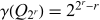 therefore yields
 |
(3)
|
for  (Azarija et al. 2017). In particular, determining
 is equivalent to determining the minimum size
 of a binary covering code of length 10 and radius 1.
A second exact family follows by applying the Hamming code construction of Kwon and Lee (2014). For  with
 , represent
 on the vector space
 , with adjacent
vertices differing by a coordinate unit vector
or by the all-ones vector
 . Let
 be the
 matrix whose columns
are all nonzero vectors of
 . Each row contains
 ones, so
 . The set
 is a Hamming code
of size
 . For each graph
vertex
 , the images under
 of the
 allowed neighbor displacements are exactly the
 distinct vectors of
 . Hence
 has exactly one neighbor in
 . Identifying complementary vertices
in the corresponding Hamming code construction on
 gives
 , since
 is invariant under complementation.
Every total dominating set  satisfies
 by counting neighbor incidences. Consequently,
 |
(4)
|
for  . More generally, for
 ,
 has an efficient open
dominating set iff
 is a power of 2. Necessity follows
from
 , and the construction proves sufficiency.
