


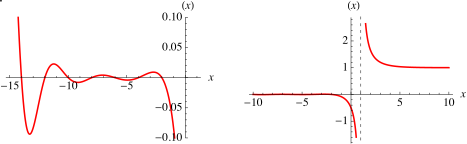
The Riemann zeta function is an extremely important special function of mathematics and physics that arises in definite integration and is
intimately related with very deep results surrounding the prime
number theorem. While many of the properties of this function have been investigated,
there remain important fundamental conjectures (most notably the Riemann
hypothesis) that remain unproved to this day. The Riemann zeta function is denoted
 and is plotted above (using two different scales) along the real axis.

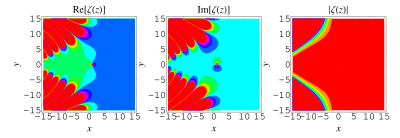
In general,  is defined over the complex plane for one complex variable, which is conventionally
denoted
is defined over the complex plane for one complex variable, which is conventionally
denoted  (instead of the usual
  ) in deference to the notation used by Riemann in his 1859
paper that founded the study of this function (Riemann 1859).
) in deference to the notation used by Riemann in his 1859
paper that founded the study of this function (Riemann 1859).
 is implemented in the Wolfram Language
as Zeta[s].
is implemented in the Wolfram Language
as Zeta[s].
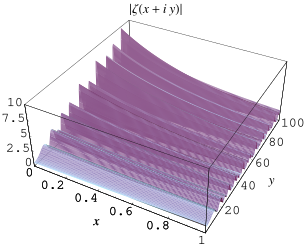
The plot above shows the "ridges" of  for
for  and
and  . The fact that the ridges appear to decrease monotonically
for
. The fact that the ridges appear to decrease monotonically
for  is not a coincidence since it turns out that monotonic decrease implies the Riemann
hypothesis (Zvengrowski and Saidak 2003; Borwein and Bailey 2003, pp. 95-96).
is not a coincidence since it turns out that monotonic decrease implies the Riemann
hypothesis (Zvengrowski and Saidak 2003; Borwein and Bailey 2003, pp. 95-96).
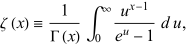
On the real line with  , the Riemann zeta function can be defined by the integral
 |
(1)
|
where  is the gamma function. If
  is an integer
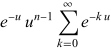
  , then we have the identity
 |  |  |
(2)
|
 |  |  |
(3)
|
 |  |  |
(4)
|
so
 |
(5)
|
To evaluate  ,
let
,
let  so that
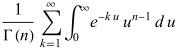
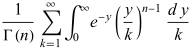
  and plug in the above identity to obtain
 |  |  |
(6)
|
 |  |  |
(7)
|
 |  |  |
(8)
|
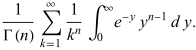
Integrating the final expression in (8) gives  , which cancels the factor
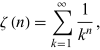
  and gives the most common form of the Riemann zeta
function,
and gives the most common form of the Riemann zeta
function,
 |
(9)
|
which is sometimes known as a p-series.
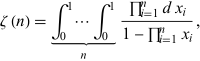
The Riemann zeta function can also be defined in terms of multiple integrals by
 |
(10)
|
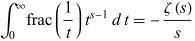
and as a Mellin transform by
 |
(11)
|
for ![0<R[s]<1](/images/equations/RiemannZetaFunction/Inline37.svg) ,
where
,
where  is the fractional part (Balazard and Saias 2000).
It appears in the unit square integral
![int_0^1int_0^1([-ln(xy)]^s)/(1-xy)dxdy=Gamma(s+2)zeta(s+2),](/images/equations/RiemannZetaFunction/NumberedEquation6.svg) |
(12)
|
valid for ![R[s]>1](/images/equations/RiemannZetaFunction/Inline39.svg) (Guillera and Sondow 2005). For
(Guillera and Sondow 2005). For  a nonnegative integer, this formula is due to Hadjicostas
(2002), and the special cases
a nonnegative integer, this formula is due to Hadjicostas
(2002), and the special cases  and
and  are due to Beukers (1979).
Note that the zeta function  has a singularity at
  , where it reduces to the divergent harmonic
series.
, where it reduces to the divergent harmonic
series.
The Riemann zeta function satisfies the reflection functional equation
 |
(13)
|
(Hardy 1999, p. 14; Krantz 1999, p. 160), a similar form of which was conjectured by Euler for real  (Euler, read in 1749, published in 1768; Ayoub 1974; Havil 2003, p. 193). A
symmetrical form of this functional equation is given by
(Euler, read in 1749, published in 1768; Ayoub 1974; Havil 2003, p. 193). A
symmetrical form of this functional equation is given by
 |
(14)
|
(Ayoub 1974), which was proved by Riemann for all complex  (Riemann 1859).
As defined above, the zeta function  with
with  a complex number
is defined for
a complex number
is defined for ![R[s]>1](/images/equations/RiemannZetaFunction/Inline49.svg) .
However,
.
However,  has a unique analytic continuation to the
entire complex plane, excluding the point
has a unique analytic continuation to the
entire complex plane, excluding the point  , which corresponds to a simple
pole with complex residue 1 (Krantz 1999,
p. 160). In particular, as
, which corresponds to a simple
pole with complex residue 1 (Krantz 1999,
p. 160). In particular, as  ,
,  obeys
obeys
![lim_(s->1)[zeta(s)-1/(s-1)]=gamma,](/images/equations/RiemannZetaFunction/NumberedEquation9.svg) |
(15)
|
where  is the Euler-Mascheroni constant (Whittaker
and Watson 1990, p. 271).
is the Euler-Mascheroni constant (Whittaker
and Watson 1990, p. 271).
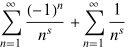
To perform the analytic continuation for ![R[s]>0](/images/equations/RiemannZetaFunction/Inline55.svg) ,
write
,
write
 |  |  |
(16)
|
 |  |  |
(17)
|
 |  |  |
(18)
|
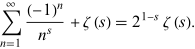
so rewriting in terms of  immediately gives
 |
(19)
|
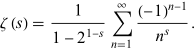
Therefore,
 |
(20)
|
Here, the sum on the right-hand side is exactly the Dirichlet eta function  (sometimes also called the alternating zeta function). While this formula defines
 for only the right half-plane
 ![R[s]>0](/images/equations/RiemannZetaFunction/Inline68.svg) , equation (◇) can be used to analytically continue
it to the rest of the complex plane. Analytic
continuation can also be performed using Hankel
functions. A globally convergent series for the Riemann zeta function (which
provides the analytic continuation of
, equation (◇) can be used to analytically continue
it to the rest of the complex plane. Analytic
continuation can also be performed using Hankel
functions. A globally convergent series for the Riemann zeta function (which
provides the analytic continuation of  to the entire complex
plane except
to the entire complex
plane except  )
is given by
)
is given by
 |
(21)
|
(Havil 2003, p. 206), where  is a binomial coefficient,
which was conjectured by Knopp around 1930, proved by Hasse (1930), and rediscovered
by Sondow (1994). This equation is related to renormalization and random variates
(Biane et al. 2001) and can be derived by applying Euler's
series transformation with
is a binomial coefficient,
which was conjectured by Knopp around 1930, proved by Hasse (1930), and rediscovered
by Sondow (1994). This equation is related to renormalization and random variates
(Biane et al. 2001) and can be derived by applying Euler's
series transformation with  to equation (20).
Hasse (1930) also proved the related globally (but more slowly) convergent series
 |
(22)
|
that, unlike (21), can also be extended to a generalization of the Riemann zeta function known as the Hurwitz
zeta function  .
.
 is defined such that
 |
(23)
|
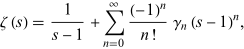
(If the singular term is excluded from the sum definition of  , then
  as well.) Expanding
  about
about  gives
gives
 |
(24)
|
where  are the so-called Stieltjes constants.
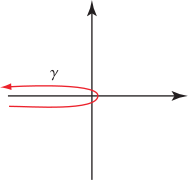
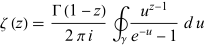
The Riemann zeta function can also be defined in the complex plane by the contour integral
 |
(25)
|
for all  ,
where the contour is illustrated above (Havil 2003, pp. 193
and 249-252).
,
where the contour is illustrated above (Havil 2003, pp. 193
and 249-252).
Zeros of  come in (at least) two different types. So-called "trivial zeros" occur
at all negative even integers
come in (at least) two different types. So-called "trivial zeros" occur
at all negative even integers  ,
,  ,
,  , ..., and "nontrivial zeros" at certain
 |
(26)
|
for  in the "critical strip"
  . The Riemann
hypothesis asserts that the nontrivial Riemann
zeta function zeros of
. The Riemann
hypothesis asserts that the nontrivial Riemann
zeta function zeros of  all have real part
 ![sigma=R[s]=1/2](/images/equations/RiemannZetaFunction/Inline88.svg) , a line called the "critical line." This is now known to be true for
the first
, a line called the "critical line." This is now known to be true for
the first  roots.
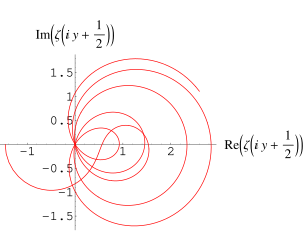
The plot above shows the real and imaginary parts of  (i.e., values of
  along the critical line)
as
along the critical line)
as  is varied from 0 to 35 (Derbyshire 2004, p. 221).
The Riemann zeta function can be split up into
 |
(27)
|
where  and
and  are the Riemann-Siegel functions.
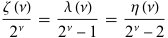
The Riemann zeta function is related to the Dirichlet lambda function  and Dirichlet
eta function
and Dirichlet
eta function  by
by
 |
(28)
|
and
 |
(29)
|
(Spanier and Oldham 1987).
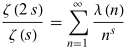
It is related to the Liouville function  by
by
 |
(30)
|
(Lehman 1960, Hardy and Wright 1979). Furthermore,
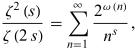 |
(31)
|
where  is the number of distinct prime factors
of
is the number of distinct prime factors
of  (Hardy and Wright 1979, p. 254).
For  a positive even integer
  ,
,  , ...,
 |
(32)
|
giving the first few as
 |  |  |
(33)
|
 |  |  |
(34)
|
 |  |  |
(35)
|
 |  |  |
(36)
|
(OEIS A117972 and A117973). For  ,
,
 |
(37)
|
where  is the Glaisher-Kinkelin constant.
Using equation (◇) gives the derivative
is the Glaisher-Kinkelin constant.
Using equation (◇) gives the derivative
 |
(38)
|
which can be derived directly from the Wallis formula (Sondow 1994).  can also be derived directly from the Euler-Maclaurin summation formula (Edwards
2001, pp. 134-135). In general,
can also be derived directly from the Euler-Maclaurin summation formula (Edwards
2001, pp. 134-135). In general,  can be expressed analytically in terms of
  ,
,  , the Euler-Mascheroni
constant
, the Euler-Mascheroni
constant  ,
and the Stieltjes constants
,
and the Stieltjes constants  , with the first few examples being
 |  | ![gamma_1+1/2gamma^2-1/(24)pi^2-1/2[ln(2pi)]^2](/images/equations/RiemannZetaFunction/Inline125.svg) |
(39)
|
 |  | ![3ln(2pi)gamma_1+3gammagamma_1+3/2gamma_2-zeta(3)-1/2[ln(2pi)]^3-1/8pi^2ln(2pi)+3/2gamma^2ln(2pi)+gamma^3.](/images/equations/RiemannZetaFunction/Inline128.svg) |
(40)
|
Derivatives  can also be given in closed form, for example,
 |  | ![1/4[(pi+2gamma+6ln2+2lnpi)zeta(1/2)]](/images/equations/RiemannZetaFunction/Inline132.svg) |
(41)
|
 |  |  |
(42)
|
(OEIS A114875).
The derivative of the Riemann zeta function for ![R[s]>1](/images/equations/RiemannZetaFunction/Inline136.svg) is defined by
is defined by
 |  |  |
(43)
|
 |  |  |
(44)
|
 can be given in closed form as
 |  | ![1/6pi^2[gamma+ln(2pi)-12lnA]](/images/equations/RiemannZetaFunction/Inline146.svg) |
(45)
|
 |  |  |
(46)
|
(OEIS A073002), where  is the Glaisher-Kinkelin
constant (given in series form by Glaisher 1894).
is the Glaisher-Kinkelin
constant (given in series form by Glaisher 1894).
The series for  about
about  is
is
 |
(47)
|
where  are Stieltjes constants.
In 1739, Euler found the rational coefficients  in
in  in terms of the Bernoulli
numbers. Which, when combined with the 1882 proof by Lindemann that
in terms of the Bernoulli
numbers. Which, when combined with the 1882 proof by Lindemann that  is transcendental, effectively proves that
  is transcendental. The study of
  is significantly more difficult. Apéry (1979)
finally proved
is significantly more difficult. Apéry (1979)
finally proved  to be irrational, but no similar results are
known for other odd
to be irrational, but no similar results are
known for other odd  . As a result of Apéry's important discovery,
  is sometimes called Apéry's
constant. Rivoal (2000) and Ball and Rivoal (2001) proved that there are infinitely
many integers
is sometimes called Apéry's
constant. Rivoal (2000) and Ball and Rivoal (2001) proved that there are infinitely
many integers  such that
  is irrational, and subsequently that at least one of
  ,
,  , ...,
  is irrational
(Rivoal 2001). This result was subsequently tightened by Zudilin (2001), who showed
that at least one of
is irrational
(Rivoal 2001). This result was subsequently tightened by Zudilin (2001), who showed
that at least one of  ,
,  ,
,  , or
, or  is irrational.
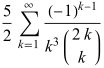
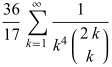
A number of interesting sums for  , with
  a positive integer, can
be written in terms of binomial coefficients as the binomial
sums
a positive integer, can
be written in terms of binomial coefficients as the binomial
sums
 |  |  |
(48)
|
 |  |  |
(49)
|
 |  |  |
(50)
|
(Guy 1994, p. 257; Bailey et al. 2007, p. 70). Apéry arrived at his result with the aid of the  sum formula above. A relation of
the form
sum formula above. A relation of
the form
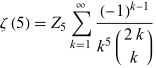 |
(51)
|
has been searched for with  a rational or algebraic
number, but if
a rational or algebraic
number, but if  is a root of a polynomial
of degree 25 or less, then the Euclidean norm of the coefficients must be larger
than
is a root of a polynomial
of degree 25 or less, then the Euclidean norm of the coefficients must be larger
than  ,
and if
,
and if  if algebraic of degree 25 or less, then the norm of coefficients must exceed
  (Bailey et al. 2007,
pp. 70-71, updating Bailey and Plouffe). Therefore, no such sums for
(Bailey et al. 2007,
pp. 70-71, updating Bailey and Plouffe). Therefore, no such sums for  are known for
  .
.
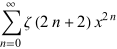
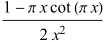
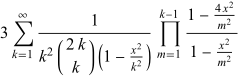
The identity
 |  |  |
(52)
|
 |  |  |
(53)
|
 |  |  |
(54)
|
 |  |  |
(55)
|
for  is complex number not equal to a nonzero integer gives an Apéry-like formula
for even positive
is complex number not equal to a nonzero integer gives an Apéry-like formula
for even positive  (Bailey et al. 2006, pp. 72-77).
The Riemann zeta function  may be computed analytically for even
  using either contour
integration or Parseval's theorem with the
appropriate Fourier series. An unexpected and important
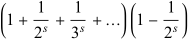
formula involving a product over the primes was first
discovered by Euler in 1737,
using either contour
integration or Parseval's theorem with the
appropriate Fourier series. An unexpected and important
formula involving a product over the primes was first
discovered by Euler in 1737,
 |  |  |
(56)
|
 |  |  |
(57)
|
 |  |  |
(58)
|
 |  |  |
(59)
|
 |  |  |
(60)
|
Here, each subsequent multiplication by the  th prime
  leaves only terms that are powers
of
leaves only terms that are powers
of  .
Therefore,
.
Therefore,
![zeta(s)=[product_(n=1)^infty(1-p_n^(-s))]^(-1),](/images/equations/RiemannZetaFunction/NumberedEquation28.svg) |
(61)
|
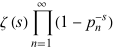
which is known as the Euler product formula (Hardy 1999, p. 18; Krantz 1999, p. 159), and called "the golden key" by Derbyshire (2004, pp. 104-106). The formula can also be written
 |
(62)
|
where  and
and  are the primes congruent to 1 and 3 modulo 4, respectively.
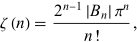
For even  ,
,
 |
(63)
|
where  is a Bernoulli number (Mathews and Walker 1970,
pp. 50-53; Havil 2003, p. 194). Another intimate connection with the Bernoulli numbers is provided by
is a Bernoulli number (Mathews and Walker 1970,
pp. 50-53; Havil 2003, p. 194). Another intimate connection with the Bernoulli numbers is provided by
 |
(64)
|
for  ,
which can be written
,
which can be written
 |
(65)
|
for  .
(In both cases, only the even cases are of interest since
.
(In both cases, only the even cases are of interest since  trivially for odd
  .) Rewriting (65),
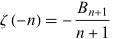 |
(66)
|
for  ,
3, ... (Havil 2003, p. 194), where
,
3, ... (Havil 2003, p. 194), where  is a Bernoulli number,
the first few values of which are
is a Bernoulli number,
the first few values of which are  , 1/120,
  , 1/240, ... (OEIS A001067
and A006953).
, 1/240, ... (OEIS A001067
and A006953).
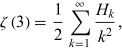
Although no analytic form for  is known for odd
  ,
,
 |
(67)
|
where  is a harmonic number (Stark 1974). In addition,
 can be expressed as the sum limit
![zeta(n)=lim_(x->infty)1/((2x+1)^n)sum_(k=1)^x[cot(k/(2x+1))]^n](/images/equations/RiemannZetaFunction/NumberedEquation35.svg) |
(68)
|
for  ,
5, ... (Apostol 1973, given incorrectly in Stark 1974).
,
5, ... (Apostol 1973, given incorrectly in Stark 1974).
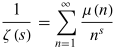
For  the Möbius function,
 |
(69)
|
(Havil 2003, p. 209).
The values of  for small positive integer values of
  are
are
 |  |  |
(70)
|
 |  |  |
(71)
|
 |  |  |
(72)
|
 |  |  |
(73)
|
 |  |  |
(74)
|
 |  |  |
(75)
|
 |  |  |
(76)
|
 |  |  |
(77)
|
 |  |  |
(78)
|
 |  |  |
(79)
|
Euler gave  to
to  for even
  (Wells 1986, p. 54), and Stieltjes (1993) determined
the values of
(Wells 1986, p. 54), and Stieltjes (1993) determined
the values of  ,
...,
,
...,  to 30 digits of accuracy in 1887. The denominators of
  for
for  , 2, ... are 6, 90, 945, 9450, 93555, 638512875, ... (OEIS
A002432). The numbers of decimal digits in
the denominators of
, 2, ... are 6, 90, 945, 9450, 93555, 638512875, ... (OEIS
A002432). The numbers of decimal digits in
the denominators of  for
for  , 1, ... are 1, 5, 133, 2277, 32660, 426486, 5264705, ...
(OEIS A114474).
, 1, ... are 1, 5, 133, 2277, 32660, 426486, 5264705, ...
(OEIS A114474).
An integral for positive even integers is given by
 |
(80)
|
and integrals for positive odd integers are given by
 |  |  |
(81)
|
 |  |  |
(82)
|
 |  |  |
(83)
|
 |  |  |
(84)
|
where  is an Euler polynomial and
  is a Bernoulli polynomial
(Cvijović and Klinowski 2002; J. Crepps, pers. comm., Apr. 2002).
is a Bernoulli polynomial
(Cvijović and Klinowski 2002; J. Crepps, pers. comm., Apr. 2002).
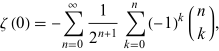
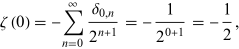
The value of  can be computed by performing the inner sum in equation (◇) with
  ,
,
 |
(85)
|
to obtain
 |
(86)
|
where  is the Kronecker delta.
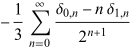
Similarly, the value of  can be computed by performing the inner sum in equation
(◇) with
can be computed by performing the inner sum in equation
(◇) with  ,
,
 |
(87)
|
which gives
 |  |  |
(88)
|
 |  | 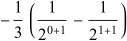 |
(89)
|
 |  |  |
(90)
|
This value is related to a deep result in renormalization theory (Elizalde et al. 1994, 1995, Bloch 1996, Lepowski 1999).
It is apparently not known if the value
 |
(91)
|
(OEIS A059750) can be expressed in terms of known mathematical constants. This constant appears, for example, in Knuth's series.
Rapidly converging series for  for
for  odd were first discovered by Ramanujan (Zucker 1979, 1984,
Berndt 1988, Bailey et al. 1997, Cohen 2000). For
odd were first discovered by Ramanujan (Zucker 1979, 1984,
Berndt 1988, Bailey et al. 1997, Cohen 2000). For  and
and  ,
,
 |
(92)
|
where  is again a Bernoulli number and
  is a binomial coefficient.
The values of the left-hand sums (divided by
is a binomial coefficient.
The values of the left-hand sums (divided by  ) in (92) for
  , 7, 11, ... are 7/180, 19/56700, 1453/425675250, 13687/390769879500,
7708537/21438612514068750, ... (OEIS A057866
and A057867). For
, 7, 11, ... are 7/180, 19/56700, 1453/425675250, 13687/390769879500,
7708537/21438612514068750, ... (OEIS A057866
and A057867). For  and
and  , the corresponding formula is slightly messier,
 |
(93)
|
(Cohen 2000).
Defining
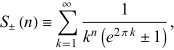 |
(94)
|
the first few values can then be written
 |  | 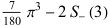 |
(95)
|
 |  |  |
(96)
|
 |  | 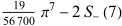 |
(97)
|
 |  |  |
(98)
|
 |  |  |
(99)
|
 |  |  |
(100)
|
 |  |  |
(101)
|
 |  |  |
(102)
|
 |  |  |
(103)
|
 |  |  |
(104)
|
(Plouffe 1998).
Another set of related formulas are
 |  |  |
(105)
|
 |  |  |
(106)
|
 |  |  |
(107)
|
 |  |  |
(108)
|
 |  |  |
(109)
|
(Plouffe 2006).
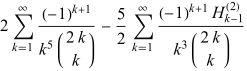
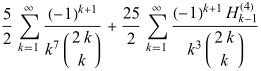
Multiterm sums for odd  include
 |  |  |
(110)
|
 |  |  |
(111)
|
 |  |  |
(112)
|
 |  | ![5/2sum_(k=1)^(infty)((-1)^(k+1))/(k^(11)(2k; k))+(25)/2sum_(k=1)^(infty)((-1)^(k+1)H_(k-1)^((4)))/(k^7(2k; k))-(75)/4sum_(k=1)^(infty)((-1)^(k+1)H_(k-1)^((8)))/(k^3(2k; k))+(125)/4sum_(k=1)^(infty)((-1)^(k+1)[H_(k-1)^((4))]^2)/(k^3(2k; k))](/images/equations/RiemannZetaFunction/Inline378.svg) |
(113)
|
(Borwein and Bradley 1996, 1997; Bailey et al. 2007, p. 71), where  is a generalized harmonic
number.
is a generalized harmonic
number.
G. Huvent (2002) found the beautiful formula
![zeta(5)=-(16)/(11)sum_(n=1)^infty([2(-1)^n+1]H_n)/(n^4).](/images/equations/RiemannZetaFunction/NumberedEquation45.svg) |
(114)
|
A number of sum identities involving  include
![sum_(n=2)^(infty)[zeta(n)-1]](/images/equations/RiemannZetaFunction/Inline381.svg) |  |  |
(115)
|
![sum_(n=2,4,...)^(infty)[zeta(n)-1]](/images/equations/RiemannZetaFunction/Inline384.svg) |  |  |
(116)
|
![sum_(n=3,5,...)^(infty)[zeta(n)-1]](/images/equations/RiemannZetaFunction/Inline387.svg) |  |  |
(117)
|
![sum_(n=2)^(infty)(-1)^n[zeta(n)-1]](/images/equations/RiemannZetaFunction/Inline390.svg) |  |  |
(118)
|
Sums involving integers multiples of the argument include
![sum_(n=1)^(infty)[zeta(2n)-1]](/images/equations/RiemannZetaFunction/Inline393.svg) |  |  |
(119)
|
![sum_(n=1)^(infty)[zeta(3n)-1]](/images/equations/RiemannZetaFunction/Inline396.svg) |  | ![1/3[-(-1)^(2/3)H_((3-isqrt(3))/2)+(-1)^(1/3)H_((3+isqrt(3))/2)]](/images/equations/RiemannZetaFunction/Inline398.svg) |
(120)
|
![sum_(n=1)^(infty)[zeta(4n)-1]](/images/equations/RiemannZetaFunction/Inline399.svg) |  | 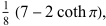 |
(121)
|
where  is a harmonic number.
Two surprising sums involving  are given by
 |  |  |
(122)
|
 |  |  |
(123)
|
where  is the Euler-Mascheroni constant (Havil
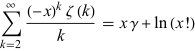
2003, pp. 109 and 111-112). Equation (122) can be generalized
to
is the Euler-Mascheroni constant (Havil
2003, pp. 109 and 111-112). Equation (122) can be generalized
to
 |
(124)
|
(T. Drane, pers. comm., Jul. 7, 2006) for  .
.
Other unexpected sums are
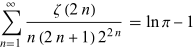 |
(125)
|
(Tyler and Chernhoff 1985; Boros and Moll 2004, p. 248) and
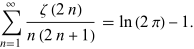 |
(126)
|
(125) is a special case of
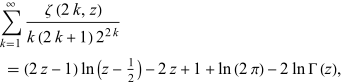 |
(127)
|
where  is a Hurwitz zeta function (Danese 1967;
Boros and Moll 2004, p. 248).
is a Hurwitz zeta function (Danese 1967;
Boros and Moll 2004, p. 248).
Considering the sum
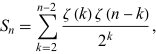 |
(128)
|
then
 |
(129)
|
where  is the natural logarithm of 2, which is a
particular case of
is the natural logarithm of 2, which is a
particular case of
 |
(130)
|
where  is the digamma function and
  is the Euler-Mascheroni
constant, which can be derived from
is the Euler-Mascheroni
constant, which can be derived from
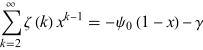 |
(131)
|
(B. Cloitre, pers. comm., Dec. 11, 2005; cf. Borwein et al. 2000, eqn. 27).
A generalization of a result of Ramanujan (who gave the  case) is given by
![sum_(k=1)^infty1/([k(k+1)]^(2m+1))=-2sum_(k=0)^mzeta(2k)(4m-2k+1; 2m),](/images/equations/RiemannZetaFunction/NumberedEquation54.svg) |
(132)
|
where  is a binomial coefficient (B. Cloitre,
pers. comm., Sep. 20, 2005).
is a binomial coefficient (B. Cloitre,
pers. comm., Sep. 20, 2005).
An additional set of sums over  is given by
 |  |  |
(133)
|
 |  | 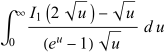 |
(134)
|
 |  | 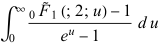 |
(135)
|
 |  |  |
(136)
|
 |  |  |
(137)
|
 |  |  |
(138)
|
 |  | 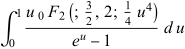 |
(139)
|
 |  |  |
(140)
|
 |  |  |
(141)
|
 |  |  |
(142)
|
 |  |  |
(143)
|
(OEIS A093720, A076813, and A093721), where  is a modified
Bessel function of the first kind,
is a modified
Bessel function of the first kind,  is a regularized
hypergeometric function. These sums have no known closed-form
expression.
is a regularized
hypergeometric function. These sums have no known closed-form
expression.
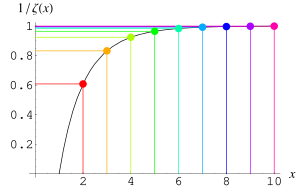
The inverse of the Riemann zeta function  , plotted above, is the asymptotic density of
  th-powerfree numbers (i.e., squarefree
numbers, cubefree numbers, etc.). The following table
gives the number
th-powerfree numbers (i.e., squarefree
numbers, cubefree numbers, etc.). The following table
gives the number  of
of  th-powerfree
numbers
th-powerfree
numbers  for several values of
  .
.
 |  |  |  |  |  |  |  |
| 2 | 0.607927 | 7 | 61 | 608 | 6083 | 60794 | 607926 |
| 3 | 0.831907 | 9 | 85 | 833 | 8319 | 83190 | 831910 |
| 4 | 0.923938 | 10 | 93 | 925 | 9240 | 92395 | 923939 |
| 5 | 0.964387 | 10 | 97 | 965 | 9645 | 96440 | 964388 |
| 6 | 0.982953 | 10 | 99 | 984 | 9831 | 98297 | 982954 |

 Aizenberg, L.; Adamchik, V.; and Levit,
V. E. "Approaching the Riemann Hypothesis with Mathematica."
Aizenberg, L.; Adamchik, V.; and Levit,
V. E. "Approaching the Riemann Hypothesis with Mathematica."
 et
et  ." Astérisque 61, 11-13, 1979.Apostol,
T. M. "Another Elementary Proof of Euler's Formula for
." Astérisque 61, 11-13, 1979.Apostol,
T. M. "Another Elementary Proof of Euler's Formula for  ." Amer. Math. Monthly 80, 425-431,
1973.Arfken, G.
." Amer. Math. Monthly 80, 425-431,
1973.Arfken, G.  de Riemann, 2." Adv. Math. 143, 284-287,
1999.Ball, K. and Rivoal, T. "Irrationalité d'une infinité
valeurs de la fonction zêta aux entiers impairs." Invent. Math. 146,
193-207, 2001.Berndt, B. C. Ch. 14 in
de Riemann, 2." Adv. Math. 143, 284-287,
1999.Ball, K. and Rivoal, T. "Irrationalité d'une infinité
valeurs de la fonction zêta aux entiers impairs." Invent. Math. 146,
193-207, 2001.Berndt, B. C. Ch. 14 in  and
and  ." Bull. London Math. Soc. 11, 268-272,
1979.Biane, P.; Pitman, J.; and Yor, M. "Probability Laws Related
to the Jacobi Theta and Riemann Zeta Functions, and Brownian Excursions." Bull.
Amer. Math. Soc. 38, 435-465, 2001.Bloch, S. "Zeta Values
and Differential Operators on the Circle." J. Algebra 182, 476-500,
1996.Boros, G. and Moll, V.
." Bull. London Math. Soc. 11, 268-272,
1979.Biane, P.; Pitman, J.; and Yor, M. "Probability Laws Related
to the Jacobi Theta and Riemann Zeta Functions, and Brownian Excursions." Bull.
Amer. Math. Soc. 38, 435-465, 2001.Bloch, S. "Zeta Values
and Differential Operators on the Circle." J. Algebra 182, 476-500,
1996.Boros, G. and Moll, V.  ." Proc. Amer. Math. Soc. 123, 1191-1198,
1995.Borwein, J. and Bailey, D.
." Proc. Amer. Math. Soc. 123, 1191-1198,
1995.Borwein, J. and Bailey, D.  ." Exp. Math. 6, 181-194, 1997.Borwein,
J. M.; Bradley, D. M.; and Crandall, R. E. "Computational Strategies
for the Riemann Zeta Function." J. Comput. Appl. Math. 121, 247-296,
2000.Castellanos, D. "The Ubiquitous Pi. Part I." Math.
Mag. 61, 67-98, 1988.Choudhury, B. K. "The Riemann
Zeta-Function and Its Derivatives." Proc. Roy. Soc. London Ser. A 450,
477-499, 1995.Cohen, H. "High Precision Computation of Hardy-Littlewood
Constants." Preprint.
." Exp. Math. 6, 181-194, 1997.Borwein,
J. M.; Bradley, D. M.; and Crandall, R. E. "Computational Strategies
for the Riemann Zeta Function." J. Comput. Appl. Math. 121, 247-296,
2000.Castellanos, D. "The Ubiquitous Pi. Part I." Math.
Mag. 61, 67-98, 1988.Choudhury, B. K. "The Riemann
Zeta-Function and Its Derivatives." Proc. Roy. Soc. London Ser. A 450,
477-499, 1995.Cohen, H. "High Precision Computation of Hardy-Littlewood
Constants." Preprint.  ." Messenger Math. 24, 1-16,
1894.Guillera, J. and Sondow, J. "Double Integrals and Infinite
Products for Some Classical Constants Via Analytic Continuations of Lerch's Transcendent."
16 June 2005
." Messenger Math. 24, 1-16,
1894.Guillera, J. and Sondow, J. "Double Integrals and Infinite
Products for Some Classical Constants Via Analytic Continuations of Lerch's Transcendent."
16 June 2005  -Function." §F17 in
  ." Feb. 3, 2002.
  ,
,  ,
,  , and
, and  ." Amer. Math. Monthly 108, 222-231,
2001.Ivic, A. A.
." Amer. Math. Monthly 108, 222-231,
2001.Ivic, A. A.  -Function."
  ,
,
 ,
...,
,
...,  ."
25 Apr 2001.
."
25 Apr 2001. 
 , 3, 4, ..., Once More." Math.
Mag. 47, 197-202, 1974.Stieltjes, T. J.
, 3, 4, ..., Once More." Math.
Mag. 47, 197-202, 1974.Stieltjes, T. J.  ,
,  ,
,  ,
,  Is Irrational." Uspekhi Mat. Nauk 56,
149-150, 2001.Zvengrowski, P. and Saidak, F. "On the Modulus of
the Riemann Zeta Function in the Critical Strip." Math. Slovaca 53,
145-172, 2003.
Is Irrational." Uspekhi Mat. Nauk 56,
149-150, 2001.Zvengrowski, P. and Saidak, F. "On the Modulus of
the Riemann Zeta Function in the Critical Strip." Math. Slovaca 53,
145-172, 2003.