

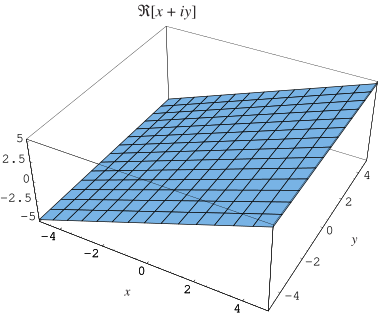
The real part of a complex number  , denoted
 ![Re[z]](/images/equations/RealPart/Inline2.svg) in this work, is the real number not
multiplying i, so
in this work, is the real number not
multiplying i, so ![Re[x+iy]=x](/images/equations/RealPart/Inline3.svg) . A nonzero complex
number with zero real part is called an imaginary
number or sometimes, for emphasis, a purely
imaginary number. In terms of
. A nonzero complex
number with zero real part is called an imaginary
number or sometimes, for emphasis, a purely
imaginary number. In terms of  itself,
![Re[z]=1/2(z+z^_),](/images/equations/RealPart/NumberedEquation1.svg) |
where  is the complex
conjugate of
is the complex
conjugate of  .
.
For the operator symbols, two typographic conventions are common. The upright two-letter abbreviation  is used by ISO 80000-2 and the NIST Digital Library of Mathematical Functions. By
contrast, the traditional plain TeX control sequences \Re and \Im
render as the black-letter symbols identified by Unicode as U+211C BLACK-LETTER CAPITAL
R and U+2111 BLACK-LETTER CAPITAL I. The Computer Modern source names these glyphs
"Uppercase Fraktur R" and "Uppercase Fraktur I." Unicode separately
encodes the script or calligraphic capitals U+211B SCRIPT CAPITAL R and U+2110 SCRIPT
CAPITAL I.
is used by ISO 80000-2 and the NIST Digital Library of Mathematical Functions. By
contrast, the traditional plain TeX control sequences \Re and \Im
render as the black-letter symbols identified by Unicode as U+211C BLACK-LETTER CAPITAL
R and U+2111 BLACK-LETTER CAPITAL I. The Computer Modern source names these glyphs
"Uppercase Fraktur R" and "Uppercase Fraktur I." Unicode separately
encodes the script or calligraphic capitals U+211B SCRIPT CAPITAL R and U+2110 SCRIPT
CAPITAL I.
Separately, two argument-delimiter conventions are common. ISO normally places a function argument
in parentheses, but permits the parentheses
to be omitted after a multi-letter function name when
the argument is simple and unambiguous. This accounts
for both  and
and  . Some mathematical publishing styles
use square brackets as alternative delimiters,
especially around an expression containing parentheses.
ISO instead recommends parentheses for grouping because
square brackets can have other meanings.
. Some mathematical publishing styles
use square brackets as alternative delimiters,
especially around an expression containing parentheses.
ISO instead recommends parentheses for grouping because
square brackets can have other meanings.
The real part is implemented in the Wolfram Language as Re[z]
and displayed in traditional form formatting as  .
.
