The Riemann-Siegel function is defined for positivereal by
(1)
This function is sometimes also called the Hardy function or Hardy -function (Karatsuba and Voronin 1992, Borwein et al. 2000).
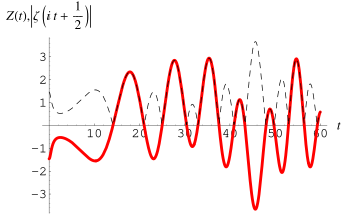
The top plot superposes (thick line) on , where is the Riemann zeta
function.
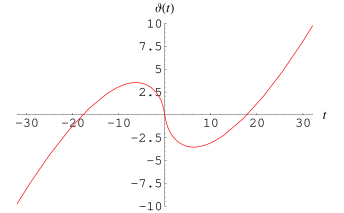
The Riemann-Siegel theta function is defined for real as
(2)
(3)
where
is the log gamma function and the argument
is chosen continuously along real so that (Brent 2019, pp. 320-321). This convention gives
.
The function
has local extrema at (OEIS A114865
and A114866).
Values
on the increasing positive branch of above its minimum such that
(4)
for ,
1, ... are known as Gram points (Edwards 2001, pp. 125-126).
(Edwards 2001, p. 120; Brent 2019, p. 320). The reduced numerators and denominators of the inverse-power coefficients are given by OEIS A282898
and OEIS A114721, respectively.
Berry, M. V. "The Riemann-Siegel Expansion for the Zeta Function: High Orders and Remainders." Proc. Roy. Soc. London A450,
439-462, 1995.Borwein, J. M.; Bradley, D. M.; and Crandall,
R. E. "Computational Strategies for the Riemann Zeta Function." J.
Comput. Appl. Math.121, 247-296, 2000.Brent, R. P.
"On the Accuracy of Asymptotic Approximations to the Log-Gamma and Riemann-Siegel
Theta Functions." J. Austral. Math. Soc.107, 319-337, 2019. https://doi.org/10.1017/S1446788718000393.Brent,
R. P. "On the Zeros of the Riemann Zeta Function in the Critical Strip."
Math. Comput.33, 1361-1372, 1979.Edwards, H. M.
Riemann's
Zeta Function. New York: Dover, 2001.Karatsuba, A. A. and
Voronin, S. M. The
Riemann Zeta-Function. Hawthorn, NY: de Gruyter, 1992.Odlyzko,
A. M. "The th Zero of the Riemann Zeta Function and 70 Million of
Its Neighbors." Preprint.Sloane, N. J. A. Sequences
A067626, A114721,
A114865, A114866,
and A282898 in "The On-Line Encyclopedia
of Integer Sequences."Titchmarsh, E. C. The
Theory of the Riemann Zeta Function, 2nd ed. New York: Clarendon Press, 1987.van
de Lune, J.; te Riele, H. J. J.; and Winter, D. T. "On the Zeros
of the Riemann Zeta Function in the Critical Strip. IV." Math. Comput.46,
667-681, 1986.Vardi, I. Computational
Recreations in Mathematica. Reading, MA: Addison-Wesley, p. 143, 1991.


 function is defined for positive real
 by

 -function (Karatsuba and Voronin 1992, Borwein et al. 2000).
The top plot superposes
 (thick line) on
 , where
 is the Riemann zeta
function.
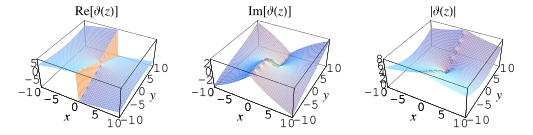
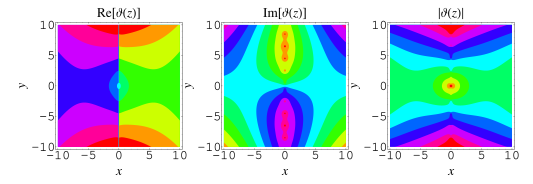
 is defined for real
 as


 is the log gamma function and the argument
is chosen continuously along real
 so that
 (Brent 2019, pp. 320-321). This convention gives
 .
 has local extrema at
 (OEIS A114865
and A114866).
 on the increasing positive branch of
 above its minimum such that

 ,
1, ... are known as Gram points (Edwards 2001, pp. 125-126).
 about 0 is given for
 by


 is the order-
 polygamma function and
 .
Its asymptotic series as
 is


 th Zero of the Riemann Zeta Function and 70 Million of
Its Neighbors." Preprint.Sloane, N. J. A. Sequences