


The Stieltjes constants  , for nonnegative
integers
 , are defined by the expansion of the Riemann
zeta function about
 ,
 |
(1)
|
(Havil 2003, p. 118), where
 |
(2)
|
Another sum that can be used to define the constants is
 |
(3)
|
These constants are returned by the Wolfram Language function StieltjesGamma[n].
A generalization  takes
 as the coefficient of
 in the Laurent series
of the Hurwitz zeta function
 about
 . These generalized Stieltjes
constants are implemented in the Wolfram
Language as StieltjesGamma[n,
a].
The case  gives the usual Euler-Mascheroni constant
 |
(4)
|
A limit formula for  is given by
 |
(5)
|
where  is the imaginary part and
 is the Riemann zeta
function.
An alternative definition is given by absorbing the coefficient of  into the constant,
 |
(6)
|
(e.g., Hardy 1912, Kluyver 1927).
The Stieltjes constants are also given by
 |
(7)
|
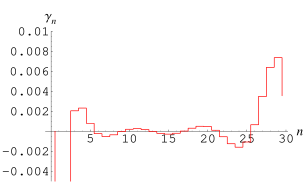
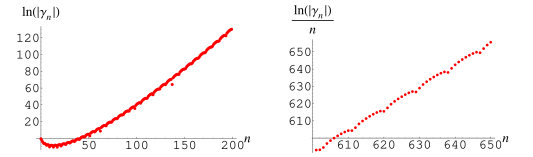
Plots of the values of the Stieltjes constants as a function of  are illustrated above (Kreminski). The first few numerical
values are given in the following table.
 | OEIS |  |
| 0 | A001620 | 0.5772156649 |
| 1 | A082633 |  |
| 2 | A086279 |  |
| 3 | A086280 | 0.002053834420 |
| 4 | A086281 | 0.002325370065 |
| 5 | A086282 | 0.0007933238173 |
Briggs (1955-1956) proved that there are infinitely many  of each sign. The signs of
 for
 , 1, ... are 1,
 ,
 , 1, 1, 1,
 ,
 ,
 ,
 , ... (OEIS A114523),
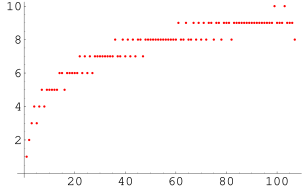
and the run lengths of consecutive signs are 1, 2, 3, 4, 3, 4, 5, 4, 5, 5, 5, ...
(OEIS A114524). A plot of run lengths is shown
above.
Berndt (1972) gave, for positive integers  , upper bounds of
 |
(8)
|
However, these bounds are extremely weak. A stronger bound is given by
 |
(9)
|
for  (Matsuoka 1985).
Vacca (1910) proved that the Euler-Mascheroni constant may be expressed as
 |
(10)
|
where  is the floor function and the lg
function
 is the logarithm to base 2. Hardy (1912) derived the
formula
 |
(11)
|
from Vacca's expression.
Kluyver (1927) gave similar series for  valid for all
 ,
 |
(12)
|
where  is a Bernoulli polynomial. However, this
series converges extremely slowly, requiring more than
 terms to get two digits of
 and many more for higher order
 .
 can also be expressed as a single sum using
 |
(13)
|
 also appears in the asymptotic expansion of the sum
 |
(14)
|
where  was called
 and given incorrectly by Ellison and Mendès-France (1975) (and the error was
subsequently reproduced by Le Lionnais 1983, p. 47). For positive
integer
 , the exact form of (14) is given
by
 |
(15)
|
where  is a harmonic number and
 is a generalized Stieltjes constant.
A set of constants related to  is
 |
(16)
|
(Sitaramachandrarao 1986, Lehmer 1988).
The Stieltjes constants also satisfy the beautiful sum
 |
(17)
|
(O. Marichev, pers. comm., 2008).
The Abel-Plana formula applied to the Hurwitz zeta series gives an integral representation whose expansion at  yields integrals for the generalized Stieltjes constants.
These integrals can be used for numerical evaluation, including in the ordinary case
(Blagouchine 2015; Johansson and Blagouchine 2019).

 ." Quart. J. Pure Appl. Math. 43, 215-216,
1912.Hardy, G. H. and Wright, E. M. "The Behavior of
 When
 ."
§17.3 in
 is
 keine Nullstelle besitzt." Univ. Nac. Tucmán
Rev. Ser. A 16, 209-217, 1966.Le Lionnais, F.