


An irrational number is a real number that cannot be expressed as a fraction  for integers
  and
and  with
with  . Irrational numbers have decimal
expansions that neither terminate nor become periodic. Every irrational number
is either an algebraic number or a real transcendental
number. The irrational numbers form a dense set
in the real line, since every nonempty open
interval contains an irrational number.
. Irrational numbers have decimal
expansions that neither terminate nor become periodic. Every irrational number
is either an algebraic number or a real transcendental
number. The irrational numbers form a dense set
in the real line, since every nonempty open
interval contains an irrational number.
There is no standard notation for the set of irrational numbers, but the notations  ,
,
 , or
, or  , where the bar, minus sign, or backslash indicates the set complement of the rational
numbers
, where the bar, minus sign, or backslash indicates the set complement of the rational
numbers  over the reals
  , could all be used.
The most famous irrational number is  , sometimes called Pythagoras's
constant. Legend has it that the Pythagorean philosopher Hippasus used geometric
methods to demonstrate the irrationality of
, sometimes called Pythagoras's
constant. Legend has it that the Pythagorean philosopher Hippasus used geometric
methods to demonstrate the irrationality of  while at sea and, upon notifying his comrades of his
great discovery, was immediately thrown overboard by the fanatic Pythagoreans. Other
examples include
while at sea and, upon notifying his comrades of his
great discovery, was immediately thrown overboard by the fanatic Pythagoreans. Other
examples include  ,
e, and pi. The Erdős-Borwein
constant
,
e, and pi. The Erdős-Borwein
constant
 |  |  |
(1)
|
 |  |  |
(2)
|
 |  |  |
(3)
|
(OEIS A065442; Erdős 1948, Guy 1994), where  is the number of divisors of
  , and a set of generalizations (Borwein
1992) are also known to be irrational (Bailey and Crandall 2002).
, and a set of generalizations (Borwein
1992) are also known to be irrational (Bailey and Crandall 2002).
A real mth root of an integer  , where
  is a positive integer,
is irrational unless
is a positive integer,
is irrational unless  is the
  th
power of an integer. Numbers
of the form
th
power of an integer. Numbers
of the form  ,
where
,
where  is the logarithm, are irrational if
  and
and  are integers greater than 1 and
one has a prime factor which the other lacks.
are integers greater than 1 and
one has a prime factor which the other lacks.  is irrational for rational
  .
.  is irrational for every rational
number
is irrational for every rational
number  (Niven 1956, Stevens 1999), and
  (for
(for  measured in degrees) is irrational for every rational
  with
the exception of
with
the exception of  (Niven 1956).
  is irrational for every rational
  (Stevens 1999).
The irrationality of e was proven by Euler in 1737; for the general case, see Hardy and Wright (1979, p. 46).  is irrational for positive
integer
is irrational for positive
integer  .
The irrationality of pi itself was proven by Lambert in 1760;
for the general case, see Hardy and Wright (1979, p. 47). Apéry's
constant
.
The irrationality of pi itself was proven by Lambert in 1760;
for the general case, see Hardy and Wright (1979, p. 47). Apéry's
constant  (where
  is the Riemann zeta function) was proved
irrational (Apéry 1979, van der Poorten 1979). Rivoal (2000) proved that there
are infinitely many integers
is the Riemann zeta function) was proved
irrational (Apéry 1979, van der Poorten 1979). Rivoal (2000) proved that there
are infinitely many integers  such that
  is irrational. Subsequently, he also showed that
at least one of
is irrational. Subsequently, he also showed that
at least one of  ,
,
 ,
...,
,
...,  is irrational (Rivoal 2001). Fauzan (2026) announced a proof
that zeta(5) is irrational.
is irrational (Rivoal 2001). Fauzan (2026) announced a proof
that zeta(5) is irrational.
Sun (2026) and OpenAI (2026) reported proofs of the irrationality of Catalan's constant. As of Oct. 7, 2026, independent specialist verification of the complete arguments had not been reported, and VibeMathed (2026) had not independently rebuilt the accompanying OpenAI Lean formalization.
By Gelfond's theorem, every value of  is transcendental
if
is transcendental
if  is algebraic with
  , 1 and
  is algebraic but not a
rational number. Each real value is therefore
irrational. This establishes the irrationality of Gelfond's
constant
is algebraic but not a
rational number. Each real value is therefore
irrational. This establishes the irrationality of Gelfond's
constant  (using the principal value
  ) and Gelfond-Schneider
constant
) and Gelfond-Schneider
constant  .
Nesterenko (1996) proved that
.
Nesterenko (1996) proved that  is irrational. In fact, he proved that
  ,
,  and
and  are algebraically
independent, but it was not previously known that
are algebraically
independent, but it was not previously known that  was irrational.
Given a polynomial equation
 |
(4)
|
where  is a positive integer and
  are integers, the real
roots
are integers, the real
roots  are either integral or irrational. For real
  , if
, if  is irrational, then so are
  ,
,  , and
, and  .
.
Irrationality has not yet been established for  ,
,  ,
,  , or
, or  (where
  is the Euler-Mascheroni
constant).
is the Euler-Mascheroni
constant).
Quadratic surds are irrational numbers which have eventually periodic regular continued fractions.
Hurwitz's irrational number theorem gives bounds of the form
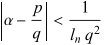 |
(5)
|
for the best rational approximation possible for an arbitrary irrational number  , where the
  are called Lagrange numbers
and get steadily larger for each "bad" set of irrational
numbers which is excluded.
are called Lagrange numbers
and get steadily larger for each "bad" set of irrational
numbers which is excluded.
The series
 |
(6)
|
where  is the divisor function, is irrational for
  and 2.

 et
et  ." Astérisque 61, 11-13, 1979.Bailey,
D. H. and Crandall, R. E. "Random Generators and Normal Numbers."
Exper. Math. 11, 527-546, 2002.
." Astérisque 61, 11-13, 1979.Bailey,
D. H. and Crandall, R. E. "Random Generators and Normal Numbers."
Exper. Math. 11, 527-546, 2002.  Is Irrational." Preprint. 17 Sep 2026.
  ,
,
 ,
,
 ,
and
,
and  ."
Amer. Math. Monthly 108, 222-231, 2001.Manning, H. P.
."
Amer. Math. Monthly 108, 222-231, 2001.Manning, H. P.
 and
and  ."
§12-13 in
."
§12-13 in  ,
,
 ,
...,
,
...,  ."
25 Apr 2001.
."
25 Apr 2001.  ." Mitt. Math. Ges. Hamburg 18, 151-158,
1999.Sun, Z.-W. "Catalan's Constant Is Irrational." 3 Sep
2026.
." Mitt. Math. Ges. Hamburg 18, 151-158,
1999.Sun, Z.-W. "Catalan's Constant Is Irrational." 3 Sep
2026.  ."
Math. Intel. 1, 196-203, 1979.VibeMathed. "Irrationality
of Catalan's Constant." Oct. 7, 2026.
."
Math. Intel. 1, 196-203, 1979.VibeMathed. "Irrationality
of Catalan's Constant." Oct. 7, 2026.