


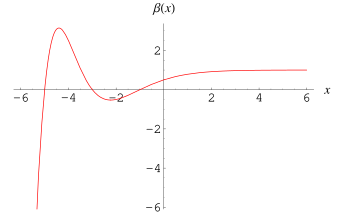
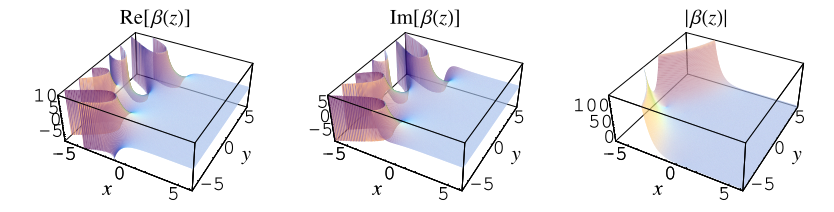
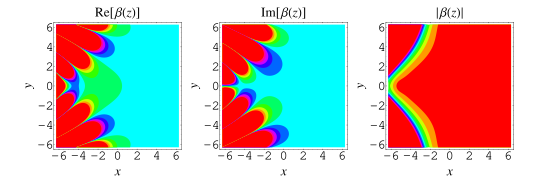
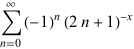
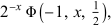
The Dirichlet beta function, often shortened to Dirichlet beta, is defined for ![Re[x]>0](/images/equations/DirichletBetaFunction/Inline1.svg) by the sum
by the sum
 |  |  |
(1)
|
 |  |  |
(2)
|
where  is the Lerch transcendent. The series
converges absolutely for
is the Lerch transcendent. The series
converges absolutely for ![Re[x]>1](/images/equations/DirichletBetaFunction/Inline9.svg) . The beta function can be written in terms of the
Hurwitz zeta function
. The beta function can be written in terms of the
Hurwitz zeta function  by
by
![beta(x)=1/(4^x)[zeta(x,1/4)-zeta(x,3/4)].](/images/equations/DirichletBetaFunction/NumberedEquation1.svg) |
(3)
|
At  the difference of Hurwitz zeta functions
is interpreted by its limit. The beta function extends to an entire
function on the whole complex plane using analytic continuation,
the difference of Hurwitz zeta functions
is interpreted by its limit. The beta function extends to an entire
function on the whole complex plane using analytic continuation,
 |
(4)
|
where  is the gamma function and removable singularities
on the right are evaluated by limits.
is the gamma function and removable singularities
on the right are evaluated by limits.
The Dirichlet beta function is implemented in the Wolfram Language as DirichletBeta[x].
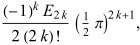
For a nonnegative integer  , the beta function has the special values
 |  |  |
(5)
|
 |  |  |
(6)
|
 |  |  |
(7)
|
where  is an Euler number.
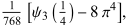
Particular values for  are
are
 |  |  |
(8)
|
 |  |  |
(9)
|
 |  |  |
(10)
|
 |  | ![1/(768)[psi_3(1/4)-8pi^4],](/images/equations/DirichletBetaFunction/Inline36.svg) |
(11)
|
where  is Catalan's constant and
  is the polygamma
function. For
is the polygamma
function. For  , 3, 5, ...,
  , where the multiples are 1/4, 1/32, 5/1536, 61/184320,
... (OEIS A046976 and A053005).
, where the multiples are 1/4, 1/32, 5/1536, 61/184320,
... (OEIS A046976 and A053005).
It is involved in the integral
![int_0^1int_0^1([-ln(xy)]^s)/(1+x^2y^2)dxdy=Gamma(s+2)beta(s+2)](/images/equations/DirichletBetaFunction/NumberedEquation3.svg) |
(12)
|
for ![Re[s]>-2](/images/equations/DirichletBetaFunction/Inline41.svg) (Guillera and Sondow 2008).
(Guillera and Sondow 2008).
Rivoal and Zudilin (2003) proved that at least one of the seven numbers  ,
,  ,
,  ,
,  ,
,  ,
,  , and
, and  is irrational.
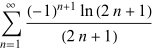
The derivative  can also be computed analytically at a number of integer values of
  including
 |  |  |
(13)
|
 |  |  |
(14)
|
 |  | ![ln[(Gamma^2(1/4))/(2pisqrt(2))]](/images/equations/DirichletBetaFunction/Inline59.svg) |
(15)
|
 |  |  |
(16)
|
 |  |  |
(17)
|
 |  | ![1/4pi{gamma+2ln2+3lnpi-4ln[Gamma(1/4)]}](/images/equations/DirichletBetaFunction/Inline68.svg) |
(18)
|
 |  |  |
(19)
|
(OEIS A378910, A113847, and A078127), where  is Catalan's constant,
 is the gamma function, and
  is the Euler-Mascheroni
constant.
is the Euler-Mascheroni
constant.
A nice sum involving  is given by
![sum_(k=1)^inftyln[((4k+1)^(1/(4k+1)^n))/((4k-1)^(1/(4k-1)^n))]=-beta^'(n)](/images/equations/DirichletBetaFunction/NumberedEquation4.svg) |
(20)
|
for  a positive integer.
