The isogonal conjugate of a point in the plane of the triangle is constructed by reflecting
the lines ,
,
and
about the angle bisectors at , , and . The three reflected lines then concur
at the isogonal conjugate (Honsberger 1995, pp. 55-56). In older literature,
isogonal conjugate points are also known as counter points (Gallatly 1913), Gegenpunkte
(Gallatly 1913), and focal pairs (Morley 1954).
Isogonal conjugation maps the interior of a triangle onto itself. This mapping transforms lines into circumconics.
The type of conic section is determined by whether
the line
meets the circumcircle,
The isogonal conjugate of a point on the circumcircle is a point at infinity (and conversely). The
sides of the pedal triangle of a point are perpendicular
to the connectors of the corresponding polygon vertices
with the isogonal conjugate. The isogonal conjugate of a set of points is the locus of their isogonal conjugate points.
The product of isotomic and isogonal conjugation is a collineation which transforms the sides of
a triangle to themselves (Vandeghen 1965).


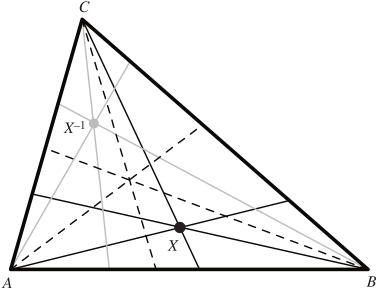
 of a point
  in the plane of the triangle
  is constructed by reflecting
the lines
is constructed by reflecting
the lines  ,
,
 ,
and
,
and  about the angle bisectors at
  ,
,  , and
, and  . The three reflected lines then concur
at the isogonal conjugate (Honsberger 1995, pp. 55-56). In older literature,
isogonal conjugate points are also known as counter points (Gallatly 1913), Gegenpunkte
(Gallatly 1913), and focal pairs (Morley 1954).
. The three reflected lines then concur
at the isogonal conjugate (Honsberger 1995, pp. 55-56). In older literature,
isogonal conjugate points are also known as counter points (Gallatly 1913), Gegenpunkte
(Gallatly 1913), and focal pairs (Morley 1954).


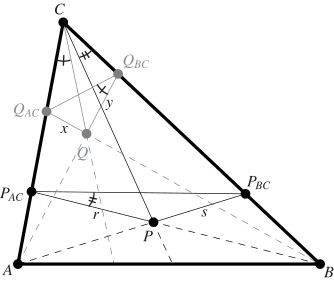
 and
and  isogonal conjugates,

 meets the circumcircle
  ,
,
 does not intersect
  , the isogonal transform
is an ellipse;
, the isogonal transform
is an ellipse;
 is tangent to
  ,
the transform is a parabola;
,
the transform is a parabola;
 cuts
cuts  ,
the transform is a hyperbola, which is a rectangular
hyperbola if the line passes through the circumcenter
,
the transform is a hyperbola, which is a rectangular
hyperbola if the line passes through the circumcenter
