

The trilinear coordinates of a point  with respect to a reference
triangle
 are an ordered triple of numbers, each of which is proportional to the signed
distance from
 to one of the side lines. The sign is positive
on the side of each line containing the opposite polygon
vertex. Trilinear coordinates are denoted
 or
 and also are known as homogeneous coordinates
or "trilinears." Trilinear coordinates were introduced by Plücker
in 1835. Since it is only the ratio of signed
distances that is significant, the triplet of trilinear coordinates obtained
by multiplying a given triplet by any nonzero constant
describes the same point, so
 |
(1)
|
For simplicity, the three polygon vertices  ,
 , and
 of a triangle are commonly written
as
 ,
 , and
 , respectively.
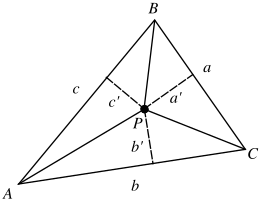
Trilinear coordinates can be normalized so that they give the actual signed distances from  to each of the sides. To perform
the normalization, let the point
 in the above diagram have trilinear coordinates
 and lie at signed
distances
 ,
 , and
 from the sides
 ,
 , and
 , respectively. Then the signed
distances
 ,
 , and
 can be found using the signed
areas
 ,
 , and
 of
 ,
 , and
 , respectively, taking the orientation
of
 as positive. We then have
 |  |  |
(2)
|
 |  |  |
(3)
|
 |  |  |
(4)
|
 |  |  |
(5)
|
so
 |
(6)
|
where  is the area of
 and
 ,
 , and
 are the lengths of its sides
(Kimberling 1998). To obtain trilinear coordinates giving the actual signed
distances, take
 , so we have the coordinates
 |
(7)
|
These normalized trilinear coordinates are known as exact trilinear coordinates.
The trilinear coordinates of the line
 |
(8)
|
are
 |
(9)
|
where  is the point-line distance from
polygon vertex
 to the line.
The homogeneous barycentric coordinates corresponding to trilinear coordinates  are
 , and the
trilinear coordinates corresponding to homogeneous barycentric
coordinates
 are
 .
Important points  of a triangle
are called triangle centers, and the vector
functions describing the location of the points in
terms of side length, angles,
or both, are called triangle center functions
 . Since by symmetry,
triangle center functions are of the form
 |
(10)
|
it is common to call the scalar function  "the" triangle
center function. Note also that side lengths and angles are interconvertible through the law
of cosines, so a triangle center function
may be given in terms of side lengths, angles,
or both. Trilinear coordinates for some common triangle
centers are summarized in the following table, where
 ,
 , and
 are the angles at the corresponding
polygon vertices and
 ,
 , and
 are the opposite side lengths.
Here, the normalizations have been chosen to give a simple form.
| triangle center | triangle center function |
circumcenter  |  |
| de Longchamps point |  |
| equal detour point |  |
Feuerbach point  |  |
incenter  | 1 |
| isoperimetric point |  |
symmedian point  |  |
nine-point
center  |  |
orthocenter  |  |
triangle
centroid  |  ,  |
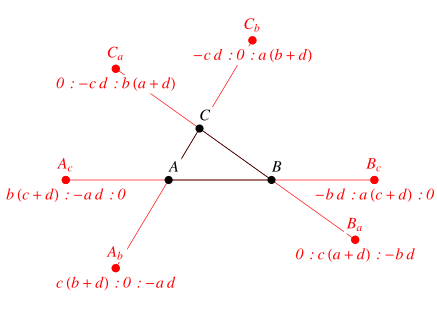
In trilinear coordinates, the coordinates of the polygon vertices are 1:0:0 ( ), 0:1:0 (
 ), and 0:0:1 (
 ). Extensions along the sidelines by a distance
 have trilinears as illustrated above.
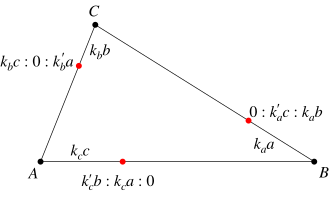
Trilinear coordinates of points fractional distances  ,
 , and
 along the sidelines are given in the above figure, where
 .
A point located a fraction  of the distance along the sideline
 from
 to
 has trilinear coordinates
 |
(11)
|
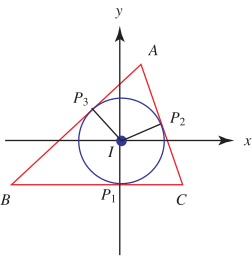
To convert trilinear to Cartesian coordinates as illustrated above, place the incenter at the origin
and make  parallel to the
 -axis, with
 to the left of
 and
 above
 . Then
 |  |  |
(12)
|
 |  |  |
(13)
|
where
 |
(14)
|
is the inradius,  is the triangle area,
and
 |
(15)
|
(Kimberling 1998).
The formula for  uses the signed distance
 from
 .
Using the signed distance
 from
 gives the equivalent expression
 |
(16)
|
The labels  ,
 ,
and
 refer to
 ,
 ,
and
 , respectively, in either orientation of the reference
triangle (P. Dini, pers. comm., Nov. 6, 2026).
More generally, to convert trilinear coordinates to a vector position for a given triangle specified by the  -
and
 -coordinates of its axes, pick two unit
vectors along the sides. For instance, pick
 |  |  |
(17)
|
 |  |  |
(18)
|
where these are the unit vectors  and
 .
Assume the triangle has been labeled such that
 is the upper rightmost polygon vertex and
 . Then the vectors obtained
by traveling
 and
 along the sides and then inward perpendicular
to them must meet
 |
(19)
|
Solving the two equations
 |  |  |
(20)
|
 |  |  |
(21)
|
gives
 |  |  |
(22)
|
 |  |  |
(23)
|
But  and
 are unit vectors, so
 |  |  |
(24)
|
 |  |  |
(25)
|
And the vector coordinates of the point  are then
 |
(26)
|
