


|
|
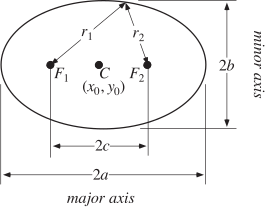
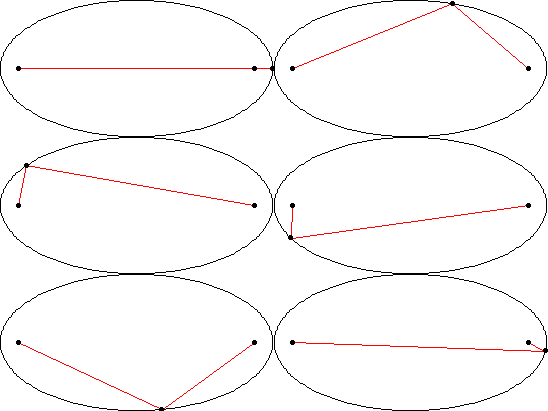
An ellipse is a curve that is the locus of all points in the plane the sum of whose distances
 and
 from two fixed points
 and
 (the foci) separated by a distance of
 is a given positive constant
 (Hilbert and Cohn-Vossen 1999,
p. 2). This results in the two-center bipolar
coordinate equation
 |
(1)
|
where  is the semimajor
axis and the origin of the coordinate system is at
one of the foci. The corresponding parameter
 is known as the semiminor axis.
The ellipse is a conic section and a Lissajous curve.
An ellipse can be specified in the Wolfram Language using Circle[ x, y
 ,
 a,
b
 ].
If the endpoints of a segment are moved along two intersecting lines, a fixed point on the segment (or on the line that prolongs it) describes an arc of an ellipse. This is known as the trammel construction of an ellipse (Eves 1965, p. 177).
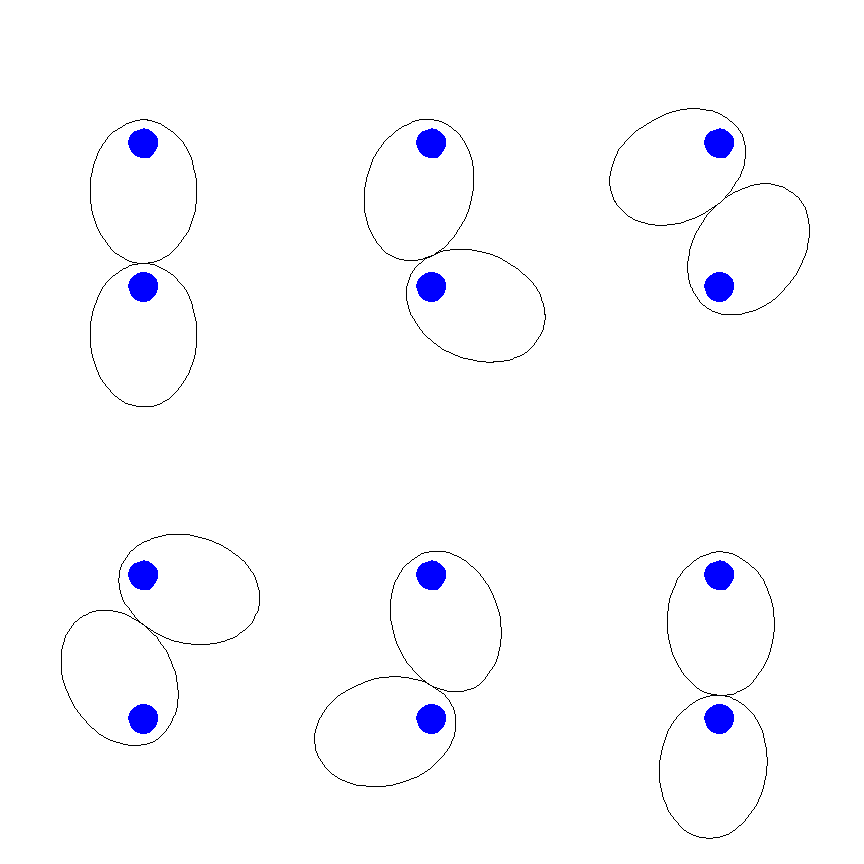
It is possible to construct elliptical gears that rotate smoothly against one another (Brown 1871, pp. 14-15; Reuleaux and Kennedy 1876, p. 70; Clark and Downward 1930; KMODDL).
The ellipse was first studied by Menaechmus, investigated by Euclid, and named by Apollonius. The focus and conic section directrix of an ellipse were considered by Pappus. In 1602, Kepler believed that the orbit of Mars was oval; he later discovered that it was an ellipse with the Sun at one focus. In fact, Kepler introduced the word "focus" and published his discovery in 1609. In 1705 Halley showed that the comet now named after him moved in an elliptical orbit around the Sun (MacTutor Archive). An ellipse rotated about its minor axis gives an oblate spheroid, while an ellipse rotated about its major axis gives a prolate spheroid.
A ray of light passing through a focus will pass through the other focus after a single bounce (Hilbert and Cohn-Vossen 1999, p. 3). Reflections not passing through a focus will be tangent to a confocal hyperbola or ellipse, depending on whether the ray passes between the foci or not.
Let an ellipse lie along the x-axis and find the equation of the figure (1) where  and
 are at
 and
 . In Cartesian coordinates,
 |
(2)
|
Bring the second term to the right side and square both sides,
 |
(3)
|
Now solve for the square root term and simplify
 |  |  |
(4)
|
 |  |  |
(5)
|
 |  |  |
(6)
|
Square one final time to clear the remaining square root,
 |
(7)
|
Grouping the  terms then gives
 |
(8)
|
which can be written in the simple form
 |
(9)
|
Defining a new constant
 |
(10)
|
puts the equation in the particularly simple form
 |
(11)
|
The parameter  is called the semiminor axis by analogy with the
parameter
 ,
which is called the semimajor axis (assuming
 ). The fact that
 as defined above is actually the semiminor
axis is easily shown by letting
 and
 be equal. Then two right triangles are produced,
each with hypotenuse
 , base
 ,
and height
 .
Since the largest distance along the minor axis will be achieved at this point,
 is indeed the semiminor
axis.
If, instead of being centered at (0, 0), the center of the ellipse is at ( ,
 ), equation (11)
becomes
 |
(12)
|
As can be seen from the Cartesian equation for the ellipse, the curve can also be given by a simple parametric form analogous
to that of a circle, but with the  and
 coordinates having different scalings,
 |  |  |
(13)
|
 |  |  |
(14)
|
where  is the eccentric
anomaly, which generally differs from the polar angle.
The general quadratic curve
 |
(15)
|
is an ellipse when, after defining
 |  |  |
(16)
|
 |  |  |
(17)
|
 |  |  |
(18)
|
 ,
 , and
 . These conditions include a circle,
which occurs iff
 and
 .
For the formulas below, multiply all six coefficients
by
 if necessary so that
 . The center of the ellipse
 is given by
 |  |  |
(19)
|
 |  |  |
(20)
|
the semimajor axis and semiminor axis lengths are
 |  |  |
(21)
|
 |  |  |
(22)
|
The counterclockwise angle of rotation from the x-axis to the major axis of the ellipse
is given modulo  by
 |
(23)
|
where the inverse cotangent takes values in ![(-pi/2,pi/2]](/images/equations/Ellipse/Inline78.svg) . For a circle,
the angle of rotation is arbitrary,
and
 has been chosen.
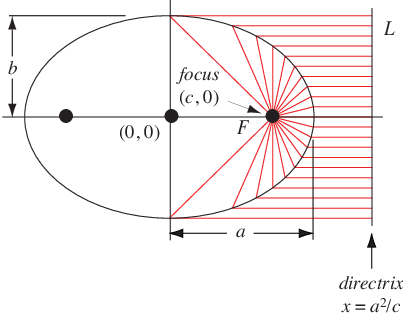
A noncircular ellipse can also be defined as the locus of points whose distance from the focus is proportional
to the horizontal distance from a vertical line known as the conic
section directrix, where the ratio is  . Letting
 be the ratio and
 the distance from the center at which the directrix lies,
then in order for this to be true, it must hold at the extremes of the major and
minor axes, so
 |
(24)
|
Solving gives
 |  |  |
(25)
|
 |  |  |
(26)
|
For a noncircular ellipse, the focal parameter is
 |  |  |
(27)
|
 |  |  |
(28)
|
 |  |  |
(29)
|
where  is a characteristic of the ellipse known
as the eccentricity, to be defined shortly.
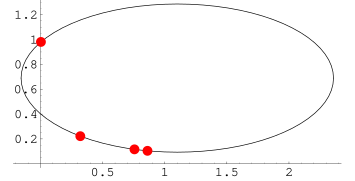
An ellipse whose axes are parallel to the coordinate axes is uniquely determined by any four non-concyclic points on it, and the ellipse
passing through the four points  ,
 ,
 , and
 has equation
 |
(30)
|
Let four distinct points on a noncircular ellipse with axes parallel to the coordinate axes have angular coordinates  in the parametrization above, for
 , 2, 3, and 4. When all
 are finite, these points are concyclic iff
 |
(31)
|
where the intermediate variable  has been defined (Berger et al. 1984;
Trott 2006, pp. 39-40). A necessary condition in the different variables
 is
 |
(32)
|
The sine values alone do not specify the signs of  , so this condition by itself does not establish concyclic
points.
Like hyperbolas, noncircular ellipses have two distinct foci and two associated directrices, each conic section directrix being perpendicular to the line joining the two foci (Eves 1965, p. 275).
Define a new constant  called the eccentricity (where
 is the case of a circle) to replace

 |
(33)
|
from which it follows that
 |  |  |
(34)
|
 |  |  |
(35)
|
 |  |  |
(36)
|
 |  |  |
(37)
|
 |  |  |
(38)
|
 |  |  |
(39)
|
The eccentricity can therefore be interpreted as the position of the focus as a fraction of the semimajor axis.
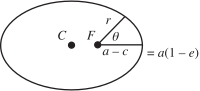
If  and
 are measured from a focus
 instead of from the center
 (as they commonly are in orbital mechanics) then the equations
of the ellipse are
 |  |  |
(40)
|
 |  |  |
(41)
|
and (11) becomes
 |
(42)
|
Clearing the denominators gives
 |
(43)
|
Substituting in  gives
 |
(44)
|
Plugging in to re-express  and
 in terms of
 and
 ,
 |
(45)
|
Dividing by  and simplifying gives
 |
(46)
|
which can be solved for  to obtain
 |
(47)
|
The sign can be determined by requiring that  must be positive. When
 , (47) becomes
 , but since
 is always positive, we must take
the negative sign, so (47) becomes
 |
(48)
|
 |
(49)
|
 |
(50)
|
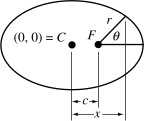
The distance from a focus to a point with horizontal coordinate  (where the origin is taken to lie at
the center of the ellipse) is found from
 |
(51)
|
Plugging this into (50) yields
 |
(52)
|
 |
(53)
|
For an ellipse with center  , semimajor axis
 , semiminor
axis
 ,
and major axis rotated counterclockwise through an angle
 from the x-axis,
a general polar equation follows by substituting
 and
 into the translated and rotated Cartesian
equation (Eberly 2011),
 |
(54)
|
where  ,
 , and
 . Here,
 and
 are measured from the chosen origin,
which need not be the center or a focus.
This is a quadratic equation in
 and can have two nonnegative
solutions for a given
 when the origin lies outside the ellipse. When the center is at the origin, it simplifies
to
 |
(55)
|
In pedal coordinates with the pedal point at the focus, the equation of the ellipse is
 |
(56)
|
The arc length of the ellipse from  to
 in the counterclockwise direction is
 |  |  |
(57)
|
 |  |  |
(58)
|
 |  |  |
(59)
|
where  ,
 is an incomplete elliptic
integral of the second kind with elliptic modulus
 (the eccentricity),
and
 is the corresponding complete elliptic integral of
the second kind (N. M. Nobre, pers. comm., Oct. 24, 2019). To
represent
 in the Wolfram Language, the second
argument of EllipticE[t,
m] is the parameter
 rather than the elliptic
modulus
 .
The relationship between the polar angle from the ellipse center  and the eccentric anomaly
 follows from
 |
(60)
|
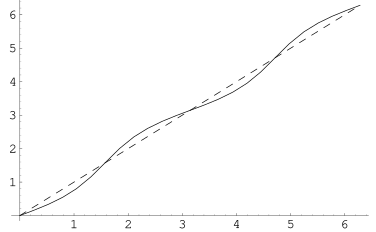
This function is illustrated above with  shown as the solid curve and
 as the dashed, with
 . Care must be taken to make sure that the correct branch
of the inverse tangent function is used, with
 increasing continuously from
 at
 . Here,
 is measured from the center,
in contrast to the focus-based polar
angle used above. As can be seen,
 weaves back and forth around
 , with crossings occurring at multiples of
 . The curvature and tangential
angle of the ellipse are given by
 |  |  |
(61)
|
 |  |  |
(62)
|
where the complex argument is chosen continuously with  , giving the direction of the
tangent vector. In particular, there is a vertical
tangent at
 and
 .
The entire perimeter  of the ellipse is given by setting
 (corresponding to
 ), which is equivalent to four times the length of
one of the ellipse's quadrants,
 |  |  |
(63)
|
 |  |  |
(64)
|
 |  |  |
(65)
|
where  is a complete
elliptic integral of the second kind with elliptic
modulus
 (the eccentricity). The perimeter can be computed using
the rapidly converging Gauss-Kummer series
as
 |  |  |
(66)
|
 |  |  |
(67)
|
(OEIS A056981 and A056982), where  is a binomial
coefficient and
 |
(68)
|
This can also be written analytically as
 |  |  |
(69)
|
 |  |  |
(70)
|
where  is a hypergeometric
function,
 is a complete elliptic integral
of the first kind, and
 is a complete elliptic integral
of the second kind. Here,
 is the elliptic modulus.
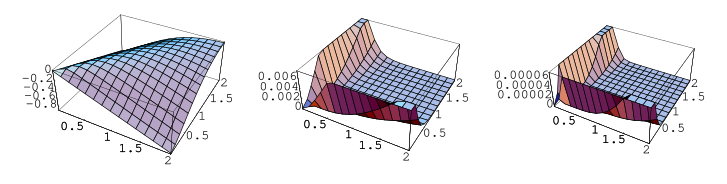
Approximations to the perimeter include
 |  |  |
(71)
|
 |  |  |
(72)
|
 |  |  |
(73)
|
where the last two are due to Ramanujan (1913-1914), and (73) has a relative error of  for small values of
 .
The error surfaces are illustrated above for these functions.
The maximum and minimum distances from the focus are called the apoapsis and periapsis, and are given by
 |  |  |
(74)
|
 |  |  |
(75)
|
The area of an ellipse may be found by direct integration
 |  |  |
(76)
|
 |  |  |
(77)
|
 |  |  |
(78)
|
 |  |  |
(79)
|
 |  |  |
(80)
|
 |  |  |
(81)
|
The area can also be computed more simply by making the change of coordinates  and
 from the elliptical region
 to the new region
 . Then the equation becomes
 |
(82)
|
or  , so
 is a circle of radius
 . Since
 |
(83)
|
the Jacobian is
 |  |  |
(84)
|
 |  |  |
(85)
|
The area is therefore
 |  | 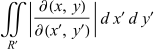 |
(86)
|
 |  | 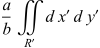 |
(87)
|
 |  |  |
(88)
|
 |  |  |
(89)
|
as before. The area of an arbitrary ellipse given by the quadratic equation
 |
(90)
|
is
 |
(91)
|
The area of the pedal curve of an ellipse with semiaxes  and
 , center
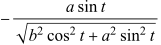 , and pedal
point
 is
 |
(92)
|
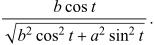
The unit tangent vector of the ellipse so parameterized is
 |  | 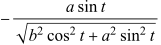 |
(93)
|
 |  |  |
(94)
|
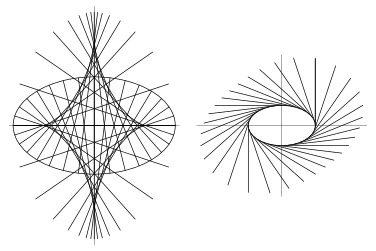
A sequence of normal and tangent vectors are plotted above for the ellipse.
The locus of the apex of a variable right circular cone containing a noncircular ellipse fixed in three-space is a hyperbola through the foci of the ellipse. In addition, the locus of the apex of a right circular cone containing that hyperbola is the original ellipse. Furthermore, the eccentricities of the ellipse and hyperbola are reciprocals. The locus of centers of a Pappus chain of circles is an ellipse. Surprisingly, the locus of the end of a garage door mounted on rollers along a vertical track but extending beyond the track is a quadrant of an ellipse (Wells 1991, p. 66). (The envelope of the door's positions is an astroid.)

 ." Quart. J. Pure. Appl. Math. 45, 350-372,
1913-1914.Reuleaux, F. and Kennedy, A. B. W. (Eds.).