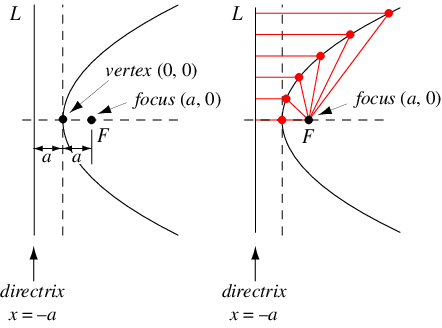
A parabola (plural "parabolas"; Gray 1997, p. 45) is the set of all points in the plane equidistant from a given line  (the conic
section directrix) and a given point
(the conic
section directrix) and a given point  not on the line (the focus). The
focal parameter (i.e., the distance between the
directrix and focus) is therefore given by
not on the line (the focus). The
focal parameter (i.e., the distance between the
directrix and focus) is therefore given by  , where
  is the distance from the vertex to the directrix or focus.
The surface of revolution obtained by rotating
a parabola about its axis of symmetry is called a paraboloid.
is the distance from the vertex to the directrix or focus.
The surface of revolution obtained by rotating
a parabola about its axis of symmetry is called a paraboloid.
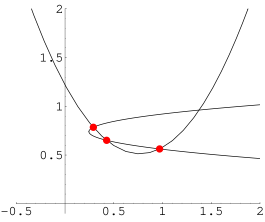
The parabola was studied by Menaechmus in an attempt to achieve cube duplication. Menaechmus solved the problem by finding the intersection of the
two parabolas  and
and  . Euclid wrote about the parabola,
and it was given its present name by Apollonius. Pascal considered the parabola as
a projection of a circle, and Galileo showed that projectiles
falling under uniform gravity follow parabolic paths. Gregory and Newton considered
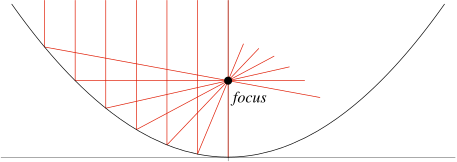
the catacaustic properties of a parabola that bring
parallel rays of light to a focus (MacTutor Archive), as illustrated above.
. Euclid wrote about the parabola,
and it was given its present name by Apollonius. Pascal considered the parabola as
a projection of a circle, and Galileo showed that projectiles
falling under uniform gravity follow parabolic paths. Gregory and Newton considered
the catacaustic properties of a parabola that bring
parallel rays of light to a focus (MacTutor Archive), as illustrated above.
For a parabola opening to the right with vertex at (0, 0), the equation in Cartesian coordinates is
 |
(1)
|
 |
(2)
|
 |
(3)
|
 |
(4)
|
The quantity  is known as the latus rectum.
If the vertex is at  instead of (0, 0), the equation of the parabola with latus
rectum
instead of (0, 0), the equation of the parabola with latus
rectum  is
is
 |
(5)
|
A parabola opening upward with vertex at  and latus rectum
  has equation
 |
(6)
|
Solving for  gives the vertex form
  .
.
Three points uniquely determine one parabola with directrix parallel to the  -axis and one with directrix parallel
to the
-axis and one with directrix parallel
to the  -axis. If these parabolas pass through
the three points
-axis. If these parabolas pass through
the three points  ,
,
 , and
, and  , they are given by equations
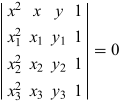 |
(7)
|
and
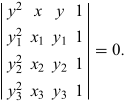 |
(8)
|
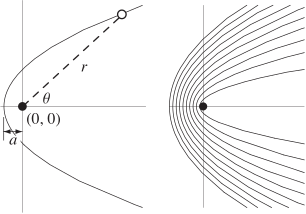
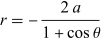
In polar coordinates, the equation of a parabola with parameter 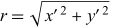 and center (0, 0) is given by
 |
(9)
|
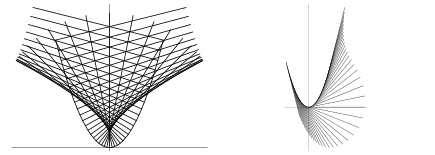
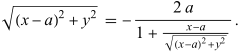
(left figure). The equivalence with the Cartesian form can be seen by setting up a coordinate system  and plugging in
  and
and  to obtain
 |
(10)
|
Expanding and collecting terms,
 |
(11)
|
so solving for  gives (4). A set of confocal parabolas is shown in the figure
on the right.
gives (4). A set of confocal parabolas is shown in the figure
on the right.
In pedal coordinates with the pedal point at the focus, the equation is
 |
(12)
|
The parabola can be written parametrically as
 |  |  |
(13)
|
 |  |  |
(14)
|
or
 |  |  |
(15)
|
 |  |  |
(16)
|
A segment of a parabola is a Lissajous curve.
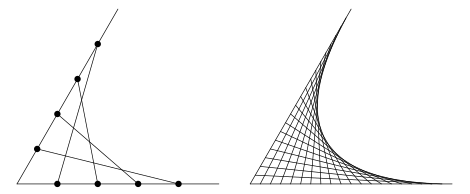
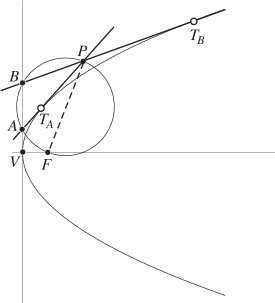
A parabola may be generated as the envelope of two concurrent line segments by connecting opposite points on the two lines (Wells 1991).
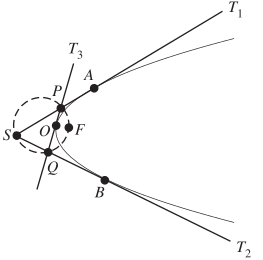
In the above figure, the lines  ,
,  ,
and
,
and  are tangent to the parabola at points
 ,
,  , and
, and  ,
respectively. Then
,
respectively. Then  (Wells 1991). Moreover, the circumcircle of
  passes through the focus
  (Honsberger 1995, p. 47). In addition,
the foot of the perpendicular to a tangent to a parabola from the focus
always lies on the tangent at the vertex (Honsberger 1995, p. 48).
(Honsberger 1995, p. 47). In addition,
the foot of the perpendicular to a tangent to a parabola from the focus
always lies on the tangent at the vertex (Honsberger 1995, p. 48).
Given an arbitrary point  located "outside" a parabola, the tangent or tangents to the parabola through
 can be constructed by drawing the circle having
  as a diameter, where
  is the focus. Then locate the points
 and
and  at which the circle cuts the vertical
tangent through
at which the circle cuts the vertical
tangent through  .
The points
.
The points  and
and  (which can collapse to a single point
in the degenerate case) are then the points of tangency of the lines
(which can collapse to a single point
in the degenerate case) are then the points of tangency of the lines  and
and  and the parabola (Wells 1991).
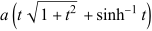
The curvature, arc length, and tangential angle are
 |  |  |
(17)
|
 |  |  |
(18)
|
 |  |  |
(19)
|
The tangent vector of the parabola is
 |  |  |
(20)
|
 |  |  |
(21)
|
The plots below show the normal and tangent vectors to a parabola.