

A torus graph embedding represents a graph on a torus with distinct vertices and with edges
meeting only at common endpoints. More general drawings on the torus
may contain other graph edge intersections, and the
smallest number of crossings among all such drawings of a graph  is its toroidal
crossing number.
is its toroidal
crossing number.
A graph admits a torus graph embedding iff its graph genus is at most 1. This includes every planar graph, while a toroidal graph, in the genus-class convention, has graph genus exactly 1 (Gross and Tucker 1987).
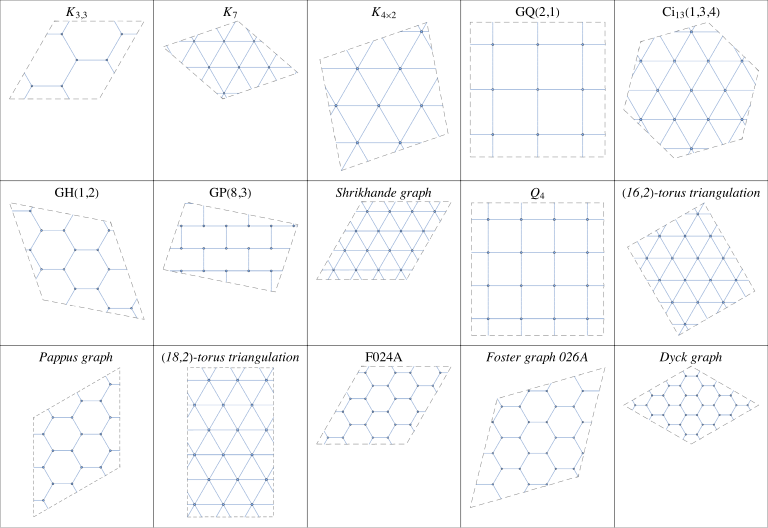
The illustrations above show cellular embeddings of toroidal graphs in a torus.
In each illustration, opposite sides of the displayed fundamental
region are identified, the edges meet only at common
endpoints, and every graph face is homeomorphic
to an open disk. The orthogonal-grid embeddings of the generalized quadrangle  and tesseract graph
  use their isomorphisms
with the
use their isomorphisms
with the  and
and  torus grid graphs, respectively.
A torus can be represented as the quotient space  ,
where
,
where
 |
(1)
|
and  and
and  are linearly independent period vectors.
A parallelogram spanned by these vectors
is a fundamental region whose opposite sides
are identified by translation. Consequently, a graph edge reaching one side continues from the corresponding
point on the opposite side, and the displayed boundary
serves only as a cut through the surface rather than
as part of the graph.
are linearly independent period vectors.
A parallelogram spanned by these vectors
is a fundamental region whose opposite sides
are identified by translation. Consequently, a graph edge reaching one side continues from the corresponding
point on the opposite side, and the displayed boundary
serves only as a cut through the surface rather than
as part of the graph.
Periodic quotients of the Kagome lattice by suitable finite-index translation sublattices give 4-regular graphs embedded on the torus (Kotani and Sunada 2000).
For a drawing whose lifted edges are straight, an oriented graph edge from a vertex
at  to a vertex at
  can be specified by an integer
pair
can be specified by an integer
pair  .
The lifted graph edge joins
.
The lifted graph edge joins  to
to
 |
(2)
|
Reversing the graph edge negates  , while translating all lifted edges
by
, while translating all lifted edges
by  produces the periodic drawing in the plane associated with
the covering map
produces the periodic drawing in the plane associated with
the covering map  . Repeated labels therefore represent the
same graph vertex on the torus,
while a finite patch shows how wrapping edges continue
into neighboring fundamental regions. The patch
is part of a single periodic lift rather than a graph
disjoint union on one torus.
. Repeated labels therefore represent the
same graph vertex on the torus,
while a finite patch shows how wrapping edges continue
into neighboring fundamental regions. The patch
is part of a single periodic lift rather than a graph
disjoint union on one torus.
The shape of the fundamental region does not determine the graph. A rectangular parallelogram requires an orthogonal basis of the period lattice, and a square additionally requires the two basis vectors to have equal lengths. An affine transformation can make any fundamental parallelogram a square, but generally changes lengths and angles. A Voronoi diagram of the period lattice supplies another fundamental region, which may be a hexagon. The hexagonal shape of this cut does not by itself make the embedded graph a honeycomb toroidal graph.
Requiring the lifted drawing to follow a particular tessellation imposes additional structure. For example, honeycomb toroidal graphs arise from translation quotients of the hexagonal grid and are both cubic and bipartite, although these two properties do not by themselves characterize the family. A brick-wall representation has the same combinatorial structure as the hexagonal grid, even though some consecutive sides of a graph face are collinear (Alspach 2021). The regular triangular and square tessellations similarly yield embeddings with vertex degree 6 and 4 and graph faces of length 3 and 4, respectively (Brehm and Kühnel 2008).
The kagome lattice supplies another regular periodic template. Its local face pattern is  , and finite toroidal examples arise by quotienting
the lattice by a finite-index translation sublattice (Kotani and Sunada 2000).
, and finite toroidal examples arise by quotienting
the lattice by a finite-index translation sublattice (Kotani and Sunada 2000).
For a cellular embedding, every graph face is homeomorphic to an open disk.
If a cellular embedding has vertex
count  ,
edge count
,
edge count  , and graph face count
  , then
 |
(3)
|
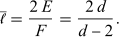
For a  -regular graph with
  , the mean face length is therefore
 |
(4)
|
For  ,
4, and 6, these means are 6, 4, and 3, respectively. Individual
graph faces may have other lengths, but if every graph face has length at least the mean,
then all must have the mean length.
,
4, and 6, these means are 6, 4, and 3, respectively. Individual
graph faces may have other lengths, but if every graph face has length at least the mean,
then all must have the mean length.
