


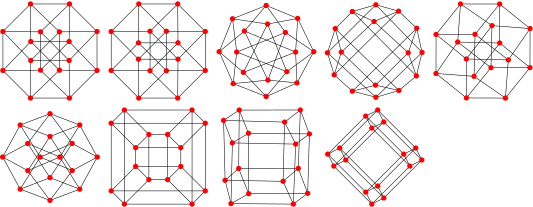
The tesseract graph, commonly denoted  , is the 4-hypercube graph
and the skeleton of the tesseract.
It is a quartic symmetric graph with girth 4 and graph diameter
4. The automorphism group of the tesseract
graph is of group order
, is the 4-hypercube graph
and the skeleton of the tesseract.
It is a quartic symmetric graph with girth 4 and graph diameter
4. The automorphism group of the tesseract
graph is of group order  (Buekenhout and Parker 1998). The figures above
show several nice drawings, the leftmost of which appears in Coxeter (1973) and a
number of which can be found in Carr and Kocay (1999). The final graph drawing highlights
a bipartition of
(Buekenhout and Parker 1998). The figures above
show several nice drawings, the leftmost of which appears in Coxeter (1973) and a
number of which can be found in Carr and Kocay (1999). The final graph drawing highlights
a bipartition of  .
.
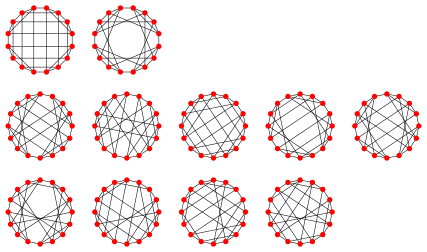
The tesseract graph has two distinct generalized LCF notations of order 4, five of order 2, and four of order 1, illustrated above.
The order-4 LCF notations are given by ![[(-7,-3),(3,7),(-3,5),(-5,3)]^4](/images/equations/TesseractGraph/Inline4.svg) and
and ![[(-5,-3),(3,5),(-5,5),(-5,5)]^4](/images/equations/TesseractGraph/Inline5.svg) .
.
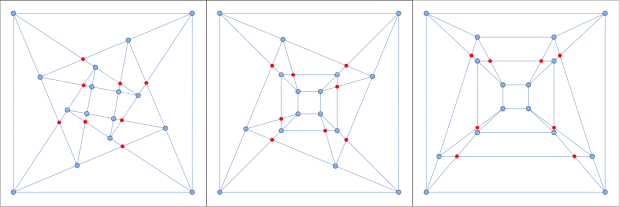
The tesseract graph has graph crossing number 8, rectilinear crossing number 8, and local crossing number 1, as illustrated in the first two drawings above. These drawings are due to E. Pegg, Jr. (pers. comm., Aug. 17, 2026).
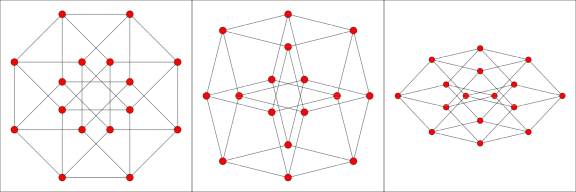
The tesseract graph is a unit-distance graph, as illustrated above.
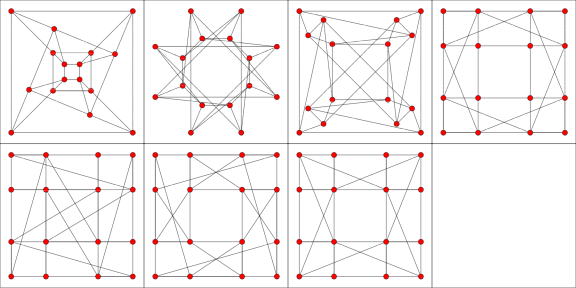
Several voltage graph drawings of  are illustrated above.
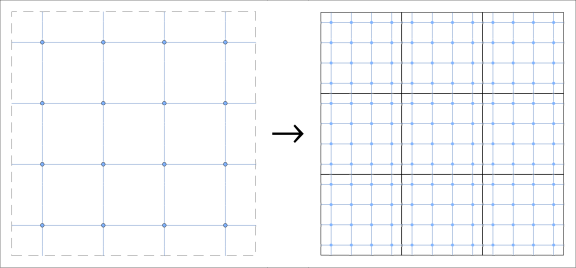
The tesseract graph is isomorphic to the  torus grid graph
and is therefore toroidal, as illustrated above.
The left-hand drawing shows an graph embedding
in a fundamental region whose paired boundary
sides are identified to form a torus. The right-hand drawing
shows a finite patch of the corresponding periodic lift, illustrating how edges
continue across these boundaries and where corresponding vertices
in different regions represent the same vertex on
the torus.
torus grid graph
and is therefore toroidal, as illustrated above.
The left-hand drawing shows an graph embedding
in a fundamental region whose paired boundary
sides are identified to form a torus. The right-hand drawing
shows a finite patch of the corresponding periodic lift, illustrating how edges
continue across these boundaries and where corresponding vertices
in different regions represent the same vertex on
the torus.
It has graph spectrum  , making it an integral
graph. It is cospectral with the Hoffman
graph, so neither graph is determined
by spectrum.
, making it an integral
graph. It is cospectral with the Hoffman
graph, so neither graph is determined
by spectrum.
The tesseract graph is isomorphic to the 4-Hadamard graph.
It has cycle polynomial
 |
It is implemented in the Wolfram Language as GraphData["TesseractGraph"].

 ."
."
 )."
)."