

A projective plane graph embedding represents the distinct vertices of a graph by distinct points of the real projective plane and the edges by arcs that meet only at common endpoints. A graph admits such an embedding iff it is a projective planar graph, or equivalently when the projective plane crossing number of the graph is 0 (Gross and Tucker 1987).
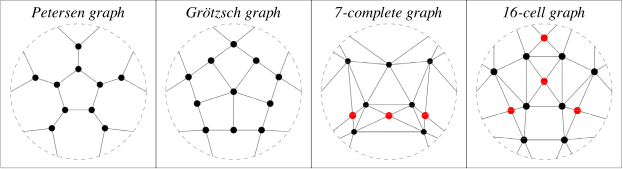
The illustrations show drawings on the real projective plane. Those of the Petersen graph and Grötzsch
graph have no crossings and are projective plane graph embeddings, whereas the
drawings of the complete graph  and 16-cell graph have
crossings marked in red.
and 16-cell graph have
crossings marked in red.
The real projective plane can be represented by a disk with each pair of antipodal points on its boundary identified. Under this representation, a graph edge that reaches the boundary continues from the corresponding antipode. The displayed boundary is only a cut through the surface, rather than an additional graph edge, and each identified pair of displayed boundary points represents a single point of the surface rather than a crossing.
Every planar graph admits a projective plane graph embedding, since a planar graph embedding
can be placed in a small disk in the real
projective plane. The complete graph  and the Petersen graph
are nonplanar graphs that also admit projective
plane graph embeddings.
and the Petersen graph
are nonplanar graphs that also admit projective
plane graph embeddings.
Projective plane graph embeddings are not necessarily cellular. In the construction just described, the graph face
containing the part of the real projective plane
outside the small disk is not homeomorphic
to an open disk. A projective plane graph embedding is cellular exactly when every graph
face is homeomorphic to an open disk.
If a cellular projective plane graph embedding
has vertex count  , edge count
  , and graph face count
  , then
 |
because the Euler characteristic of the real projective plane is 1. This formula counts the vertices, edges, and faces after the boundary identifications, not the pieces visible in the disk.
For a nonplanar graph with a projective plane graph embedding of face-width  , the graph genus is
  , where
  is the floor function
(Fiedler et al. 1995). Consequently, the graph also
admits a torus graph embedding iff
is the floor function
(Fiedler et al. 1995). Consequently, the graph also
admits a torus graph embedding iff  or
or  .
A projective plane graph embedding can therefore exist even when the graph has no
torus graph embedding.
.
A projective plane graph embedding can therefore exist even when the graph has no
torus graph embedding.
