


A brick-wall representation is a planar graph embedding of the graph formed by the corners and sides
of a hexagonal grid, drawn in the pattern of staggered
rectangular bricks (Junnila and Laihonen 2012). It places the vertices
at  and joins each vertex to
 |
Horizontal edges form continuous rows, while vertical edges alternate between successive rows.
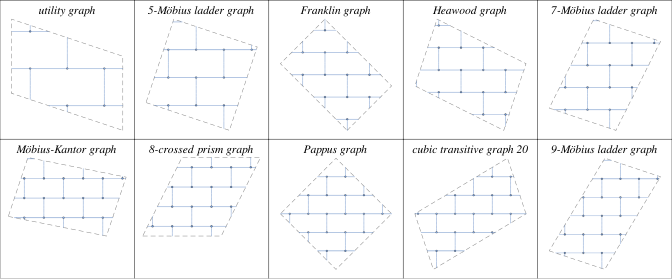
Some examples are illustrated above. Each graph face looks like a rectangle, but its boundary contains six edges and six vertices, including a vertex in the middle of each long side. Thus the brick-wall and regular hexagon drawings represent the same graph, with different geometric shapes for its faces (Junnila and Laihonen 2012, Fig. 1).
