


The honeycomb toroidal graph  on
on  vertices for
  ,
,  , and
, and  positive integers satisfying
 and
and  even is defined as the graph
on vertex set
even is defined as the graph
on vertex set  for
for  and
and 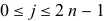 . Edges are then
defined as follows, with the indices
. Edges are then
defined as follows, with the indices  and
and  taken modulo
  and
and  , respectively.
1. For each  from 0 to
  ,
,
 is adjacent to
  and
and  .
.
2. For each even  from 0 to
  , there is an edge from
  to
to  for all odd
  .
.
3. For each odd  from 1 to
  , there is an edge from
  to
to  for all even
  .
.
4. If  is even, there is an edge
from
is even, there is an edge
from  to
to  for all odd
  .
.
5. If  is odd, there is an edge
from
is odd, there is an edge
from  to
to  for all even
  .
.
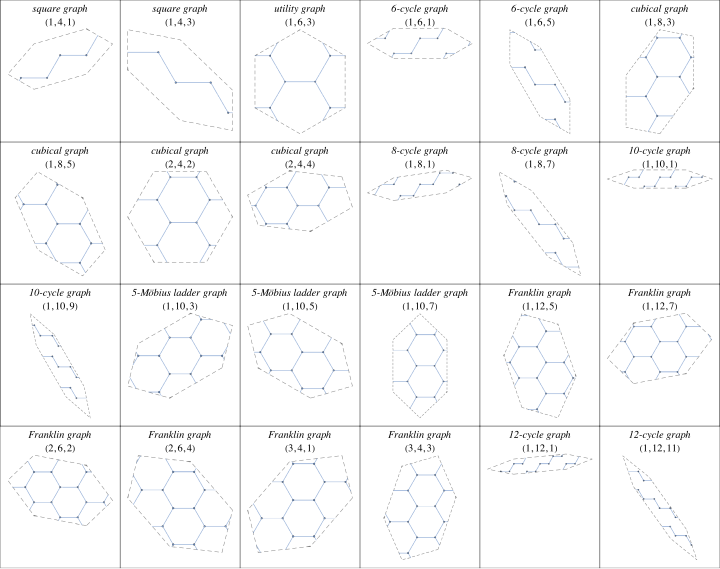
Torus graph embeddings are illustrated above for the first few honeycomb toroidal graphs, where a single graph may have multiple parameters and therefore multiple embeddings on the torus.
Honeycomb toroidal graphs are cubic, except some cases with  which give cycle graphs
  . They are also vertex-transitive,
and Cayley graphs (Alspach and Dean 2009).
. They are also vertex-transitive,
and Cayley graphs (Alspach and Dean 2009).
Honeycomb toroidal graphs have also been called generalized honeycomb tori and brick products (Alspach and Dean 2009).
Known positive exact graph crossing numbers and selected candidates are summarized below. Square brackets denote candidates derived from computed upper bounds, not proved exact values. One honeycomb parameterization is shown for each graph.
| crossing number | honeycomb toroidal graph parameters |
| 1 |  for odd
  |
| 2 | (1, 12, 5) |
| 3 | (1, 14, 5), (1, 18, 5) |
| 4 | (1, 16, 5), (1, 16, 7), (1, 20, 5), (1, 24, 5) |
| 5 | (1, 30, 5), [(1, 20, 9)] |
| 6 | (1, 36, 5), [(1, 24, 7)] |
| 7 | (1, 42, 5), [(1, 28, 7)] |
| 8 | [(1, 26, 7)] |
| 9 | [(1, 30, 7)] |
| 10 | (1, 36, 7), (1, 40, 7), (1, 40, 17) |
| 11 | (1, 38, 7), (1, 44, 11), (1, 44, 21) |
| 12 | (1, 40, 9), (1, 40, 11), (1, 42, 7), (1, 44, 7), (1, 48, 7), [(1, 36, 11)] |
| 13 | (1, 46, 7), (1, 46, 9), [(1, 38, 15)] |
| 14 | (1, 44, 9), (1, 50, 7), [(1, 42, 13)] |
| 15 | (1, 50, 9), (1, 50, 19), [(1, 42, 9)] |
| 16 | [(1, 48, 9)] |
The toroidal graph drawing above exhibits a honeycomb toroidal graph as a translation quotient of the infinite hexagonal grid.
Writing its parameters as  , where
  in the definition above, let
  be the residue of
  modulo
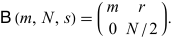
  . For primitive translation vectors
  and
and  , a basis of the
honeycomb cell point lattice is
, a basis of the
honeycomb cell point lattice is
 |
The corresponding period vectors may be taken as  and
and  .
Since
.
Since  and each primitive cell contains two vertices, the
quotient has
and each primitive cell contains two vertices, the
quotient has  vertices.
The choice of period vectors is not unique: exchanging them, reversing their signs, or applying an integer change
of basis with a unimodular
matrix leaves the translation point
lattice unchanged. The Möbius-Kantor
graph, for example, has the three honeycomb presentations  ,
,  , and
, and  . A particular torus
graph embedding additionally specifies a displayed fundamental
region, representatives of the quotient vertices,
and the translation crossed by each wrapping graph
edge. An edge with wrapping vector
. A particular torus
graph embedding additionally specifies a displayed fundamental
region, representatives of the quotient vertices,
and the translation crossed by each wrapping graph
edge. An edge with wrapping vector  continues into the region translated by
  . Parallelogram,
hexagonal, and brick-wall drawings
can therefore depict the same periodic graph embedding.
. Parallelogram,
hexagonal, and brick-wall drawings
can therefore depict the same periodic graph embedding.
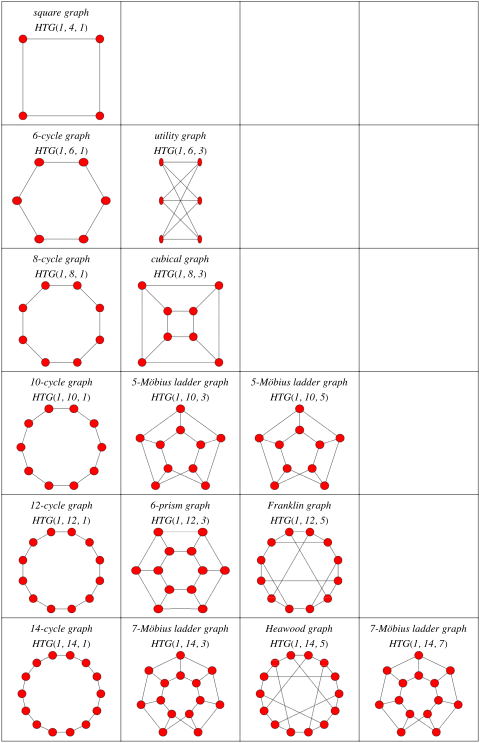
The following table summarizes some special cases.

 -
- ,
,
 ,
,
 ,
,

 ,
,  ,
,  ,
,  ,
,  ,
, 
 ,
,  ,
,  ,
,  ,
,  ,
, 
 ,
,  ,
,  ,
,  ,
,  ,
, 
 ,
,  ,
,  ,
,  ,
,  ,
, 
 ,
,  ,
,  ,
,  ,
,  ,
, 
 ,
,  ,
, 
 ,
,  ,
,  ,
,  ,
, 
 ,
,  ,
,  ,
,  ,
, 
 ,
,  ,
,  ,
,  ,
, 
 ,
,  ,
,  ,
,  ,
,  ,
, 
 ,
,  ,
,  ,
,  ,
, 
 ,
, 
 ,
, 
 ,
,  ,
,  ,
, 
 ,
,  ,
,  ,
, 
 ,
,  ,
, 
 ,
,  ,
, 
 ,
,  ,
,  ,
, 

 ,
,
 ,
,
 ,
,


 ,
, 

 A
A ,
,

 A
A
 A
A
 A
A
 A
A
 A
A ,
, 
 A
A
 A
A
 A
A
 A
A
 B
B
 A
A
 A
A
 A
A
 A
A
 A
A
 A
A
 A
A
 A
A
 B
B
 A
A
 A
A
 A
A
 A
A
 A
A
 B
B
 B
B
 A
A
 A
A
 A
A
 A
A
 B
B
 A
A
 ,
,
 ,
,
 ,
,
 ,
,
 ,
,


 ,
, 
 ,
,  ,
, 

 ,
,
 ,
,
 for
for  odd
odd

 ,
,  ,
,  for
for  even
even

