


The torus grid graph  is the graph formed from the graph
Cartesian product
is the graph formed from the graph
Cartesian product  of the cycle graphs
  and
and  . By analogy with the KC graph
and KP graph, the
. By analogy with the KC graph
and KP graph, the  torus grid graph could also be called a "CC graph."
 is isomorphic to
  .
.
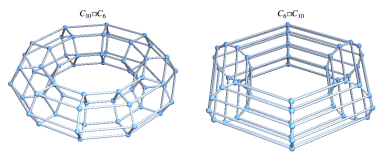
 can be formed starting
with an
can be formed starting
with an  grid graph and connecting corresponding left/right and
top/bottom vertex pairs with edges.
While such a graph drawing has overlapping edges in
the plane, it can naturally be placed on the surface of
a torus with no edge intersections
or overlaps. Torus grid graphs are therefore toroidal
graphs. The isomorphic torus grid graphs
grid graph and connecting corresponding left/right and
top/bottom vertex pairs with edges.
While such a graph drawing has overlapping edges in
the plane, it can naturally be placed on the surface of
a torus with no edge intersections
or overlaps. Torus grid graphs are therefore toroidal
graphs. The isomorphic torus grid graphs  and
and  are illustrated above.
The torus grid graphs are quartic and Hamiltonian and have vertex count
 |
(1)
|
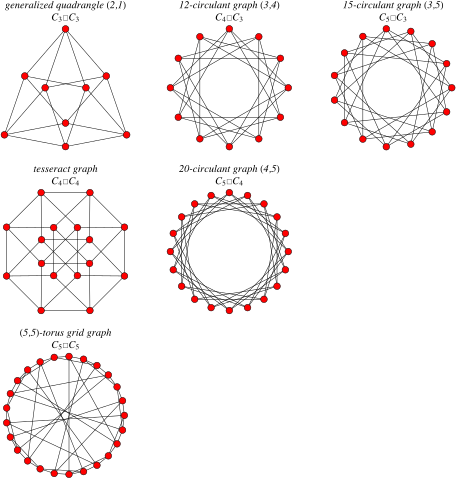
Torus grid graphs are circulant graphs iff  and
and  are relatively prime,
i.e.,
are relatively prime,
i.e.,  .
In such cases,
.
In such cases,  is isomorphic to
  .
Special cases are summarized in the following table and illustrated above in attractive
(but non-toroidal) drawings.
.
Special cases are summarized in the following table and illustrated above in attractive
(but non-toroidal) drawings.



Harary et al. (1973) conjectured that the graph crossing number is given by
 |
(2)
|
for all  satisfying
  (Clancy et al. 2019). The conjecture is now known to hold for
  (Adamsson and Richter 2004 and earlier work
cited therein), as well as for
(Adamsson and Richter 2004 and earlier work
cited therein), as well as for  . An asymptotic lower bound of
 |
(3)
|
was given by Salazar and Ugalde (2004). Clancy et al. (2019) summarize additional results and details.
Riskin (1993) proved that the projective plane crossing number of  is 2 and that of
  is
is  for
for  .
.
Riskin (2001) showed that the Klein bottle crossing numbers of  with
with  for
for  , 4, 5, 6 are 1, 2, 4, and 6, respectively.
Juarez and Salazar (2003) proved that, for each fixed  , the Klein
bottle crossing number of
, the Klein
bottle crossing number of  is
is  for all sufficiently large
  , where
  is the floor function.
Their theorem does not give a general explicit threshold
for
is the floor function.
Their theorem does not give a general explicit threshold
for  .
.
The torus grid graph  is unit-distance since it is isomorphic to
the graph Cartesian product
is unit-distance since it is isomorphic to
the graph Cartesian product  , where
  is the
  -prism graph (which is itself
unit-distance).
-prism graph (which is itself
unit-distance).
Mertens (2024) computed the domination polynomial and numbers of dominating sets for  torus grid graphs up to
  .
.

 ." J. Combin. Theory 90, 21-39,
2004.Clancy, K.; Haythorpe, M.; and Newcombe, A. §3.1.1 in "A
Survey of Graphs with Known or Bounded Crossing Numbers." 15 Feb 2019.
." J. Combin. Theory 90, 21-39,
2004.Clancy, K.; Haythorpe, M.; and Newcombe, A. §3.1.1 in "A
Survey of Graphs with Known or Bounded Crossing Numbers." 15 Feb 2019.  ." J. Graph Th. 17, 683-693,
1993.
." J. Graph Th. 17, 683-693,
1993.  : A Self-Contained Proof Using Mostly Combinatorial
Arguments." Graphs Combin. 20, 247-253, 2004.Stewart,
I. Fig. 41 in
: A Self-Contained Proof Using Mostly Combinatorial
Arguments." Graphs Combin. 20, 247-253, 2004.Stewart,
I. Fig. 41 in