


A planar graph embedding is a drawing of a graph in the plane in which distinct vertices occupy distinct points and edges intersect only at common endpoints. A planar graph embedding is also called a plane drawing and, when the crossing-free condition is understood, a planar drawing. The graph together with this specified embedding is a plane graph (Harary 1994, p. 103; Harborth and Möller 1994). In general topology, the term planar embedding applies more broadly to an embedding of any topological space into the plane.
A planar graph is an abstract graph that admits such a drawing. Different planar graph embeddings of the same graph can have different cyclic orders of incident edges or different arrangements of faces. Requiring straight edges gives a planar straight line embedding.
A planar straight line embedding of a planar graph can be constructed in the Wolfram Language using PlanarGraph[g] or the "PlanarEmbedding" setting of GraphLayout. Precomputed planar graph embeddings of some graphs are available as GraphData[g, "Graph", "Planar"].
Choosing a graph face of an embedding on the sphere, removing a point from that face, and identifying the punctured sphere with the plane produces a planar graph embedding whose chosen face is unbounded. Conversely, adjoining the point at infinity converts a planar graph embedding into an embedding on the sphere. The same graphs are therefore embeddable in either surface, although distinguishing an outer graph face can change the equivalence relation used to classify the embeddings (Erickson 2017).
A planar graph embedding of a connected graph determines a planar map by recording the embedded edges and graph faces. A rotation system records the cyclic order of incident edges, while the graph vertex coordinates and the shapes of the edges are additional drawing data.
In general, planar graphs may have several inequivalent embeddings on the sphere. Polyhedral graphs are uniquely embeddable there, up to homeomorphism, and hence have a uniquely determined abstract dual graph. If equivalence is restricted to orientation-preserving homeomorphisms, an embedding and its mirror image are counted separately unless an orientation-preserving homeomorphism identifies them.
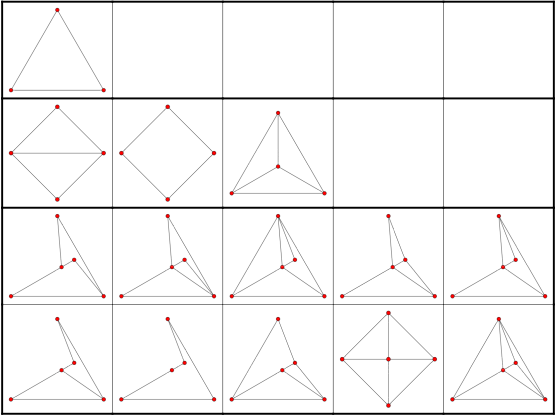
The numbers of embeddings on the sphere of 2-connected planar graphs with  , 2, ... vertices are 0,
0, 1, 3, 10, 61, 564, 7593, 123874, ... (OEIS A034889).
These counts use the convention that a biconnected
graph has at least three vertices. At
, 2, ... vertices are 0,
0, 1, 3, 10, 61, 564, 7593, 123874, ... (OEIS A034889).
These counts use the convention that a biconnected
graph has at least three vertices. At  , the count first exceeds the number of nonisomorphic 2-connected planar
graphs, because one graph has two inequivalent embeddings
on the sphere. The counts do not distinguish choices of
an outer graph face.
, the count first exceeds the number of nonisomorphic 2-connected planar
graphs, because one graph has two inequivalent embeddings
on the sphere. The counts do not distinguish choices of
an outer graph face.
For disconnected graphs, the embeddings of the connected components alone do not specify the entire drawing. One connected component may lie in a graph face of another, so the nesting and choice of containing faces must also be recorded. For three or more connected components, not every embedding on the sphere is equivalent to a side-by-side arrangement. Even for two connected components, which graph face of each contains the other can matter (B. McKay, pers. comm., Nov. 18, 2025).
For a connected graph  , an embedding of
  on the sphere amounts
to an embedding of
on the sphere amounts
to an embedding of  with a distinguished graph face
containing the isolated vertex. Equivalent choices
are determined by the automorphisms of the
embedded planar map, not necessarily all automorphisms
of the abstract graph (B. McKay, pers. comm., Nov. 18,
2025).
with a distinguished graph face
containing the isolated vertex. Equivalent choices
are determined by the automorphisms of the
embedded planar map, not necessarily all automorphisms
of the abstract graph (B. McKay, pers. comm., Nov. 18,
2025).
