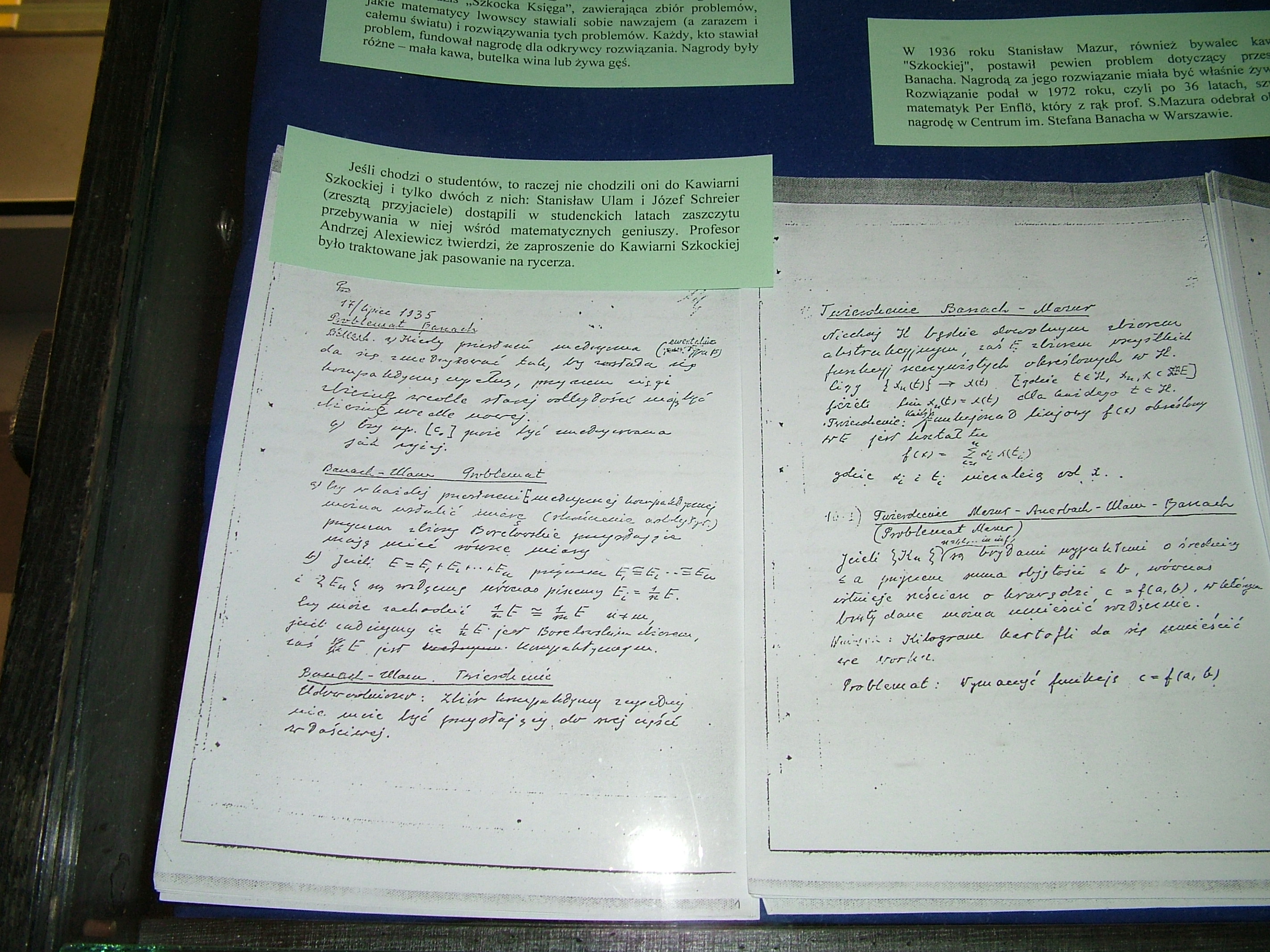
The Scottish Book problems are the mathematical questions and recorded topics collected by mathematicians meeting at the Scottish Café in Lwów, now Lviv, Ukraine. The original was a bound handwritten notebook. It began in 1935, and its last dated contribution is from 1941. Its problems were contributed by several mathematicians, including Banach, Mazur, Steinhaus, and Ulam (Ulam 1958, Mauldin 2015).
The photograph shows facsimile pages displayed at an exhibition, not the original bound notebook. The photograph by Stako is licensed under Creative Commons Attribution-ShareAlike 3.0.
The collection includes problems in functional analysis, topology, set
theory, and geometry. Problem 19, the Ulam
floating body problem, asks whether a homogeneous convex
body floating in equilibrium in every orientation must be a closed
ball. Ryabogin (2022) answered this negatively using bodies of relative density
 . The original problem statements are distinct from
the later solutions and commentaries included in Mauldin's (2015) expanded edition,
which also contains selected problems from the New Scottish Book.
The Scottish Book should also be distinguished from Ulam's (1960) A Collection of Mathematical Problems, which includes material originating both in the Scottish Book and in Ulam's later work.

The New Scottish Book continued the tradition in postwar Wrocław at the initiative of Edward Marczewski. Hugo Steinhaus entered its first problems in July 1946. Its three volumes contain 968 problems (University of Wrocław). The photograph is from exhibition press materials of the Memory and Future Centre, published by Culture.pl.
The following table summarizes all 193 numbered problems of the original Scottish Book in their original order, together with the five decimal-numbered additions 10.1, 15.1, 17.1, 20.1, and 188.1 (Mauldin 2015). The descriptions summarize the original statements rather than the later solutions or commentary. Problem 171 is misprinted as a second Problem 163 in the 2015 edition. The proposer of Problem 189 is listed as Fermant, following that edition.
| number | proposer | problem |
| 1 | Banach | compact remetrization of metric spaces preserving convergent sequences |
| 2 | Banach and Ulam | congruence-invariant finitely additive measures on compact metric spaces and uniqueness of equal-piece decompositions |
| 3 | Banach and Ulam | impossibility of a compact set being congruent to a proper subset of itself |
| 4 | Schreier | Cesàro summability of almost every subsequence of a bounded Cesàro-summable sequence |
| 5 | Mazur | comparison of density-one subsequence convergence with matrix summability methods, including bounded sequences |
| 6 | Mazur and Orlicz | normal forms for invertible row-finite infinite matrices in summability theory |
| 7 | Mazur and Banach | homeomorphism types of infinite-dimensional convex subsets of Banach spaces |
| 8 | Mazur | representing Cesàro-summable series as Cauchy products of convergent series |
| 9 | Mazur and Orlicz | common intersections of families of finite sets of uniformly bounded size |
| 10 | Banach and Mazur | representation of continuous linear functionals on spaces with pointwise convergence by finitely many evaluations |
| 10.1 | Mazur, Auerbach, Ulam, and Banach | bounded-cube packing bounds for countably many convex bodies with bounded diameters and finite total volume |
| 11 | Banach and Ulam | product extensions of finitely additive measures on integers and measurability of convergence, coprimality, and order relations |
| 12 | Banach | ambient equivalence of embedded spheres to standard spheres under tangent-plane hypotheses |
| 13 | Ulam | lifting Boolean operations on subsets of integers modulo finite sets to maps of integers |
| 14 | Schauder and Mazur | polynomial
approximation of functions and their weak derivatives in  |
| 15 | Schauder | integrability thresholds for solutions of the Poisson's equation with zero boundary values in arbitrary dimension |
| 15.1 | Mazur and Orlicz | whether local boundedness forces a complete metrizable topological vector space to be normable |
| 16 | Ulam | measures on spaces of measurable functions with prescribed product laws for point evaluations |
| 17 | Ulam | a converse law of large numbers for Bernoulli trials with varying success probabilities |
| 17.1 | Ulam | agreement of every continuous function with an analytic function on some perfect set |
| 18 | Ulam | existence of knotted magnetic field lines generated by current in a knotted closed wire |
| 19 | Ulam | Ulam floating body problem |
| 20 | Ulam | approximation of homeomorphisms by compositions of coordinate-preserving homeomorphisms |
| 20.1 | Mazur and Orlicz | minimal and uniformly bounded numbers of points for irreducibility-preserving linear substitutions |
| 21 | Ulam | maps from a disk onto a torus with arbitrarily small fibers |
| 22 | Ulam and Schreier | generating all subsets of the real line from additive subgroups by countable unions and set differences |
| 23 | Schauder | interior regularity and higher-dimensional extensions of boundary estimates for saddle functions |
| 24 | Mazur | continuity of additive functionals whose compositions with continuous paths are measurable |
| 25 | Schauder | operator classes extending singular integral equations beyond the classical Fredholm setting |
| 26 | Mazur and Orlicz | whether uniform convergence of linear functionals on bounded sets implies uniform convergence near zero |
| 27 | Mazur and Orlicz | common zeros of complex polynomials on Banach spaces from bounded approximate common zeros |
| 28 | Mazur | possible Cesàro sums of rearrangements of a real series and analogs for other summation methods |
| 29 | Ulam | simplicity of identity components of homeomorphism groups of spheres |
| 30 | Ulam | simultaneous conjugacy of pairs from conjugacy of corresponding group words |
| 31 | Ulam | whether conjugacy classes in compact metric groups are of first category |
| 32 | Ulam | approximation of multiplication and inversion in compact metric groups by finite group laws |
| 33 | Ulam | equivalence of sequences of projective or measurable sets to sequences of Borel sets under bijections |
| 34 | Ulam | whether a collection closed under countable unions and set differences and selections must contain every subset of the real line |
| 35 | Ulam | homeomorphism of infinite-dimensional projective Hilbert space with Hilbert space |
| 36 | Ulam | retraction of the Hilbert-space unit ball onto its boundary sphere |
| 37 | Ulam | classification of rings of sets and sigma-rings of sets up to isomorphism |
| 38 | Ulam | limiting connectivity probabilities in a random friendship model with a fixed number of choices per person |
| 39 | Auerbach | discontinuous multiplicative, subadditive analogs of absolute value |
| 40 | Banach and Ulam | extension of Lebesgue measure to all projective sets while preserving congruence invariance |
| 41 | Mazur | finite-dimensional Banach spaces universal for all Banach spaces of a fixed dimension |
| 42 | Ulam | fixed points for continuous transformations of families of compact convex sets |
| 43 | Mazur | Banach-Mazur game and variants defined by binary digits or decreasing positive terms |
| 44 | Steinhaus | classification of surfaces carrying two straight lines through every point, with and without continuity |
| 45 | Banach | automatic continuity of Baire-measurable products of homomorphisms of complete metric non-Abelian groups |
| 46 | Banach | unicoherence of spheres in Banach spaces |
| 47 | Banach | decomposition of permutations of an infinite matrix into row-preserving and column-preserving permutations |
| 48 | Mazur and Banach | isomorphism between spaces of continuous functions on countable compact sets and spaces of convergent sequences |
| 49 | Mazur and Banach | universal Banach spaces in the separable reflexive, countable-basis, and separable-dual classes |
| 50 | Banach | Baire measurability of the Denjoy integral as a functional |
| 51 | Mazur | countability of pairwise orthogonal families of measurable functions or numerical sequences without square-integrability assumptions |
| 52 | Banach | descriptive complexity of the set of everywhere-differentiable continuous functions |
| 53 | Banach | whether uniform short-arc connectivity of an embedded disk forces finite area and almost-everywhere tangent planes |
| 54 | Schauder | extensions of the Schauder fixed point theorem to more general topological vector spaces |
| 55 | Mazur | factorization of polynomials bounded near unbounded sets through affine functionals bounded on those sets |
| 56 | Mazur and Orlicz | simultaneous pointwise blow-up under vanishing translations for discontinuous polynomial-type functionals |
| 57 | Ruziewicz | continuous functions with prescribed oscillation bounds and arbitrarily large normalized difference quotients |
| 58 | Ruziewicz | finite and infinite chains of immediate successors among topological embeddability types |
| 59 | Ruziewicz | perfect square dissection into pairwise unequal squares |
| 60 | Ruziewicz | partitioning a sphere into arbitrarily small congruent connected regions with controlled boundaries |
| 61 | Steinhaus | surfaces containing intersecting congruent plane curves through each point, with local or global congruence requirements |
| 62 | Mazur and Ulam | whether an increasing union of mutually isomorphic groups is isomorphic to its constituent groups |
| 63 | Mazur and Ulam | inheritance of irredundant generating sets by subgroups |
| 64 | Mazur | separation of positively separated convex bodies in Banach spaces by hyperplanes |
| 65 | Mazur | preservation of nowhere density when a convex set is symmetrized |
| 66 | Mazur | almost-everywhere existence of mixed derivatives from pure second derivatives and higher-dimensional analogs |
| 67 | Banach | winning strategies in cardinality-halving variants of Banach-Mazur game |
| 68 | Ulam | convexity of manifolds whose hyperplane sections of the boundary are spheres |
| 69 | Mazur and Ulam | metric characterization of Banach spaces by unique iterated metric centers and their extensions |
| 70 | Ulam | polynomial approximation with quantitative derivative separation, motivated by Hilbert's fifth problem |
| 71 | Ulam | permutations of the natural numbers preserving asymptotic density of every subset |
| 72 | Mazur | characterizing complete metrizable vector spaces whose compact sets have compact closed convex hulls |
| 73 | Mazur and Orlicz | sharp polarization constants comparing symmetric multilinear operators with their diagonal polynomials |
| 74 | Mazur and Orlicz | coefficient
bounds for homogeneous polynomials bounded on the
unit  ball |
| 75 | Mazur | preservation of polynomial boundedness near an unbounded set under scalar dilation |
| 76 | Mazur | convexity of the body whose radial function is the area of central sections of a convex body |
| 77 | Ulam | cancellation of Cartesian squares for homeomorphism, isometry, and group isomorphism |
| 78 | Steinhaus | classification of surfaces carrying two prescribed families of congruent curves through each point |
| 79 | Mazur and Orlicz | whether polynomial bijections with polynomial inverses must be affine |
| 80 | Mazur | changes of Borel class under countable products and eventually constant sequence constructions |
| 81 | Steinhaus | characterization of surfaces generated in two ways by congruent curves and possible additive separation of their equations |
| 82 | Steinhaus | countability, orthogonality, and completeness of families of mutually independent measurable functions |
| 83 | Auerbach | whether pointwise fractional-order difference bounds imply a global Hölder condition |
| 84 | Auerbach | whether projective equivalence of all central plane sections characterizes ellipsoids |
| 85 | Banach | complete orthonormal systems for which expansions of polynomials or analytic functions diverge almost everywhere |
| 86 | Banach | completion of uniformly bounded orthonormal systems without increasing their common bound |
| 87 | Banach | intermediate
 bounds for nonlinear Lipschitz operators |
| 88 | Mazur | weighted absolute summability of coefficients
when the associated Hankel matrix maps bounded
sequences into  |
| 89 | Mazur | whether strict convexity forces weak convergence to a boundary point to be norm convergence |
| 90 | Ulam and Auerbach | the minimum number of elements generating a dense subgroup of a semisimple Lie group |
| 91 | Mazur | whether a finite-dimensional normed space isometric to its dual must be Euclidean |
| 92 | Mazur | weighted summation of bounded sequences with nonincreasing or completely monotone weights, and uniqueness of resulting limits |
| 93 | Mazur | continuous bounded-variation parametrizations of curves and attainment of their minimum possible length |
| 94 | Lomnicki and Ulam | an integral limit related to a converse law of large numbers |
| 95 | Schreier and Ulam | embedding the additive group of real numbers in the permutation group of a countable set |
| 96 | Ulam | compact or locally compact metrizable group topologies on the full permutation group of the integers |
| 97 | Kuratowski and Ulam | whether mutual approximation by maps with arbitrarily small fibers forces manifolds to be homeomorphic |
| 98 | Schreier and Ulam | finite smooth generating families approximating all continuous maps or homeomorphisms of a sphere |
| 99 | Ulam | generation of subsets of the square from Cartesian product sets by countable unions and set differences |
| 100 | Ulam and Banach | closed subsets of spheres obtainable as images of limits of homeomorphisms |
| 101 | Ulam | whether transitivity on infinite coinfinite subsets forces a permutation group to be the full symmetric group |
| 102 | Ulam | comparison of encounter probabilities for one or two moving points, and analogous first-approach questions for circle rotations |
| 103 | Schreier and Ulam | a separable topological group universal for locally compact groups |
| 104 | Schauder | existence of minimizers for regular nonparametric variational problems with fixed or free boundary data |
| 105 | Schauder | existence and regularity of minimizers for corresponding parametric surface variational problems |
| 106 | Banach | affine structure of the set of sums of convergent rearrangements of a Banach-space series |
| 107 | Sternbach | fixed points of continuous self-maps and homeomorphisms of nonseparating plane continua |
| 108 | Banach, Mazur, and Ulam | choosing Schauder bases from prescribed dense subsets or dense linear subspaces of Banach spaces |
| 109 | Mazur and Ulam | whether finitely generated rational or composition-closed classes of functions can be closed under indefinite integration |
| 110 | Ulam | fixed points for continuous self-maps with uniformly small iterates on manifolds and continua |
| 111 | Schreier | uncountable groups in which every countable subset lies in a finitely generated subgroup |
| 112 | Schreier | whether class-preserving group automorphisms must be inner |
| 113 | Schreier | classification of composition-preserving automorphisms of the space of continuous real functions |
| 114 | Auerbach and Ulam | approximating a sphere by an embedded plane in analogy with a curve spiraling toward a circle |
| 115 | Ulam | homeomorphisms of Euclidean spaces with dense orbits and possible density of nearly every orbit |
| 116 | Schreier and Ulam | density and uniform distribution of random products in compact groups and analogous measure-preserving dynamics |
| 117 | Fréchet | differentiable parametrizations with nonvanishing velocity for Jordan curves having oriented tangents everywhere |
| 118 | Fréchet | maximal determinants of sign matrices and their asymptotic growth |
| 119 | Orlicz | uniformly bounded orthogonal systems giving uniformly convergent expansions of all continuous functions |
| 120 | Orlicz | rates of approximation of Hölder-continuous functions by selected monomials |
| 121 | Orlicz | everywhere-divergent Fourier series
with coefficients in every  |
| 122 | Mazur and Orlicz | unconditionally convergent but not absolutely convergent series in every infinite-dimensional Banach space |
| 123 | Steinhaus | ham sandwich theorem for finite-Lebesgue-measure sets |
| 124 | Marcinkiewicz | uniqueness for a convolution integral equation with a continuous kernel nonzero at the origin |
| 125 | Infeld | factorization of functions along curves satisfying two first-order differential constraints |
| 126 | Kac | vanishing of a characteristic-function limit for mean-zero functions with infinite second moment |
| 127 | Kuratowski | representation of closed subsets of zero-dimensional metric spaces as countable intersections of clopen sets |
| 128 | Nikliborc | characterization of ellipsoids by polynomial Newtonian potentials inside homogeneous solids |
| 129 | Nikliborc | characterization of ellipsoidal shells by constancy of their Newtonian potential in the enclosed cavity |
| 130 | Kaczmarz | lower bounds for supremum norms of combinations of lacunary orthogonal functions in terms of coefficient sums |
| 131 | Zygmund | existence of Dini integrals under bounded truncated-integral hypotheses |
| 132 | Sierpiński | a universal Baire function of two variables representing every bivariate function by substitutions in one variable |
| 133 | Eilenberg | disjoint clopen refinements of clopen covers of metric spaces |
| 134 | Eilenberg | whether products of indecomposable continua remain indecomposable |
| 135 | Eilenberg | invariance of non-unicoherence under local homeomorphisms of locally connected continua |
| 136 | Eilenberg | dimension-raising open maps |
| 137 | Eilenberg | dimension-raising restrictions of globally dimension-lowering maps to closed subsets |
| 138 | Eilenberg | absolute-retract properties of compact convex sets in linear and metrically convex spaces |
| 139 | Ulam | conjugating injective continuous Euclidean self-maps to maps preserving measure-zero sets |
| 140 | Ulam | classification of arbitrary self-maps up to conjugacy by bijections |
| 141 | Ulam | measurable conjugacy of irrational rotations of circles and spheres |
| 142 | Ulam (theorem: G. Birkhoff) | representation of arbitrary groups as automorphism groups of binary relations |
| 143 | Mazur | definability of the inequality predicate from specified arithmetic operations, composition, and recursion |
| 144 | Mazur and Ulam | injective maps from separable Banach-space balls into an interval sending open sets to sets of positive measure |
| 145 | Ulam | existence of nonatomic countably additive measures on sigma-algebras generated by prescribed sequences of sets |
| 146 | Ulam | rates of convergence in the Lebesgue density theorem |
| 147 | Auerbach and Mazur | corner-to-corner 45-degree billiard paths in rectangles with rational side ratios |
| 148 | Auerbach | connectedness of complements of polynomial zero sets in terms of signs of irreducible factors |
| 149 | Nikliborc | comparison of Newtonian surface potentials at a common tangency point of nested convex surfaces |
| 150 | Nikliborc | recovery of symmetry of a surface and its density from symmetry of the exterior Newtonian potential |
| 151 | Wavre | nonzero harmonic functions vanishing on all cube edges, and a related algebraic-function contour-integral problem |
| 152 | Steinhaus | frequencies of lattice-point counts in irrational translates of a unit disk |
| 153 | Mazur | uniform approximation of a continuous
function  by finite sums  |
| 154 | Mazur | approximation using only nonzero orthogonal-expansion coefficients and universal linear summation methods for continuous functions |
| 155 | Mazur and Sternbach | whether bijective local isometries between Banach spaces are global isometries |
| 156 | Ward | almost-everywhere regular parametrizations of surfaces possessing geometric tangent planes everywhere |
| 157 | Ward | monotonicity from positivity of upper right approximate derivatives of approximately continuous functions |
| 158 | Stoïlow | continuous complex functions analytic off perfect discontinuous singularity sets with prescribed image behavior |
| 159 | Ruziewicz | universal power-series partial sums approximating families of continuous functions with a uniform truncation bound |
| 160 | Mazur | connectedness of complete metric groups generated by arbitrarily small neighborhoods, and arcwise connectedness of connected metric groups |
| 161 | Kac | a central limit theorem for
lacunary trigonometric sums, especially frequencies  |
| 162 | Steinhaus | almost-everywhere upper and lower limits of measurable periodic functions evaluated at integer multiples |
| 163 | von Neumann | existence of strictly positive countably additive measures on complete Boolean algebras |
| 164 | Ulam | uniform bounds on escape times for approximate iterates of maps of finite subsets of an interval |
| 165 | Ulam | boundedness of Lipschitz constants in a greedy extension of finite bijections of points with rational coordinates |
| 166 | Ulam | distinguishing manifolds by groups of homeomorphisms preserving a continuous function |
| 167 | Ulam | simultaneous equality of finitely many continuous function values before and after a self-map of a Hilbert sphere |
| 168 | Ulam | countably generated sigma-algebras containing every analytic set |
| 169 | Szpilrajn | congruence-invariant finitely additive extensions of Carathéodory length to all plane sets |
| 170 | Szpilrajn | absolute measurability of plane sets whose homeomorphic images are all Lebesgue measurable |
| 171 | Schreier and Ulam | whether associativity and permutation invariance characterize composition of self-maps |
| 172 | Eidelheit | relations between sequential weak-star closure properties and coincidence of weak-star and weak sequential convergence |
| 173 | Eidelheit | norm density of invertible bounded linear operators among all bounded operators on a Banach space |
| 174 | Eidelheit | Neumann-series expansion of inverses of operators on complete topological vector spaces |
| 175 | Borsuk | homeomorphism of products involving the Hilbert cube and a T-shaped curve with the Hilbert cube |
| 176 | Eidelheit | approximation of inverses in a unital Banach algebra by polynomials in the original element |
| 177 | Kac | functions of two Hermitian matrices that are positive definite for every pair |
| 178 | Kac | characterization of two-sided exponential distributions through a harmonic-mean identity for characteristic functions |
| 179 | Offord | Littlewood-Offord-type concentration bounds for random signed sums |
| 180 | Kampé de Fériet | representation of stationary random functions by a uniform random variable with independence at distinct times |
| 181 | Steinhaus | positive continuous or analytic functions whose integer translates sum identically to 1 |
| 182 | Knaster | effective decompositions of balls into chords and higher-dimensional analogs |
| 183 | Bogolubow | linearization of compact connected locally connected groups acting on Euclidean space |
| 184 | Saks | nonnegativity of the Laplacian of a subharmonic function with pure second derivatives everywhere |
| 185 | Saks | recovery of surface area as a limit of integrals of finite-difference area elements |
| 186 | Banach | complete orthonormal systems giving almost-everywhere unbounded expansions of every nonzero continuous function |
| 187 | Alexandroff | Alexander duality for images of punctured polyhedra, equivalence of dimension definitions, and dimension-raising open maps |
| 188 | Sobolew | sharp differentiability thresholds for local solvability of nonlinear hyperbolic Cauchy problems |
| 188.1 | Eidelheit | absolute
continuity along absolutely continuous curves for coordinatewise
absolutely continuous functions,
with or without  -integrable
partial derivatives |
| 189 | Fermant (as printed) | a Bloch-type universal disk bound in the principal star of a normalized analytic function |
| 190 | Lusternik | generalized eigenfunctionals corresponding to continuous-spectrum points of self-adjoint operators |
| 191 | Szpilrajn | existence of stochastically independent generating families for nonatomic probability measures |
| 192 | Knaster and Szpilrajn | comparison of the countable chain condition with Knaster's condition and preservation under products |
| 193 | Steinhaus | match-count probabilities and expected and probable numbers for two boxes of fifty matches |
The commentary on Problem 153 relates it to the approximation problem. The commentary tentatively identifies Problem 193 with the Banach matchbox problem (Mauldin 2015, pp. 281-282).