

An absolutely continuous function ![f:[a,b]->R](/images/equations/AbsolutelyContinuousFunction/Inline1.svg) , where
, where  , is a function such that
for every
, is a function such that
for every  there is a
  for which
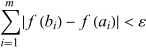 |
whenever ![[a_i,b_i] subset= [a,b]](/images/equations/AbsolutelyContinuousFunction/Inline5.svg) are finitely many subintervals whose interiors are pairwise
disjoint sets and
are finitely many subintervals whose interiors are pairwise
disjoint sets and  . The notation
 ![AC[a,b]](/images/equations/AbsolutelyContinuousFunction/Inline7.svg) denotes the class of such functions.
denotes the class of such functions.
Equivalently,  has a derivative
  almost everywhere,
this derivative is Lebesgue integrable,
and
almost everywhere,
this derivative is Lebesgue integrable,
and
 |
The equality must hold for every ![x in [a,b]](/images/equations/AbsolutelyContinuousFunction/Inline10.svg) , and the integral is a Lebesgue
integral. This characterization is a form of the fundamental
theorems of calculus.
, and the integral is a Lebesgue
integral. This characterization is a form of the fundamental
theorems of calculus.
Every Lipschitz function on ![[a,b]](/images/equations/AbsolutelyContinuousFunction/Inline11.svg) is absolutely continuous, and every absolutely continuous
function has uniform continuity. Neither converse
holds. For example,
is absolutely continuous, and every absolutely continuous
function has uniform continuity. Neither converse
holds. For example,  is absolutely continuous but is not a Lipschitz
function on
is absolutely continuous but is not a Lipschitz
function on ![[0,1]](/images/equations/AbsolutelyContinuousFunction/Inline13.svg) . The Cantor function
has uniform continuity but is not absolutely
continuous.
. The Cantor function
has uniform continuity but is not absolutely
continuous.
