


Topology is the mathematical study of the properties that are preserved through deformations, twistings, and stretchings of objects. Tearing, however, is not allowed. A circle is topologically equivalent to an ellipse (into which it can be deformed by stretching) and a sphere is equivalent to an ellipsoid. Similarly, allowing the hand angles to vary independently, the set of all possible positions of the hour hand of a clock is topologically equivalent to a circle (i.e., a one-dimensional closed curve with no intersections that can be embedded in two-dimensional space), the set of all possible positions of the hour and minute hands taken together is topologically equivalent to the surface of a torus (i.e., a two-dimensional surface that can be embedded in three-dimensional space), and the set of all possible positions of the hour, minute, and second hands taken together is topologically equivalent to the Cartesian product of three circles.
The definition of topology leads to the following mathematical joke (Renteln and Dundes 2005):
Q: What is a topologist? A: Someone who cannot distinguish between a doughnut and a coffee cup.
There is more to topology, though. Topology began with the study of curves, surfaces, and other objects in the plane and three-space. One of the central ideas in topology is that spatial objects like circles and spheres can be treated as objects in their own right, and knowledge of objects is independent of how they are "represented" or "embedded" in space. For example, the statement "if you remove a point from a circle, you get a space homeomorphic to an open interval" applies just as well to the circle as to an ellipse, and even to tangled or knotted circles, since the statement involves only topological properties.
Topology has to do with the study of spatial objects such as curves, surfaces, the space we call our universe, the space-time of general relativity, fractals, knots, manifolds (which are objects with some of the same basic spatial properties as our universe), phase spaces that are encountered in physics (such as the space of hand-positions of a clock), symmetry groups like the collection of ways of rotating a top, etc.
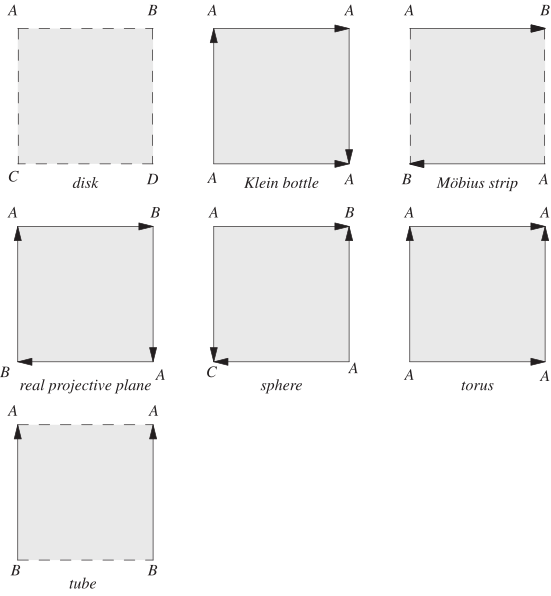
Topology can be used to abstract the inherent connectivity of objects while ignoring their detailed form. For example, the figures above illustrate the connectivity of a number of topologically distinct surfaces. In these figures, corresponding edges drawn in solid join one another with the orientation indicated with arrows, so corners labeled with the same letter correspond to the same point, and dashed lines show edges that remain free (Gardner 1971, pp. 15-17; Gray 1997, pp. 322-324). The above figures correspond to the closed disk, Klein bottle, Möbius strip, real projective plane, sphere, torus, and tube. The labels are often omitted in such diagrams since they are implied by connection of corresponding lines with the orientations indicated by the arrows.
The "objects" of topology are often formally defined as topological spaces. Two topological spaces are homeomorphic iff there is a homeomorphism between them. This is an intrinsic notion. For embedded objects, an isotopy is a continuous deformation through embeddings.
Around 1900, Poincaré used continuous deformations of loops to study topological properties (Collins 2004, p. 99). In particular, two continuous maps with the same domain and codomain are homotopic if one can be continuously deformed into the other.
Topology can be divided into algebraic topology (which includes combinatorial topology), differential topology, and low-dimensional topology. The low-level language of topology, which is not really considered a separate "branch" of topology, is known as point-set topology.
A topology on a set  is a collection
 of subsets of
 satisfying the following properties:
1. The (trivial) subsets  and the empty set
 are in
 .
2. Whenever sets  and
 are in
 , then so is
 .
3. The union of any family of sets in  is also in

(Bishop and Goldberg 1980). This definition can be used to enumerate the topologies on a fixed labeled set of  symbols. For example, the unique topology of order 1 is
 , while the four topologies of order 2 are
 ,
 ,
 , and
 . The numbers of topologies on sets of
cardinalities
 ,
2, ... are 1, 4, 29, 355, 6942, ... (OEIS A000798).
A set  for which a topology
 has been specified is called a topological
space (Munkres 2000, p. 76). For example,
 is a topology on the set
 , and
 is a topological space.
Topologies can be built up from topological bases. For the real numbers with their usual topology, a topological basis is the set of open intervals.

 Points Is at Least
 (except for Some Special Cases)." Disc. Math. 154,
27-39, 1996.Chinn, W. G. and Steenrod, N. E.