

The Banach matchbox problem asks for the probability mass function of the number of matches left in one of two boxes when the other
is first found empty. Each box initially contains  matches, where
 is a positive integer.
The box choices form an independent sequence,
with probability
 for either box at each step. If it is nonempty, a match
is removed. The experiment stops when an empty box is chosen, rather than when its
last match is removed (Feller 1957, p. 157).
If the random variable  counts the matches remaining in the other box, then
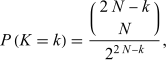 |
where  ,
 ,
 . For a specified box to be found empty with
 matches in the other, its
 successful selections and the other box's
 selections must precede the final failed selection. Counting
these orders and allowing either box to be found empty gives the formula. This is
related to the negative binomial distribution.
The match-count calculations in Problem 193 of the Scottish Book Problems are tentatively interpreted as this problem in Beyer's commentary (Mauldin 2015, pp. 281-282).
