

The Erdős problems are a large collection of questions posed or promoted by Paul Erdős and his collaborators (Bloom 2026). They range across number theory, combinatorics, graph theory, geometry, and related areas. Bloom's online Erdős Problems database listed 1217 numbered problems as of Sep. 9, 2026, together with their sources, status, references, and discussion. The numbers are database identifiers rather than established names for the individual questions.
The following table links selected problem numbers to their corresponding named problems or related mathematical topics (Bloom 2026).
 )
)Recent results on individual problems include the following.
Problem 184 is the Erdős-Gallai cycle decomposition conjecture. Kim (2026) reported that every simple
graph on  vertices admits a partition
of its edges into
vertices admits a partition
of its edges into  cycles and single edges,
where
cycles and single edges,
where  is big-O notation.
Problem 302 asks how large a subset  can be if no distinct
 satisfy
  . Writing
  for the maximum cardinality,
the problem asks in particular whether
for the maximum cardinality,
the problem asks in particular whether  , with
  as in little-O notation
(Erdős and Graham 1980, Bloom 2026). A Lean development directed by Sodelin
(2026), with the argument, code, and formalization produced by ChatGPT/Codex, reported
as in little-O notation
(Erdős and Graham 1980, Bloom 2026). A Lean development directed by Sodelin
(2026), with the argument, code, and formalization produced by ChatGPT/Codex, reported
 ,
,  , and
, and  . The first relation follows from an isolated
component in the hypergraph of forbidden triples containing
the five vertices 122, 183, 244, 366, and 732. Every
admissible selection from this component contains at most three of them and can be
replaced by 122, 183, and 244. Exact certificates show that neither 733 nor 734 belongs
to a forbidden triple on
. The first relation follows from an isolated
component in the hypergraph of forbidden triples containing
the five vertices 122, 183, 244, 366, and 732. Every
admissible selection from this component contains at most three of them and can be
replaced by 122, 183, and 244. Exact certificates show that neither 733 nor 734 belongs
to a forbidden triple on  . The values of
  for
for  , 2, ... begin 1, 2, 3, 4, 5, 5, 6, 7, 8, 9, 10, 10, 11,
... (OEIS A390395). This tabulation reaches
, 2, ... begin 1, 2, 3, 4, 5, 5, 6, 7, 8, 9, 10, 10, 11,
... (OEIS A390395). This tabulation reaches
 , so the relations above give
 ,
,  , and
, and  . The development proves the three relations but not
the external value
. The development proves the three relations but not
the external value  .
As of Sep. 25, 2026, independent human review had not established either that
the formal statement matches the classical problem or that the finite result is new.
The asymptotic Problem 302 remained
open (VibeMathed 2026c).
.
As of Sep. 25, 2026, independent human review had not established either that
the formal statement matches the classical problem or that the finite result is new.
The asymptotic Problem 302 remained
open (VibeMathed 2026c).
Problem 374 asks for the orders of growth of the counting functions for factorial square products requiring at least three and at most six factors (Bloom 2026). Yudin (2026) determined these orders of growth and confirmed the conjectured linear growth for integers requiring six factors. The existence of limiting densities for integers requiring four, five, or six factors remains open.
Problem 522 asks about the proportion of zeros in the closed unit
disk for a random Littlewood polynomial.
Kawada (2026) proved that this proportion converges almost
surely to  ,
with AI assistance in formalization and checking derivations.
,
with AI assistance in formalization and checking derivations.
Problem 617 is the Erdős-Gyárfás balanced coloring conjecture. Xia and Szeider (2026) proved the case of five colors. The general conjecture remains open.
Problem 793 asks for the maximum cardinality  of a subset
  of
of  such that
  whenever
  ,
,  ,
and
,
and  are distinct members of
  .
The recorded question is whether
.
The recorded question is whether  for some constant
  . Bloom (2026) reports that GPT-5.6 Sol,
prompted by Przemek Chojecki, gave a Lean-verified argument with
. Bloom (2026) reports that GPT-5.6 Sol,
prompted by Przemek Chojecki, gave a Lean-verified argument with
 |
Here  is the prime counting function, and
  denotes a quantity tending to 0 as
 in little-O
notation. This determines the proposed constant
as
in little-O
notation. This determines the proposed constant
as  (Bloom 2026, VibeMathed 2026b). No independent specialist review had been reported
as of Sep. 9, 2026.
(Bloom 2026, VibeMathed 2026b). No independent specialist review had been reported
as of Sep. 9, 2026.
Problem 809, the Burr-Erdős-Graham-Sós conjecture, was resolved by Bucić et al. (2026) for odd cycle
graphs of length at least 9 and by Shahab (2026) for the remaining case of the
cycle graph  (Bloom 2026).
Problem 940 asks, for every integer  , whether infinitely many positive
integers are not sums of at most
, whether infinitely many positive
integers are not sums of at most 
 -full,
or
-full,
or  -powerful,
numbers, meaning numbers
-powerful,
numbers, meaning numbers  such that
  implies
  for every prime number
  . It also asks whether the integers
representable by at most
. It also asks whether the integers
representable by at most  such summands have natural
density zero (Bloom 2026). For
such summands have natural
density zero (Bloom 2026). For  , the summands are cube-full
numbers. Beyer de Ryke (2026) proved the stronger conclusion that the positive
integers not representable by at most three cube-full
numbers have positive lower natural density.
This resolves the first question for
, the summands are cube-full
numbers. Beyer de Ryke (2026) proved the stronger conclusion that the positive
integers not representable by at most three cube-full
numbers have positive lower natural density.
This resolves the first question for  , while the density-zero question for
  remains open.
Problem 1154 concerns the possible Hausdorff dimensions of subfields
of  .
Assuming the axiom of constructibility
.
Assuming the axiom of constructibility  for the constructible
universe, Wang (2026) constructed coanalytic sets
that are proper subfields with every Hausdorff
dimension in
for the constructible
universe, Wang (2026) constructed coanalytic sets
that are proper subfields with every Hausdorff
dimension in ![[0,1]](/images/equations/ErdosProblems/Inline52.svg) .
The unrestricted existence question in ZFC remains open. Wang credits Danus with
proof search and development of the proofs.
.
The unrestricted existence question in ZFC remains open. Wang credits Danus with
proof search and development of the proofs.
For an integer  , let
, let  be the least integer
  such that the product
  has no prime
factor in the interval
has no prime
factor in the interval  . Erdős (1979) conjectured that
  grows faster than every fixed power
of
grows faster than every fixed power
of  .
Van Doorn and Tang (2026) reported the stronger bound
.
Van Doorn and Tang (2026) reported the stronger bound
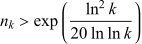 |
for all sufficiently large  . The paper credits ChatGPT 5.5 Pro with the core idea of adapting
Konyagin's argument and supplies supporting Lean formalizations produced by Aristotle.
Independent specialist review and an external audit of the formalization had not
been reported as of Sep. 21, 2026 (VibeMathed 2026a).
. The paper credits ChatGPT 5.5 Pro with the core idea of adapting
Konyagin's argument and supplies supporting Lean formalizations produced by Aristotle.
Independent specialist review and an external audit of the formalization had not
been reported as of Sep. 21, 2026 (VibeMathed 2026a).
