

A topological vector space is a vector space over  or
 that is also a Hausdorff space and for which vector
addition and scalar multiplication are
jointly continuous. Every normed
space, including each Banach space and Hilbert
space, is a topological vector space in its norm
topology.
The choice of topology determines the meaning of convergence of functions.
For example, on a measure space  , convergence in
the norm of
 means
 |
(1)
|
It implies convergence of the integrals, but the converse need not hold. The equivalence
classes of Lebesgue integrable functions
form the Banach space  , the
 case of the Lp-spaces.
For pointwise convergence, let  be a nonempty set and let
 or
 . On the vector space
 of all functions
 ,
each
 defines a seminorm
 |
(2)
|
These seminorms generate the product topology, in which  iff
 for every
 (Tao, p. 119). If
 is finite, this topology
is induced by the supremum norm
 . If
 is infinite, no norm
induces this topology on the full function
space
 . A basic neighborhood
of zero restricts only finitely many coordinates and contains
 for every
 ,
for some nonzero function
 supported at an unrestricted point. Such a neighborhood
cannot be contained in a norm unit
ball.
For a topological space  , the topology of uniform
convergence on compact sets on
 , the vector space
of scalar-valued continuous functions, is
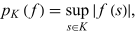
generated by the seminorms
 |
(3)
|
where  ranges over the nonempty compact
subsets of
 (Tao, pp. 119-120).
