

The detour polynomial of a graph  is the characteristic
polynomial of the detour matrix of
 .
Precomputed detour polynomials for many named graphs are available in the Wolfram Language as GraphData[graph, "DetourPolynomial"].
Since a Hamilton-connected graph with vertex count  has all off-diagonal matrix elements
equal to
 ,
the detour polynomial of such a graph is given by
 .
For a complete multipartite graph with positive part sizes  ,
 , let
 be the detour distance between distinct vertices
in parts
 and
 .
Define the
 matrix
 by
 and
 for
 . The subspace of vectors
supported in part
 with coordinate sum zero has eigenvalue
 and dimension
 . The remaining invariant
subspace consists of vectors constant on each part,
so
 |
(1)
|
The formal value  is immaterial for a singleton part.
For the complete bipartite graph  , put
 ,
 , and
 . This specializes to
 |
(2)
|
These formulas and the tables use the monic polynomial convention  .
For a strongly Hamiltonian-laceable graph with two equal bipartition classes and
even vertex count  , write its detour polynomial as
(x+N-2)^(N-2).](/images/equations/DetourPolynomial/NumberedEquation3.svg) |
(3)
|
The constant vector, the vector taking opposite signs on the two bipartition classes,
and the vectors whose coordinates sum
to zero within each class give the three factors. The Bruhat
graph and permutation star graph use
 for
 (Hsieh et al. 2000, Araki and Kikuchi 2007). The transposition
graph contains the permutation star graph
as a spanning subgraph, so the same longest
path bounds apply for
 . For
 and
 , the transposition graphs
are
 and
 ,
respectively, and also use
 . For the folded cube
graph, put
 with
 .
It is a Hamilton-connected graph for
odd
 and a strongly Hamiltonian-laceable
graph for even
 (Hsieh and Kuo 2007).
For the cycle graph and sunlet graph rows with  ,
put
 for
 .
These are the eigenvalues of the circulant
matrix
 .
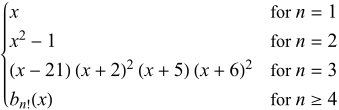
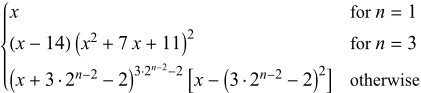
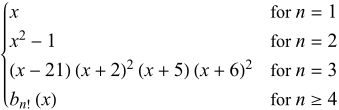
The following table summarizes detour polynomials for some common classes of graphs. Here,  is a Chebyshev polynomial of the
first kind and
 is a Chebyshev polynomial of the
second kind.


 ,


 ,











 ,


^(v-1) for n odd; b_v(x) for n even](/images/equations/DetourPolynomial/Inline67.svg)




 ,


 ,
















 ,



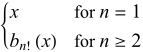


For the zero-dimensional hypercube graph and the singleton star graph,  . The 2-cocktail
party graph is
 and has polynomial
 .
The following table identifies  , the negative of the constant coefficient.
| graph | domain | OEIS for  |
| antiprism graph |  | A008788 |
| cocktail party graph |  | A008788 |
| complete graph |  | A008788 |
complete tripartite
graph  |  | A008788 |
| path graph |  | A001787 |
| star graph |  | A001787 |
| wheel graph |  | A008788 |
The following table summarizes the recurrence relations for detour polynomials for some simple classes of graphs. The path recurrence applies
for  .
| graph | order | recurrence |
path graph  | 5 |  |
