


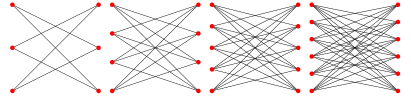
The  -crown graph, for a positive
integer
-crown graph, for a positive
integer  ,
is the graph obtained from the complete
bipartite graph
,
is the graph obtained from the complete
bipartite graph  by deleting a perfect matching
  (Brouwer and Koolen 1999, van Dam and Haemers 2003). It is
denoted here by
(Brouwer and Koolen 1999, van Dam and Haemers 2003). It is
denoted here by  .
Equivalently, it is the graph with vertex
set
.
Equivalently, it is the graph with vertex
set
 |
(1)
|
and edge set
 |
(2)
|
It is also isomorphic to the rook complement graph  (Brouwer et al. 1989, p. 222), where
  denotes the graph
Cartesian product. Colbrook and Drysdale (2026) instead denote the same graph
by
denotes the graph
Cartesian product. Colbrook and Drysdale (2026) instead denote the same graph
by  , with the two subscripts
giving the sizes of the two bipartition classes.
, with the two subscripts
giving the sizes of the two bipartition classes.
The analogous construction obtained by deleting a perfect matching from  is the complete tripartite
graph minus perfect matching.
is the complete tripartite
graph minus perfect matching.
Note that the term "crown graph" has also been used to refer to a sunlet graph  (Gallian 2025, p. 21).
The  -crowns used in the "crowning operation"
(Koester 1990) are unrelated to the crown graphs defined here. Repeated application
of that "crowning" operation to the Chiu graph
generates an infinite family of quartic planar edge-critical graphs with fractional
chromatic number 3 (Chiu et al. 2024).
-crowns used in the "crowning operation"
(Koester 1990) are unrelated to the crown graphs defined here. Repeated application
of that "crowning" operation to the Chiu graph
generates an infinite family of quartic planar edge-critical graphs with fractional
chromatic number 3 (Chiu et al. 2024).
For  , the crown graphs are distance-transitive
(Brouwer et al. 1989, p. 222), and therefore also distance-regular.
They are also Taylor graphs, as well as determined
by spectrum graphs (van Dam and Haemers 2003, p. 264).
, the crown graphs are distance-transitive
(Brouwer et al. 1989, p. 222), and therefore also distance-regular.
They are also Taylor graphs, as well as determined
by spectrum graphs (van Dam and Haemers 2003, p. 264).
For  , the line
graph of the
, the line
graph of the 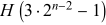 -crown
graph is the arrangement graph
-crown
graph is the arrangement graph  .
.
For  , the
, the  -crown graph is isomorphic
to the Haar graph
-crown graph is isomorphic
to the Haar graph  . Other special cases are summarized in the
following table.
. Other special cases are summarized in the
following table.


The  -crown graph
  has
has  vertices and
  edges.
The nonorientable graph genus is
 |
(3)
|
For  , a nonorientable quadrangular
graph embedding attains the lower bound obtained
from the Euler characteristic (Singh and
Sun 2023).
, a nonorientable quadrangular
graph embedding attains the lower bound obtained
from the Euler characteristic (Singh and
Sun 2023).
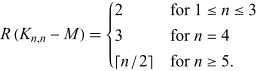
The numbers of directed Hamiltonian cycles for  , 4, 5, ... are given by 2, 12, 312,
9600, 416880, ... (OEIS A094047), which has
the beautiful closed form
, 4, 5, ... are given by 2, 12, 312,
9600, 416880, ... (OEIS A094047), which has
the beautiful closed form
 |
(4)
|
(M. Alekseyev, pers. comm., Feb. 10, 2008).
Closed formulas for the numbers  of
of  -graph cycles of the
  -crown graph are given by
  for
for  odd and
 |  |  |
(5)
|
 |  |  |
(6)
|
 |  |  |
(7)
|
(E. Weisstein, Nov. 16, 2014).
The independence polynomial of the  -crown graph is
 |
(8)
|
which satisfies the recurrence equation for 
 |
(9)
|
Colbrook and Drysdale (2026) proved that  maximizes the representation
number among all bipartite graphs on
maximizes the representation
number among all bipartite graphs on  vertices,
with
vertices,
with
![R(K_(n,n)-M)={2 for 1<=n<=3; 3 for n=4; [n/2] for n>=5.](/images/equations/CrownGraph/NumberedEquation7.svg) |
(10)
|
where ![[x]](/images/equations/CrownGraph/Inline48.svg) is the ceiling function. The finite cases in
the proof were certified by checked Boolean unsatisfiability
certificates, and the theorem was also formalized in
Lean.
is the ceiling function. The finite cases in
the proof were certified by checked Boolean unsatisfiability
certificates, and the theorem was also formalized in
Lean.
Colbrook and Drysdale (2026) report that discussions with ChatGPT 5.5, 5.6, and 6 contributed to the ordering method, obstruction classification, and odd-part argument. They also used Codex for combinatorial counting, certificate construction and verification, and Lean formalization, and state that they reviewed and adopted all content.
