


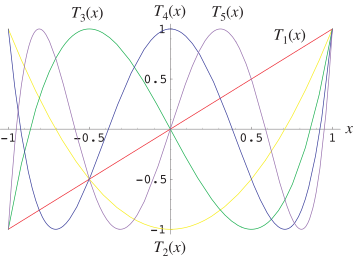
The Chebyshev polynomials of the first kind are a set of orthogonal polynomials defined as the solutions to the Chebyshev
differential equation and denoted  . They are used as an approximation to a least
squares fit, and are a special case of the Gegenbauer
polynomial with
. They are used as an approximation to a least
squares fit, and are a special case of the Gegenbauer
polynomial with  . They are also intimately connected with trigonometric
multiple-angle formulas. The Chebyshev
polynomials of the first kind are denoted
. They are also intimately connected with trigonometric
multiple-angle formulas. The Chebyshev
polynomials of the first kind are denoted  , and are implemented in the Wolfram
Language as ChebyshevT[n,
x]. They are normalized such that
, and are implemented in the Wolfram
Language as ChebyshevT[n,
x]. They are normalized such that  . The first few polynomials are illustrated above for
![x in [-1,1]](/images/equations/ChebyshevPolynomialoftheFirstKind/Inline5.svg) and
and  ,
2, ..., 5.
,
2, ..., 5.
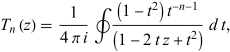
The Chebyshev polynomial of the first kind  can be defined by the contour
integral
can be defined by the contour
integral
 |
(1)
|
where the contour encloses the origin and is traversed in a counterclockwise direction (Arfken 1985, p. 416).
The first few Chebyshev polynomials of the first kind are
 |  |  |
(2)
|
 |  |  |
(3)
|
 |  |  |
(4)
|
 |  |  |
(5)
|
 |  |  |
(6)
|
 |  |  |
(7)
|
 |  |  |
(8)
|
When ordered from smallest to largest powers, the triangle of nonzero coefficients is 1; 1;  , 2;
, 2;  , 4; 1,
  , 8; 5,
  , 16, ... (OEIS A008310).
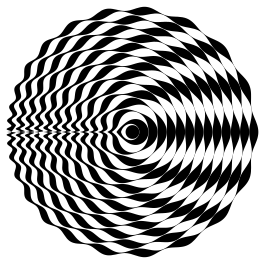
A beautiful plot can be obtained by plotting  radially, increasing the radius for each value of
  ,
and filling in the areas between the curves (Trott 1999, pp. 10 and 84).
,
and filling in the areas between the curves (Trott 1999, pp. 10 and 84).
The Chebyshev polynomials of the first kind are defined through the identity
 |
(9)
|
or
 |
(10)
|
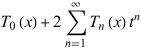
The Chebyshev polynomials of the first kind can be obtained from the generating functions
 |  |  |
(11)
|
 |  |  |
(12)
|
and
 |  |  |
(13)
|
 |  |  |
(14)
|
for  and
and  (Beeler et al. 1972, Item 15). (A closely related generating
function is the basis for the definition of Chebyshev
polynomial of the second kind.)
(Beeler et al. 1972, Item 15). (A closely related generating
function is the basis for the definition of Chebyshev
polynomial of the second kind.)
A direct representation in terms of powers of square roots is given by
![T_n(z)=1/2[(x+sqrt(x^2-1))^(-n)+(x+sqrt(x^2-1))^n].](/images/equations/ChebyshevPolynomialoftheFirstKind/NumberedEquation4.svg) |
(15)
|
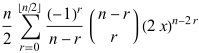
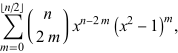
The polynomials can also be defined in terms of the sums
 |  |  |
(16)
|
 |  |  |
(17)
|
where  is a binomial coefficient
and
is a binomial coefficient
and  is the floor function, or the product
![T_n(x)=2^(n-1)product_(k=1)^n{x-cos[((2k-1)pi)/(2n)]}](/images/equations/ChebyshevPolynomialoftheFirstKind/NumberedEquation5.svg) |
(18)
|
(Zwillinger 1995, p. 696).
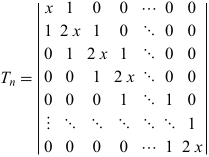
 also satisfy the curious determinant equation
 |
(19)
|
(Nash 1986).
The Chebyshev polynomials of the first kind are a special case of the Jacobi polynomials  with
with 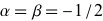 ,
,
 |  |  |
(20)
|
 |  |  |
(21)
|
where  is a hypergeometric
function (Koekoek and Swarttouw 1998).
is a hypergeometric
function (Koekoek and Swarttouw 1998).
Zeros occur when
![x=cos[(pi(k-1/2))/n]](/images/equations/ChebyshevPolynomialoftheFirstKind/NumberedEquation7.svg) |
(22)
|
for  ,
2, ...,
,
2, ...,  . Extrema occur for
 |
(23)
|
where 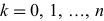 . At maximum,
  , and at minimum,
  .
.
The Chebyshev polynomials are orthogonal polynomials with respect to the weighting function 
 |
(24)
|
where  is the Kronecker delta.
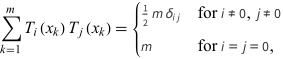
Chebyshev polynomials of the first kind satisfy the additional discrete identity
is the Kronecker delta.
Chebyshev polynomials of the first kind satisfy the additional discrete identity
 |
(25)
|
where  for
for  , ...,
  are the
  zeros of
  .
.
They also satisfy the recurrence relations
 |  |  |
(26)
|
 |  | ![xT_n(x)-sqrt((1-x^2){1-[T_n(x)]^2})](/images/equations/ChebyshevPolynomialoftheFirstKind/Inline84.svg) |
(27)
|
for  ,
as well as
,
as well as
![(x-1)[T_(2n+1)(x)-1]](/images/equations/ChebyshevPolynomialoftheFirstKind/Inline86.svg) |  | ![[T_(n+1)(x)-T_n(x)]^2](/images/equations/ChebyshevPolynomialoftheFirstKind/Inline88.svg) |
(28)
|
![2(x^2-1)[T_(2n)(x)-1]](/images/equations/ChebyshevPolynomialoftheFirstKind/Inline89.svg) |  | ![[T_(n+1)(x)-T_(n-1)(x)]^2](/images/equations/ChebyshevPolynomialoftheFirstKind/Inline91.svg) |
(29)
|
(Watkins and Zeitlin 1993; Rivlin 1990, p. 5).
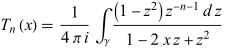
They have a complex integral representation
 |
(30)
|
and a Rodrigues representation
![T_n(x)=((-1)^nsqrt(pi)(1-x^2)^(1/2))/(2^n(n-1/2)!)(d^n)/(dx^n)[(1-x^2)^(n-1/2)].](/images/equations/ChebyshevPolynomialoftheFirstKind/NumberedEquation12.svg) |
(31)
|
Using a fast Fibonacci transform with multiplication law
 |
(32)
|
gives
 |
(33)
|
Using Gram-Schmidt orthonormalization in the range ( ,1) with weighting function
  gives
gives
 |  |  |
(34)
|
 |  | ![[x-(int_(-1)^1x(1-x^2)^(-1/2)dx)/(int_(-1)^1(1-x^2)^(-1/2)dx)]](/images/equations/ChebyshevPolynomialoftheFirstKind/Inline99.svg) |
(35)
|
 |  | ![x-([-(1-x^2)^(1/2)]_(-1)^1)/([sin^(-1)x]_(-1)^1)](/images/equations/ChebyshevPolynomialoftheFirstKind/Inline102.svg) |
(36)
|
 |  |  |
(37)
|
 |  | ![[x-(int_(-1)^1x^3(1-x^2)^(-1/2)dx)/(int_(-1)^1x^2(1-x^2)^(-1/2)dx)]x-[(int_(-1)^1x^2(1-x^2)^(-1/2)dx)/(int_(-1)^1(1-x^2)^(-1/2)dx)]·1](/images/equations/ChebyshevPolynomialoftheFirstKind/Inline108.svg) |
(38)
|
 |  | ![[x-0]x-(pi/2)/pi](/images/equations/ChebyshevPolynomialoftheFirstKind/Inline111.svg) |
(39)
|
 |  |  |
(40)
|
etc. Normalizing such that  gives the Chebyshev polynomials of the first kind.
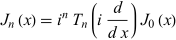
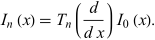
The Chebyshev polynomial of the first kind is related to the Bessel function of the first kind  and modified
Bessel function of the first kind
and modified
Bessel function of the first kind  by the relations
 |
(41)
|
 |
(42)
|
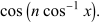
Letting  allows the Chebyshev polynomials of the first kind
to be written as
allows the Chebyshev polynomials of the first kind
to be written as
 |  |  |
(43)
|
 |  |  |
(44)
|
The second linearly dependent solution to the transformed differential equation
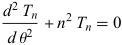 |
(45)
|
is then given by
 |  |  |
(46)
|
 |  |  |
(47)
|
which can also be written
 |
(48)
|
where  is a Chebyshev
polynomial of the second kind. Note that
is a Chebyshev
polynomial of the second kind. Note that  is therefore not a polynomial.
The triangle of resultants  is given by
  ,
,  ,
,  ,
,  ,
,  , ... (OEIS A054375).
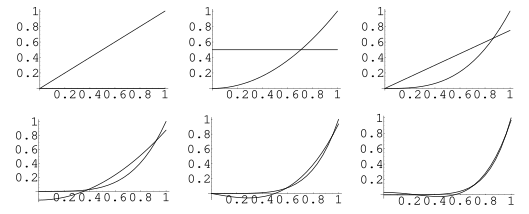
The polynomials
 |
(49)
|
of degree  , the first few of which are
 |  |  |
(50)
|
 |  |  |
(51)
|
 |  |  |
(52)
|
 |  |  |
(53)
|
 |  |  |
(54)
|
are the polynomials of degree  which stay closest to
  in the interval
  . The maximum deviation is
  at the
  points where
 |
(55)
|
for  , 1, ...,
  (Beeler et al. 1972).

 -Analogue.
Delft, Netherlands: Technische Universiteit Delft, Faculty of Technical Mathematics
and Informatics Report 98-17, pp. 41-43, 1998.Koepf, W. "Efficient
Computation of Chebyshev Polynomials." In
-Analogue.
Delft, Netherlands: Technische Universiteit Delft, Faculty of Technical Mathematics
and Informatics Report 98-17, pp. 41-43, 1998.Koepf, W. "Efficient
Computation of Chebyshev Polynomials." In  and
and  ." Ch. 22 in
  ." Amer. Math. Monthly 100, 471-474,
1993.Zwillinger, D. (Ed.).
." Amer. Math. Monthly 100, 471-474,
1993.Zwillinger, D. (Ed.).