


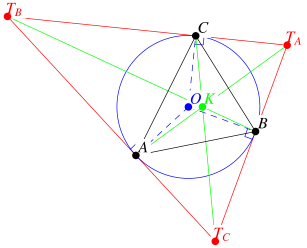
The tangential triangle is the triangle  formed by the tangent
lines to the circumcircle of a given triangle
 at its vertices.
It is therefore the antipedal triangle of
 with respect to the circumcenter
 . It is also the anticevian
triangle of
 with the symmedian point
 as the anticevian point (Kimberling 1998, p. 156). Furthermore,
the symmedian point
 of
 is the Gergonne point
of
 when
 is an acute triangle.
The tangential triangle is the polar triangle of the circumcircle.
Its trilinear vertex matrix is
 |
(1)
|
The side lengths of the tangential triangle are
 |  |  |
(2)
|
 |  |  |
(3)
|
 |  |  |
(4)
|
For an acute triangle, the perimeter is given by
 |
(5)
|
and the product of side lengths is
 |
(6)
|
The triangle area of the tangential triangle is
 |
(7)
|
where  is the triangle area of
 .
The following table gives the centers of the tangential triangle in terms of the centers
of the reference triangle that correspond to
Kimberling centers  . An asterisk marks a correspondence stated for an
acute triangle as the reference
triangle. All correspondences are understood wherever the indicated triangles
and centers are defined. Additional correspondences
were communicated by D. Reznik (pers. comm., Feb. 4, 2021).


 -Ceva conjugate of


 -of-tangential-triangle


 -of-tangential-triangle


 in


 -of-tangential-triangle


 ,
 )


 with respect to the tangential triangle


 ,
 )


 with respect to the tangential triangle


 in the


 -of-tangential-triangle


 -


 ,
 )


 and the


 in its


 -of-tangential-triangle


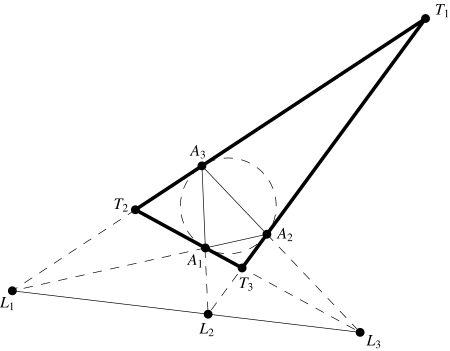
Given a triangle  and its tangential triangle
 , the extensions of the sides
of the two triangles intersect
in three points
 ,
 , and
 , which are collinear
(Honsberger 1995).
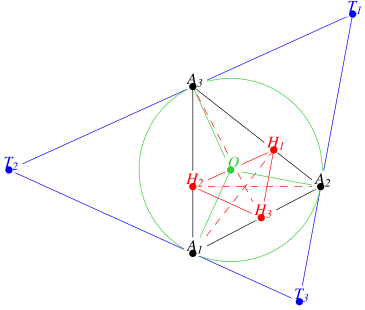
The sides of an orthic triangle are parallel to the tangents to the circumcircle at the vertices (Johnson 1929, p. 172). This is equivalent to the statement that each line from a triangle's circumcenter to a vertex is always perpendicular to the corresponding side of the orthic triangle (Honsberger 1995, p. 22), and to the fact that the orthic and tangential triangles are homothetic.
