


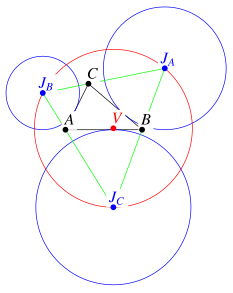
The Bevan point  of a triangle
 is the circumcenter of the excentral
triangle
 . It is named in honor of Benjamin Bevan,
a relatively unknown Englishman proposed the problem of proving that the circumcenter
 was the midpoint
of the incenter
 and the circumcenter of the
excentral triangle and that the circumradius of the excentral triangle was
 (Bevan 1806), a problem solved by John Butterworth (1806).
|
|
|
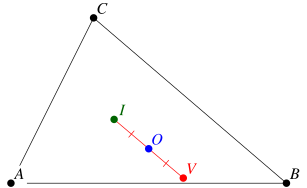
 is the reflection
of the incenter
 in the circumcenter
 (left figure), with
 |
(1)
|
where  is the circumradius and
 ,
 , and
 are the side lengths
of
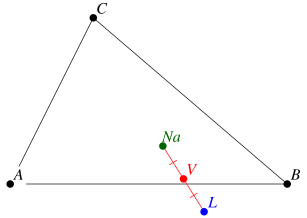
 . It is also the midpoint
of the line segment joining the Nagel
point
 and de Longchamps point
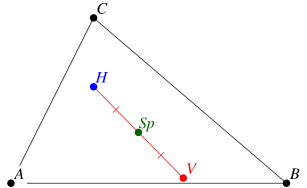
 (middle figure), and the reflection
of the orthocenter
 in the Spieker center
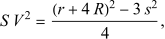
 (right figure). The corresponding squared
distances are
 |  |  |
(2)
|
 |  |  |
(3)
|
where  is the inradius and
 is the semiperimeter (Queiroz
Filho 2022).
The Bevan point is Kimberling center  and has triangle
center function
 |
(4)
|
It is the center of the Bevan circle and lies on the Darboux cubic.
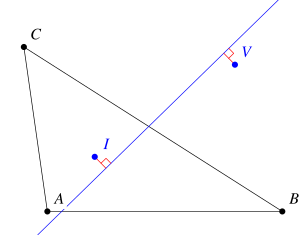
For  , the Bevan point and incenter
 are equidistant from the Euler
line (P. Moses, pers. comm., Jan. 15, 2005). Their common distance
is
 |
(5)
|
where  is the distance between the circumcenter
and orthocenter, and
 is the area of the reference
triangle.
