

The quasi-Riemann hypothesis asserts that the Riemann zeta function has a fixed zero-free region
of the form  for some real number
 . It is a weakening of the Riemann
hypothesis, which asserts that all Riemann
zeta function zeros in the critical strip have
real part
 and would therefore give
 (Davenport 1980, Billington et al. 2025).
A single constant  must work at every height
 , unlike classical zero-free
regions whose boundaries approach
 .
The pole at
 is not a zero and is excluded when stating nonvanishing.
OpenAI (2026) announced nonvanishing in the half-plane
 |
The claim covers the Riemann zeta function and all Dirichlet L-series, with the
principal-character pole at  excluded. It does not cover the boundary line
 or prove the Riemann
hypothesis or the generalized Riemann
hypothesis. The release attributes the argument and Lean formalization to an
internal OpenAI model, an example of automated proof generation
in AI-assisted mathematics. As of Oct. 25,
2026, independent specialist verification of the complete proof had not been reported.

In the plot above, the shaded area shows the announced zero-free region. The dashed critical line  passes through the plotted Riemann
zeta function zeros.
Terence Tao described the announced result as the biggest advance on the subject in 50 years. He characterized the argument as an unusual combination of existing
ideas that he thought no single living mathematician would have conceived, while
allowing that the right group of mathematicians might have found it after much trial
and error. He also noted that the method could not move the zero-free boundary to
the left of  without another extremely clever idea (Numberphile 2026, 16:04-16:59).
The manuscript illustrates the combination Tao describes by drawing on analytic number theory, harmonic analysis, and complex analysis. It compares two expressions for
a weighted sum built from the Fourier coefficients
of Kubota's cubic theta function. The
transformation of the function at its cusps
and estimates from the large sieve, including a quadratic
character estimate, bound the sum. A
second expression, obtained by Poisson summation,
isolates a Mellin transform involving the reciprocal of the target Hecke
L-function. If the supremum of the real
parts of the putative zeros exceeded the proposed bound,
the estimates would give an analytic continuation
of the reciprocal to a region extending a uniform
distance to the left of that supremum, contradicting
its definition. The manuscript first applies this argument at  . It then modifies the sum at selected primes
and uses bounds on moments of the resulting sums to reach
 (OpenAI 2026).
A stronger uniform version asks for the same  for all Dirichlet
L-series, independently of the number
theoretic character, its modulus, and the height. The generalized
Riemann hypothesis would give
 in this version as well.
The uniform version also has consequences for the size of primitive roots. Martin (1997) used sieve methods to bound the
least prime number that is a primitive
root modulo a prime number  , assuming suitable zero-free
regions for Dirichlet L-series.
Since the least primitive root
 is no larger than the least prime primitive
root, applying his bound conditionally to the announced uniform half-plane
 gives
 . The Vinogradov
notation
 means that
 for some constant
 independent of
 .
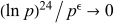
Since
 as
 for every
 , this implies
 , with the implied constant
allowed to depend on
 .
This is the bound asserted by Vinogradov's
least primitive root conjecture.

 ." Sep. 30, 2026.