

An automorphic form cusp in the classical theory of modular forms for a congruence subgroup  of
 is a group orbit of
 on the projective
line
 . Adjoining a point for each such
group orbit to the quotient of the upper
half-plane by
 gives the compact modular curve. For the full modular group Gamma, all elements of
 are equivalent to
 , so there is only one cusp
(Diamond and Shurman 2005).
The expansion at a cusp is obtained by moving a representative to  and expanding the transformed form in a local Fourier
series. A cusp form has zero constant coefficient
in this expansion at every cusp (Diamond and Shurman 2005).
In the corresponding three-dimensional setting, let  be an imaginary quadratic
field with ring of integers
 . For a finite-index subgroup
 of
 acting on three-dimensional hyperbolic
space, the cusps of the quotient are the group orbits
of
 on the projective line
 (Elstrodt et al. 1998). This is the setting for
the cusp expansions of Kubota's cubic theta
function over
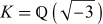 (Dunn and Radziwiłł 2024).
