

A number theoretic character, also called a Dirichlet character (because Dirichlet first introduced them in his famous proof that every arithmetic progression with
relatively prime initial term and common difference contains infinitely many primes),
modulo  is a complex function
 for positive integer
 such that
 |  |  |
(1)
|
 |  |  |
(2)
|
 |  |  |
(3)
|
for all  , and
 |
(4)
|
if  .
 can only assume values which are
 roots of unity, where
 is the totient function.
Number theoretic characters are implemented in the Wolfram Language as DirichletCharacter[k,
j, n], where  is the modulus and
 is the index.
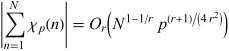
Burgess (1963) obtained bounds for short sums of nonprincipal number theoretic characters. Kerr et al. (2026) removed the logarithmic factor in the bound for sums starting
at 1 with prime modulus. For each fixed integer  and sufficiently large primes
 , a nonprincipal character
 modulo
 satisfies
 |
(5)
|
for  , where the constant
in the big-O notation may depend on
 . Their explicit upper bound
for
 is
 for
 and all primes
 .

 -Series. II." Proc. London Math. Soc. 13,
524-536, 1963.