


A voltage graph is a graph together with an assignment of elements of a group  , called the voltage
group, to the oriented edges of the graph. More
precisely, if each edge of a graph
, called the voltage
group, to the oriented edges of the graph. More
precisely, if each edge of a graph  is replaced by two oppositely oriented darts
  and
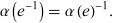
and  , a voltage assignment is a function
  from the darts to
  such that
 |
(1)
|
A voltage assignment may be specified by choosing one orientation of each edge and assigning that dart a voltage. The inverse rule then
determines the voltage on the oppositely oriented dart.
When a small base graph is used explicitly, a chosen
dart from vertex  to vertex
  with voltage
  is often recorded as a voltage triple
  .
.
The voltage assignment determines a derived graph  whose vertex
set is
whose vertex
set is  .
For an oriented edge
.
For an oriented edge  of
of  with voltage
  and for each
  , the derived graph
has an edge
, the derived graph
has an edge
 |
(2)
|
Thus the product of voltages along a walk in the base graph records how the lifted walk moves among the sheets of the
cover. The natural projection that sends  to
to  gives a covering graph projection.
The voltage group acts on
gives a covering graph projection.
The voltage group acts on  by left multiplication on the second coordinate, giving
a semiregular group action whose orbits
are the fibers of the projection,
that is, the sets of vertices mapping to single vertices of
by left multiplication on the second coordinate, giving
a semiregular group action whose orbits
are the fibers of the projection,
that is, the sets of vertices mapping to single vertices of  .
.
In this context, a graph cover of  means a graph
  together with a graph projection
  such that, at each vertex
 of
of  , the edges incident to
  are mapped bijectively onto
the edges incident to
are mapped bijectively onto
the edges incident to  .
Thus, locally around each lifted vertex, the cover
looks exactly like the base graph.
.
Thus, locally around each lifted vertex, the cover
looks exactly like the base graph.
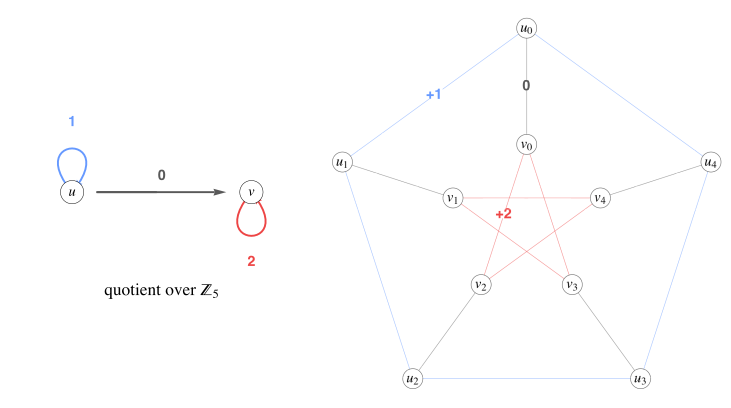
For example, the Petersen graph is the derived graph of a voltage graph whose voltage group
is the cyclic group  , which arises from the inherent symmetry of the graph. To
recover a voltage presentation from a given graph, examine the structure of its automorphism group to identify subgroups
whose action on the vertices is a semiregular
group action. When the desired presentation has a cyclic
group as its voltage group, the relevant subgroups
are cyclic. In the conventional Petersen
graph embedding, rotation
by
, which arises from the inherent symmetry of the graph. To
recover a voltage presentation from a given graph, examine the structure of its automorphism group to identify subgroups
whose action on the vertices is a semiregular
group action. When the desired presentation has a cyclic
group as its voltage group, the relevant subgroups
are cyclic. In the conventional Petersen
graph embedding, rotation
by  generates such a subgroup,
which is isomorphic to
generates such a subgroup,
which is isomorphic to  .
Since no nonidentity rotation fixes a vertex, this subgroup acts semiregularly
on the vertices and is used as the voltage group.
The group orbits of the
.
Since no nonidentity rotation fixes a vertex, this subgroup acts semiregularly
on the vertices and is used as the voltage group.
The group orbits of the  subgroup are the five outer-cycle
vertices and the five inner-star vertices. The corresponding base
graph has one vertex for each group orbit, denoted
subgroup are the five outer-cycle
vertices and the five inner-star vertices. The corresponding base
graph has one vertex for each group orbit, denoted
 and
and  , respectively.
The voltage in each triple records how far the lifted edge shifts the second coordinate in  . In this embedding, an outer edge
has shift 1, a spoke has shift 0, and an inner-star edge has shift 2. With these
choices, one convenient set of voltage triples is
. In this embedding, an outer edge
has shift 1, a spoke has shift 0, and an inner-star edge has shift 2. With these
choices, one convenient set of voltage triples is
 |
(3)
|
Using the base-graph vertex labels 1 and 2 for  and
and  , respectively, gives the numeric voltage triples
 |
(4)
|
where the third entry in each triple is interpreted as a residue modulo 5. Writing subscripts modulo 5, the derived graph
has vertices  and
and  and edges
 |
(5)
|
These three edge types are the outer 5-cycle, the five spokes, and the inner pentagram in this embedding.
It is useful to distinguish the existence of a voltage presentation from the appearance of a particular graph embedding. A circulant
graph drawn with vertices 0, 1, ...,  around a circle so that rotation
by one step preserves adjacency gives a voltage presentation with a cyclic voltage group and a base
graph having a single vertex. In contrast, an LCF
notation embedding is voltage only when the repeated LCF pattern is realized
by a genuine cyclic graph
automorphism; the existence of a Hamiltonian
cycle displayed on a circle does not by itself imply
a semiregular group action. Conversely,
a voltage embedding need not be an LCF or circular embedding. The term voltage in
this sense records a cyclic graph
automorphism and quotient voltage data, not necessarily the radial-looking geometry
of a particular drawing.
around a circle so that rotation
by one step preserves adjacency gives a voltage presentation with a cyclic voltage group and a base
graph having a single vertex. In contrast, an LCF
notation embedding is voltage only when the repeated LCF pattern is realized
by a genuine cyclic graph
automorphism; the existence of a Hamiltonian
cycle displayed on a circle does not by itself imply
a semiregular group action. Conversely,
a voltage embedding need not be an LCF or circular embedding. The term voltage in
this sense records a cyclic graph
automorphism and quotient voltage data, not necessarily the radial-looking geometry
of a particular drawing.
For example, the Paley graph of order 13 is a circulant graph on the cyclic group  , so a semiregular
action by a cyclic group has a single group
orbit and the corresponding radial voltage drawing naturally places the vertices
on one circle. The Paley graph
of order 25 is built from the finite field
, so a semiregular
action by a cyclic group has a single group
orbit and the corresponding radial voltage drawing naturally places the vertices
on one circle. The Paley graph
of order 25 is built from the finite field  , whose additive group is isomorphic to
  rather than
  . Cyclic actions
of order 5 therefore have five vertex orbits, and the corresponding voltage drawing
organizes fibers over multiple base
graph vertices. Thus identifying an embedding as voltage points to an underlying
semiregular group action and quotient
presentation, while LCF and circulant descriptions record Hamiltonian-cycle notation
and cyclic adjacency structure, respectively.
. Cyclic actions
of order 5 therefore have five vertex orbits, and the corresponding voltage drawing
organizes fibers over multiple base
graph vertices. Thus identifying an embedding as voltage points to an underlying
semiregular group action and quotient
presentation, while LCF and circulant descriptions record Hamiltonian-cycle notation
and cyclic adjacency structure, respectively.
Ordinary voltage assignments provide a compact way to describe regular graph covers. More generally, permutation voltage assignments generate arbitrary graph covers (Gross and Tucker 1977). Voltage graphs are especially useful in topological graph theory, where they encode graph covers and derived embeddings on surfaces (Gross 1974, Gross and Tucker 1987).
An SPQR tree provides a complementary compact description for a biconnected graph that is also planar, encoding its possible planar embeddings through its triconnected decomposition (Di Battista and Tamassia 1996). In contrast, a voltage graph uses group-valued edge data to describe graph covers and derived embeddings.
