


A rotation system is a combinatorial way to encode a graph embedding on a surface. Instead of drawing an explicit embedding of a graph, the cyclic order of the graph edges around each graph vertex is instead recorded. The collection of these cyclic orders for all vertices (i.e., "rotations" at each vertex) then gives a rotation system. This cyclic order determines how edges are arranged locally and therefore determines the embedding up to homeomorphism.
A rotation system allows the graph faces of an embedding to be computed without any explicit drawing. However, rotation systems are not unique; different cyclic orders can produce different embeddings of the same graph.
To construct a rotation system, replace each edge by two oppositely directed darts and at each vertex specify a list of darts based on which dart comes next when turning around the vertex in a counterclockwise direction.
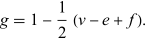
A rotation system completely determines the vertices, edges, and faces of a cellular embedding, and therefore also
determines the genus of the surface using the Euler
characteristic. For a connected graph with
 vertices,
  edges, and
  faces in an orientable cellular
embedding, the genus is
faces in an orientable cellular
embedding, the genus is
 |
This makes rotation systems useful for counting planar embeddings, which are precisely the rotation systems of graph genus 0, up to the chosen equivalence of embeddings. Similarly, the graph genus of a graph can be found by minimizing the genus over all rotation systems of the graph. This combinatorial viewpoint is often known as the Heffter-Edmonds-Ringel rotation principle (Gross and Tucker 1987, Mohar and Thomassen 2001).
For a biconnected graph that is also planar, an SPQR tree compactly represents all planar rotation systems through the reflection choices of its R-node skeletons, which have vertex connectivity at least 3, and the cyclic orders of the parallel edges in its P-node skeletons, which are dipole graphs (Di Battista and Tamassia 1996).
Covering embeddings can also be described compactly using voltage graphs.
