


A biconnected graph is a connected graph on at least three vertices having no articulation
vertices (Skiena 1990, p. 175). Equivalently, it is a graph  having vertex
connectivity
 .
The minimum-order convention excludes the one-vertex graph
and the two-vertex path, even though neither has an
articulation vertex.
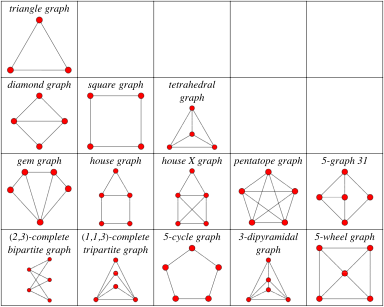
The numbers of biconnected simple graphs on  , 2, ... nodes
are 0, 0, 1, 3, 10, 56, 468, ... (cf. OEIS A002218).
The first few of these are illustrated above.
A block of a graph is a maximal connected subgraph having no articulation vertex (Harary 1994, p. 26; West 2000, p. 155). Blocks include isolated vertices, bridges, and maximal biconnected subgraphs. A connected graph consisting of a single block is also called a nonseparable graph. Such a graph is biconnected when it has at least three vertices.
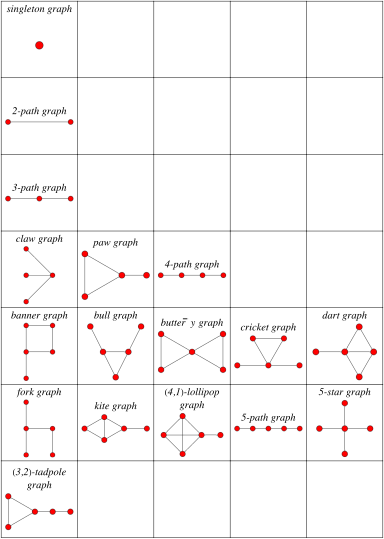
A number of graphs that are connected but not biconnected are illustrated above. For graphs on
at least two vertices, these are precisely the 1-connected
graphs. Including the one-vertex graph,
the numbers of connected but non-biconnected graphs for  , 2, ... are 1, 1, 1, 3, 11, 56, 385, ... (OEIS A052442).
A graph can be tested for biconnectivity in the Wolfram Language using KVertexConnectedGraphQ[g,
2] or VertexConnectivity[g]
 . A collection of biconnected graphs
is available using GraphData["Biconnected"].
Any graph containing a node of degree 1 cannot be biconnected. All Hamiltonian graphs on at least three vertices are biconnected (Skiena 1990, p. 177), but the converse is not necessarily so. Deleting any vertex of a Hamiltonian cycle leaves a path spanning the remaining vertices, so no articulation vertex is possible. A non-biconnected graph on at least two vertices is therefore nonhamiltonian. The singleton graph is Hamiltonian by convention. The following table summarizes some named graphs that are biconnected but non-Hamiltonian.
graph  |  |
| theta-0 graph | 7 |
| Petersen graph | 10 |
| Herschel graph | 11 |
| first Blanuša snark | 18 |
| second Blanuša snark | 18 |
flower
snark  | 20 |
| Coxeter graph | 28 |
| double star snark | 30 |
| Thomassen graph | 34 |
| Tutte graph | 46 |
| Szekeres snark | 50 |
| Meredith graph | 70 |
