


A finite field is a field with a finite field order (i.e., number of elements), also called a Galois field. The order of a
finite field is always a prime or a power
of a prime (Birkhoff and Mac Lane 1996). For each
prime power, there exists exactly
one (with the usual caveat that "exactly one" means "exactly one
up to an isomorphism") finite field GF( ), often written as
  in current usage.
GF( ) is called the prime
field of order
) is called the prime
field of order  ,
and is the field of residue
classes modulo
,
and is the field of residue
classes modulo  ,
where the
,
where the  elements are denoted 0, 1, ...,
  .
.  in GF(
 )
means the same as
)
means the same as  .
Note, however, that
.
Note, however, that  in the ring of residues modulo 4, so 2 has no reciprocal,
and the ring of residues modulo 4 is distinct from the finite
field with four elements. Finite fields are therefore denoted GF(
in the ring of residues modulo 4, so 2 has no reciprocal,
and the ring of residues modulo 4 is distinct from the finite
field with four elements. Finite fields are therefore denoted GF( ), instead of GF(
 ), where
  , for clarity.
The finite field GF(2) consists of elements 0 and 1 which satisfy the following addition and multiplication tables.
 | 0 | 1 |
| 0 | 0 | 1 |
| 1 | 1 | 0 |
 | 0 | 1 |
| 0 | 0 | 0 |
| 1 | 0 | 1 |
If a subset  of the elements of a finite field
  satisfies the axioms above with the same operators of
  , then
  is called a subfield. Finite
fields are used extensively in the study of error-correcting
codes.
is called a subfield. Finite
fields are used extensively in the study of error-correcting
codes.
When  ,
GF(
,
GF( ) can be represented
as the field of equivalence
classes of polynomials whose coefficients
belong to GF(
) can be represented
as the field of equivalence
classes of polynomials whose coefficients
belong to GF( ).
Any irreducible polynomial of degree
).
Any irreducible polynomial of degree  yields the same field
up to an isomorphism. For example, for GF(
yields the same field
up to an isomorphism. For example, for GF( ), the modulus can be taken as
  or
or  . Using the modulus
  , the elements of GF(
 )--written 0,
  ,
,  ,
...--can be represented as polynomials
with degree less than 3. For instance,
,
...--can be represented as polynomials
with degree less than 3. For instance,
 |  |  |
(1)
|
 |  |  |
(2)
|
 |  |  |
(3)
|
 |  |  |
(4)
|
 |  |  |
(5)
|
Now consider the following table which contains several different representations of the elements of a finite field. The columns are the power, polynomial representation, triples of polynomial representation coefficients (the vector representation), and the binary integer corresponding to the vector representation (the regular representation).
| power | polynomial | vector | regular |
| 0 | 0 | (000) | 0 |
 | 1 | (001) | 1 |
 |  | (010) | 2 |
 |  | (100) | 4 |
 |  | (011) | 3 |
 |  | (110) | 6 |
 |  | (111) | 7 |
 |  | (101) | 5 |
The set of polynomials in the second column is closed under addition and multiplication modulo  , and these operations on the set satisfy the axioms
of finite field. This particular finite field is said to be an extension field of
degree 3 of GF(2), written GF(
, and these operations on the set satisfy the axioms
of finite field. This particular finite field is said to be an extension field of
degree 3 of GF(2), written GF( ), and the field GF(2) is called the base field of GF(
 ). For any irreducible
polynomial used as a modulus, the class of
). For any irreducible
polynomial used as a modulus, the class of  generates the extension field
as an algebra over the base field, but need not generate
its multiplicative group. The monic
polynomial is a primitive polynomial
when the powers of that class run through all nonzero elements. For example,
generates the extension field
as an algebra over the base field, but need not generate
its multiplicative group. The monic
polynomial is a primitive polynomial
when the powers of that class run through all nonzero elements. For example,  is an irreducible
polynomial over GF(3), but its class of
is an irreducible
polynomial over GF(3), but its class of  has multiplicative order
4 rather than 8 in GF(9), so the polynomial is not
primitive (Conrad n.d., p. 2). For any prime power
has multiplicative order
4 rather than 8 in GF(9), so the polynomial is not
primitive (Conrad n.d., p. 2). For any prime power  and any positive
integer
and any positive
integer  ,
there exists a primitive polynomial of polynomial degree
,
there exists a primitive polynomial of polynomial degree  over GF(
 ).
).
For any element  of GF(
 ),
),
 , and for any nonzero
element
, and for any nonzero
element  of GF(
 ),
),
 . There is a smallest positive
integer
. There is a smallest positive
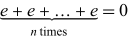
integer  satisfying the sum condition
  in GF(
 ). This number is called the field
characteristic of the finite field GF(
). This number is called the field
characteristic of the finite field GF( ). The field characteristic
is a prime number for every finite field, and it
is true that
). The field characteristic
is a prime number for every finite field, and it
is true that
 |
(6)
|
over a finite field with characteristic  .
.
