


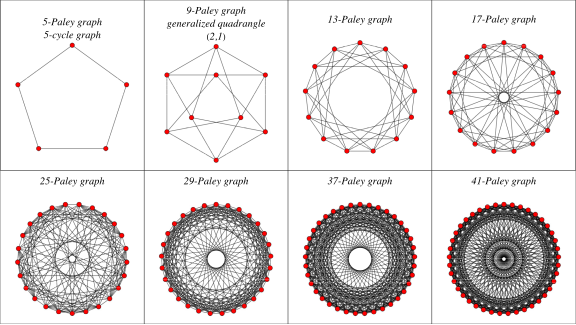
The Paley graph of order  with
with  a prime power
satisfying
a prime power
satisfying  is a graph on
  nodes with two distinct nodes adjacent iff their difference is a square in the finite
field GF(
nodes with two distinct nodes adjacent iff their difference is a square in the finite
field GF( ).
This graph is undirected when
).
This graph is undirected when  . Simple Paley graphs therefore exist for orders
5, 9, 13, 17, 25, 29, 37, 41, 49, 53, 61, 73, 81, 89, 97, 101, 109, 113, 121, 125,
137, 149, 157, 169, ... (OEIS A085759).
. Simple Paley graphs therefore exist for orders
5, 9, 13, 17, 25, 29, 37, 41, 49, 53, 61, 73, 81, 89, 97, 101, 109, 113, 121, 125,
137, 149, 157, 169, ... (OEIS A085759).
Paley graphs are commonly denoted  or
or  (Brouwer et al. 1989, p. 10), where "QR"
stands for quadratic residue.
(Brouwer et al. 1989, p. 10), where "QR"
stands for quadratic residue.
The order of the graph automorphism group of the Paley graph of order  is given by
 |
(Peisert 2001).
Paley graphs are implemented in the Wolfram Language as GraphData["Paley",
q] for small orders  .
.
Cyclotomic graphs are cubic analogs of the Paley graphs.
The Paley graph  is a strongly regular graph with parameters
 (Godsil and
Royle 2001, p. 221). For
(Godsil and
Royle 2001, p. 221). For  a prime, Paley graphs are also circulant
graphs
a prime, Paley graphs are also circulant
graphs  with parameters
  given by the squares (mod
  ).
).
Paley graphs are self-complementary, strongly regular, conference graphs, and Hamiltonian. All Paley graphs are conference graphs (Godsil and Royle 2001, p. 222). Paley graphs are their own graph distance-2 graphs.
Special cases include the cycle graph  (5-Paley),
  -generalized quadrangle
(9-Paley), and
-generalized quadrangle
(9-Paley), and  -Paulus graph (25-Paley).
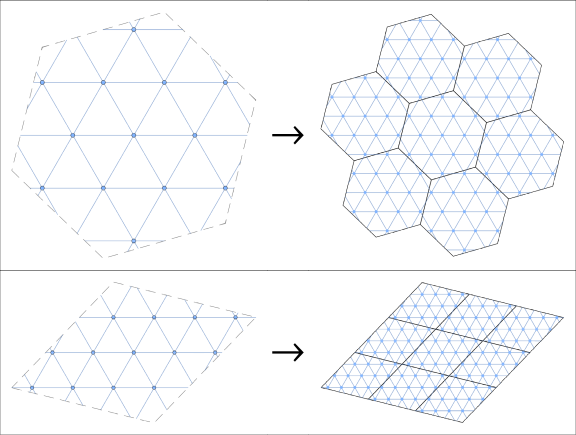
The 13-Paley graph is toroidal, as illustrated above. The first graph embedding patch appears in Jones (2020, p. 157).
The 17-Paley graph is the unique largest graph  such that neither
  nor its graph complement
contains
nor its graph complement
contains  as a subgraph (Evans et al. 1981). It follows
from this graph that Ramsey
number
as a subgraph (Evans et al. 1981). It follows
from this graph that Ramsey
number  .
.
Broere et al. (1988) showed that the clique number and chromatic number for  with
with  an even power of a prime are both
  . J. B. Shearer maintains a table of the independence numbers of Paley graphs for graphs
of size less than 7000, and Brouwer maintains a table of independence
numbers and chromatic numbers for Paley graphs
up to
. J. B. Shearer maintains a table of the independence numbers of Paley graphs for graphs
of size less than 7000, and Brouwer maintains a table of independence
numbers and chromatic numbers for Paley graphs
up to  .
.

 ) with Square Differences." Indag. Math. 46,
369-372, 1984.Bondy, J. A. and Murty, U. S. R.
) with Square Differences." Indag. Math. 46,
369-372, 1984.Bondy, J. A. and Murty, U. S. R.