

A dart in graph theory is one of the two possible orientations of an graph edge. Equivalently, a dart can be viewed as an ordered incident vertex-edge pair.
For an edge  joining vertices
  and
and  ,
the corresponding darts may be denoted
,
the corresponding darts may be denoted  and
and  .
.
Darts are used in combinatorial descriptions of graph embeddings. For example, a rotation system specifies the cyclic order of the darts emanating from each graph vertex, and a voltage graph assigns a group element to each dart, with opposite darts assigned inverse group elements (Gross and Tucker 1987).
The graph-theoretic term dart should not be confused with the dart graph.
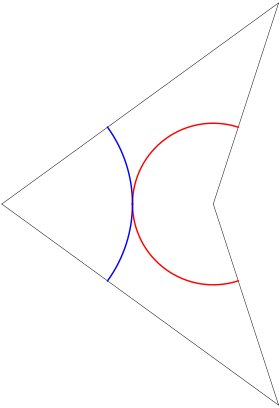
The word dart is also the name given to the Penrose tile illustrated above, with the other tile in the kite-dart pair known as the kite.
