

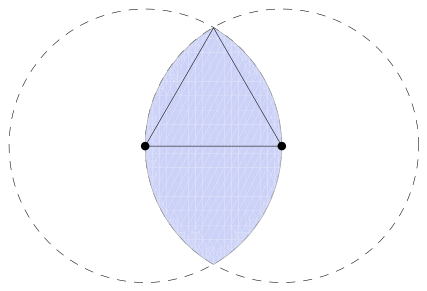
The term "vesica piscis," meaning "fish bladder" in Latin, is used for the particular symmetric lens formed by the intersection
of two equal circles whose centers are offset by a distance
equal to the circle radii (Pedoe 1995, p. xii). The height of the lens is given
by letting 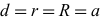 in the equation for a circle-circle intersection
 |
(1)
|
giving
 |
(2)
|
The vesica piscis therefore has two equilateral triangles inscribed in it as illustrated above.
The area of the vesica piscis is given by plugging  into the circle-circle
intersection area equation with
into the circle-circle
intersection area equation with  ,
,
 |
(3)
|
giving
 |  | 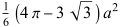 |
(4)
|
 |  |  |
(5)
|
(OEIS A093731). Since each arc of the lens is precisely 1/3 of a circle, perimeter is given by
 |
(6)
|
The same geometric figure occurs in Old Babylonian mathematics as the ox-eye (Friberg 2007, pp. 319 and 323-326). The related Old Babylonian grain
figure is also a symmetric equal-circle lens, but is
not a vesica piscis. Its circle centers are separated
by  rather than
  , making its bounding arcs quarter
circles rather than one-third circles
and producing a narrower lens.
, making its bounding arcs quarter
circles rather than one-third circles
and producing a narrower lens.
Renaissance artists frequently surrounded images of Jesus with the vesica piscis (Pedoe 1995, p. xii, Rawles 1997).
