


The ox-eye, also called the Babylonian bull's-eye, is the symmetric lens formed by two congruent circular arcs.
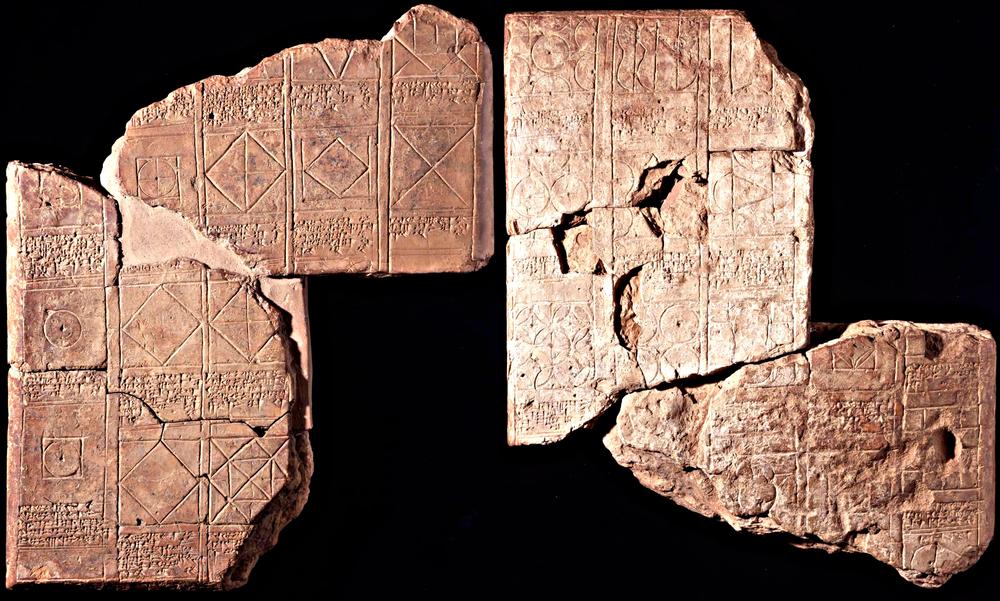
The Old Babylonian table of constants published as TMS 3 records three constants for the ox-eye. The tablet was excavated at Susa and is now in the Louvre Museum collection in Paris. Ox-eyes also occur in Neugebauer's reconstruction of problem 33 on the Old Babylonian clay tablet BM 15285, now held by the British Museum in London (Friberg 2007, pp. 323-326).
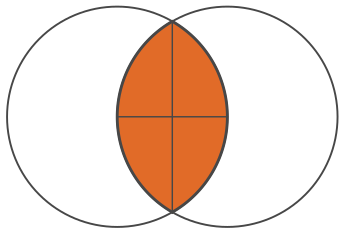
The modern reconstruction above has bounding arcs that are each one third of a circle. Geometrically, the ox-eye
is exactly a vesica piscis: the two bounding circles have equal radii  and their centers are separated by
  . The related grain
figure is not a vesica piscis; its center separation
is
. The related grain
figure is not a vesica piscis; its center separation
is  , its arcs
are quarter circles, and its lens
is narrower. Another related Babylonian arc figure is the
four-sided apsamikkum, or "cow's nose."
, its arcs
are quarter circles, and its lens
is narrower. Another related Babylonian arc figure is the
four-sided apsamikkum, or "cow's nose."
If  is the length
of either bounding arc and
is the length
of either bounding arc and  is its radius, then the
exact area is
is its radius, then the
exact area is
 |
The exact long and short transversals have lengths  and
and  , respectively. Using
  for the area of a circle
with circumference
for the area of a circle
with circumference  and the Old Babylonian value
  for
for  instead gives the sexagesimal area coefficient
  , long transversal
  , and short transversal
  (Katz 2009, pp. 16 and 29).
