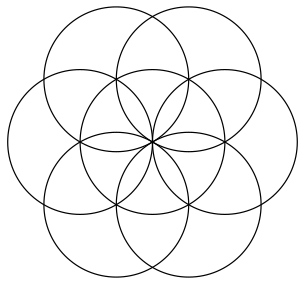
The seed of life is a seven-circle patch of a triangular overlapping circles grid . Six congruent circles have centers equally spaced
on the circumference of a central circle ,
and all seven circles have the same radius .
The resulting arrangement has sixfold rotational
symmetry and contains six congruent lenses
around its center .
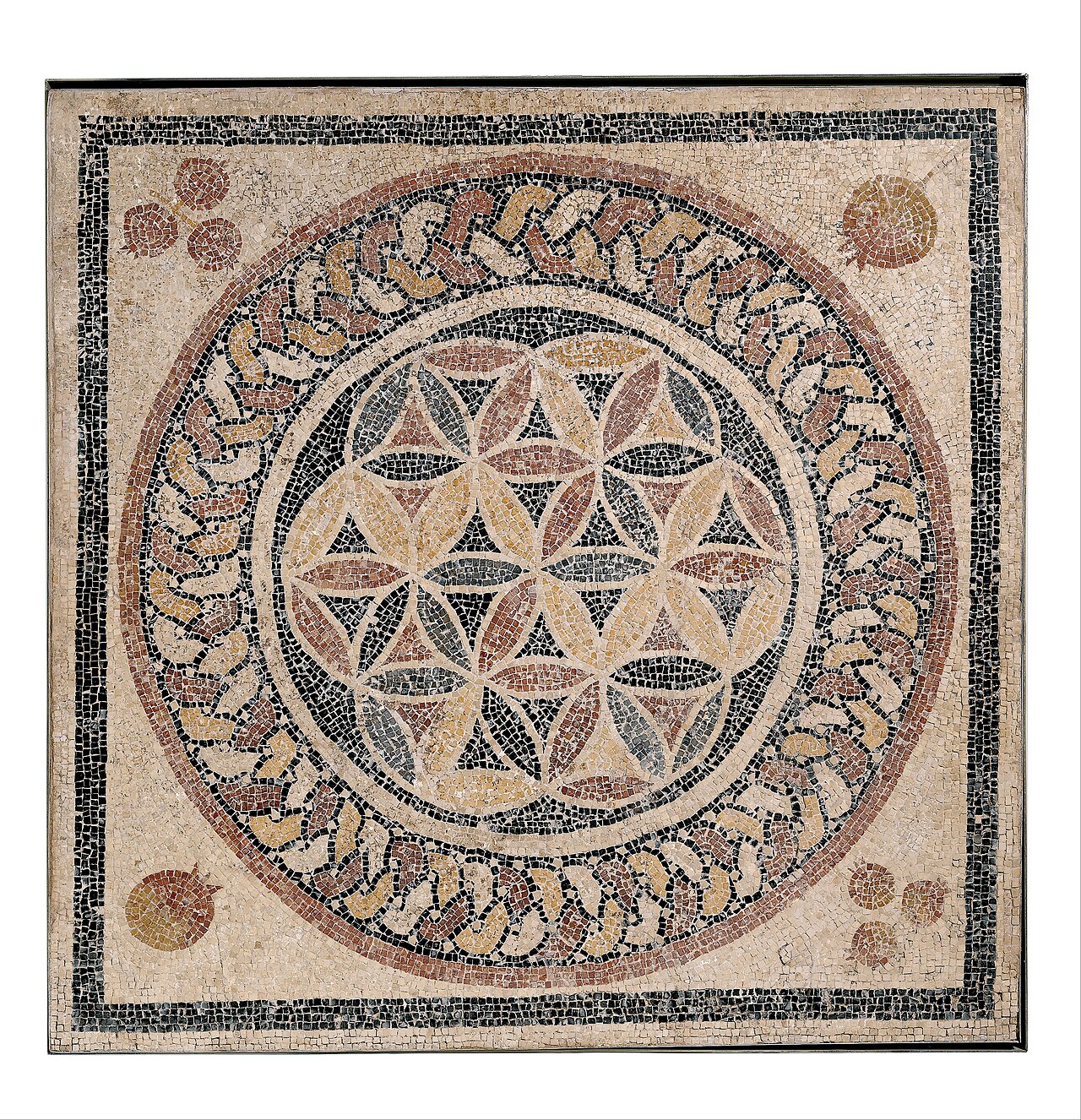
Seven-circle overlapping patterns occur in historical artifacts, including a first-century BC floor mosaic from a bathhouse in Herod's
palace (Katz and Jin 2016).
Related patterns also appear in 13th-century Italian art (Wolfram 2002, p. 43 ).
The name "seed of life" is modern. In the terminology used by Melchizedek (1999, pp. 42-43 and 158-160), the seven-circle configuration
is extracted from the flower of life . A related
13-circle selection is called the fruit
of life , and joining its circle centers
by line segments gives Metatron's
cube .
See also Circle ,
Circle Covering ,
Five Disks Problem ,
Flower
of Life ,
Fruit of Life ,
Metatron's
Cube ,
Overlapping Circles Grid ,
Venn Diagram
Explore with Wolfram|Alpha
References Israel Museum. "Mosaic Floor from a Bathhouse in Herod's Palace." Herodian period, 1st century BC, accession no. 829245. Public-domain
image via Wikimedia Commons. https://commons.wikimedia.org/wiki/File:Mosaic_floor_from_a_bathhouse_in_Herod%27s_palace_-_Google_Art_Project.jpg . Katz,
E. A. and Jin, B.-Y. "Fullerenes, Polyhedra, and Chinese Guardian Lions."
Math. Intelligencer 38 , 61-68, 2016. https://doi.org/10.1007/s00283-016-9663-0 . Melchizedek,
D. The
Ancient Secret of the Flower of Life, Volume One. Wolfram, S. A
New Kind of Science. 43 ,
2002. Referenced on Wolfram|Alpha Seed of Life
Cite this as:
Weisstein, Eric W. "Seed of Life." From
MathWorld https://mathworld.wolfram.com/SeedofLife.html
Subject classifications More... Less...