


The grain figure, also called a barleycorn or grain-field figure, is a symmetric lens bounded by two congruent circular arcs.
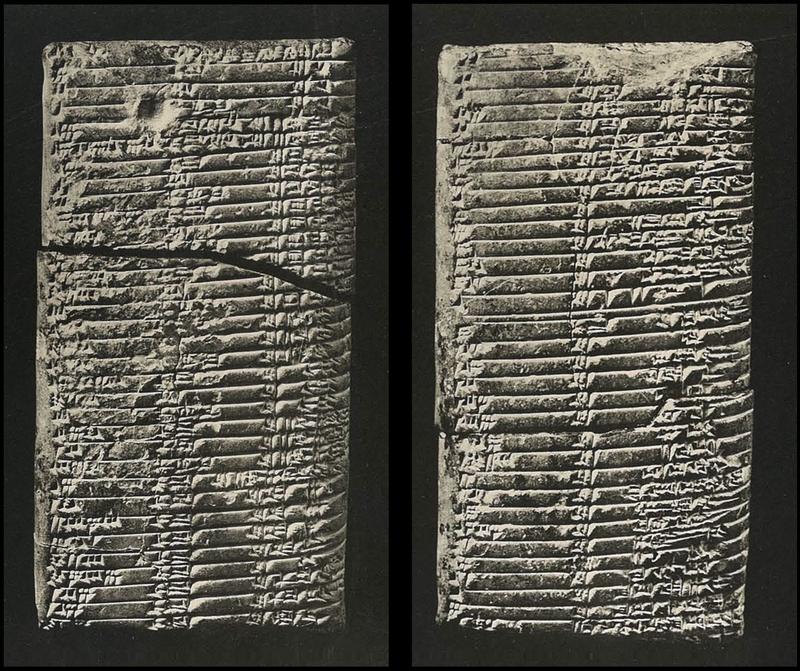
The figure occurs on Old Babylonian mathematical tablets from Susa dating to roughly 1900-1600 BC (Bruins and Rutten 1961, Robson 1999). One construction begins with a square inscribed in a circle and reflects one of the four exterior circular segments across an adjacent side of the square (Bruins and Rutten 1961, Robson 1999).

The modern reconstruction above shows the resulting lens.
The grain figure resembles a vesica piscis, but the two lenses are not the same. If the congruent bounding
circles have radius  , their centers are separated by
  in the grain figure, so each bounding arc
is one quarter of a circle. For a vesica
piscis, which is the same figure as the Babylonian ox-eye,
the center separation is
in the grain figure, so each bounding arc
is one quarter of a circle. For a vesica
piscis, which is the same figure as the Babylonian ox-eye,
the center separation is  and each bounding arc is one third of a circle.
The grain figure is therefore the narrower of the two symmetric lenses.
and each bounding arc is one third of a circle.
The grain figure is therefore the narrower of the two symmetric lenses.
If each bounding arc has arc length  , the parent circle
has circumference
, the parent circle
has circumference  and hence radius
 |
(1)
|
The area  , width
  , and height
  of the grain figure are
 |  |  |
(2)
|
 |  |  |
(3)
|
 |  |  |
(4)
|
For the tablet value  ,
the standard Old Babylonian approximations
,
the standard Old Babylonian approximations  and
and 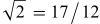 give
give
 |  |  |
(5)
|
 |  |  |
(6)
|
 |  |  |
(7)
|
