


The angles  (with
(with  integers) for which the trigonometric
functions may be expressed in terms of finite root
extraction of real numbers are limited to values of
integers) for which the trigonometric
functions may be expressed in terms of finite root
extraction of real numbers are limited to values of  which are precisely those which produce constructible
polygons. Analytic expressions for trigonometric functions with arguments of
this form can be obtained using the Wolfram
Language function ToRadicals,
e.g., ToRadicals[Sin[Pi/17]],
for values of
which are precisely those which produce constructible
polygons. Analytic expressions for trigonometric functions with arguments of
this form can be obtained using the Wolfram
Language function ToRadicals,
e.g., ToRadicals[Sin[Pi/17]],
for values of  (for
(for  ,
the trigonometric functions auto-evaluate in the Wolfram
Language).
,
the trigonometric functions auto-evaluate in the Wolfram
Language).
Compass and straightedge constructions dating back to Euclid were capable of inscribing regular
polygons of 3, 4, 5, 6, 8, 10, 12, 16, 20, 24, 32, 40, 48, 64, ..., sides. However,
Gauss showed in 1796 (when he was 19 years old) that a sufficient
condition for a regular polygon on  sides to be constructible was that
  be of the form
 |
(1)
|
where  is a nonnegative integer and the
  are distinct Fermat primes.
Here, a Fermat prime is a prime Fermat number, i.e.,
a prime number of the form
are distinct Fermat primes.
Here, a Fermat prime is a prime Fermat number, i.e.,
a prime number of the form
 |
(2)
|
where  is an integer, and the only known primes
of this form are 3, 5, 17, 257, and 65537. The first proof of the fact that this
condition was also necessary is credited to Wantzel
(1836).
is an integer, and the only known primes
of this form are 3, 5, 17, 257, and 65537. The first proof of the fact that this
condition was also necessary is credited to Wantzel
(1836).
A necessary and sufficient condition that a regular  -gon be constructible
is that
-gon be constructible
is that  be a power of 2, where
  is the totient function
(Krížek et al. 2001, p. 34).
is the totient function
(Krížek et al. 2001, p. 34).
Constructible values of  for
for  were given by Gauss (Smith 1994), and the first few
are 1, 2, 3, 4, 5, 6, 8, 10, 12, 15, 16, 17, 20, 24, 30, 32, 34, 40, 48, 51, 60,
64, 68, 80, 85, 96, 102, 120, 128, 136, 160, 170, 192, ... (OEIS A003401).
were given by Gauss (Smith 1994), and the first few
are 1, 2, 3, 4, 5, 6, 8, 10, 12, 15, 16, 17, 20, 24, 30, 32, 34, 40, 48, 51, 60,
64, 68, 80, 85, 96, 102, 120, 128, 136, 160, 170, 192, ... (OEIS A003401).
The algebraic degrees of  for constructible polygons are 1, 1, 1, 1, 2, 1,
2, 2, 2, 4, 4, 8, 4, 4, 4, 8, ...(OEIS A113401),
and of
for constructible polygons are 1, 1, 1, 1, 2, 1,
2, 2, 2, 4, 4, 8, 4, 4, 4, 8, ...(OEIS A113401),
and of  are ... (OEIS A113402).
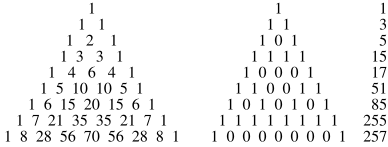
Gardner (1977) and independently Watkins (Conway and Guy 1996, Krížek et al. 2001) noticed that the number of sides for constructible polygons with odd numbers of sides are given by the first 32 rows of the Sierpiński sieve interpreted as binary numbers, giving 1, 3, 5, 15, 17, 51, 85, 255, ... (OEIS A004729, Conway and Guy 1996, p. 140). In other words, every row is a product of distinct Fermat primes, with terms given by binary counting.
A partial table of the analytic values of sine, cosine, and tangent for arguments  with small integer
  is given below. Derivations of these formulas appear in the
following entries.
is given below. Derivations of these formulas appear in the
following entries.
 ( ( ) ) |  (rad) (rad) |  |  |  |
| 0.0 | 0 | 0 | 1 | 0 |
| 15.0 |  | 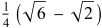 | 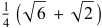 |  |
| 18.0 |  |  | 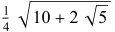 | 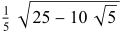 |
| 22.5 |  |  |  |  |
| 30.0 |  |  |  |  |
| 36.0 |  | 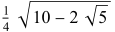 |  |  |
| 45.0 |  |  |  | 1 |
| 60.0 |  |  |  |  |
| 90.0 |  | 1 | 0 |  |
| 180.0 |  | 0 |  | 0 |
There is a nice mnemonic for remembering sines of common angles,
 |  |  |
(3)
|
 |  |  |
(4)
|
 |  |  |
(5)
|
 |  |  |
(6)
|
 |  |  |
(7)
|
In general, any trigonometric function can be expressed in radicals for arguments of the form  ,
where
,
where  is a rational number, by writing the trigonometric
functions in exponential form and the exponentials as roots of
is a rational number, by writing the trigonometric
functions in exponential form and the exponentials as roots of  . For example,
![cos(pi/(23))=-1/2(-1)^(22/23)[1+(-1)^(2/23)].](/images/equations/TrigonometryAngles/NumberedEquation3.svg) |
(8)
|
This confirms that for  rational, trigonometric functions of
  are always algebraic numbers.
For example, the cases
are always algebraic numbers.
For example, the cases  and
and  involve the cubic equation
(in
involve the cubic equation
(in  and
and  ,
respectively). The polynomial of which a given expression is a root can be obtained
in the Wolfram Language using the
syntax RootReduce[ToRadicals[expr]],
which produces a Root
object.
,
respectively). The polynomial of which a given expression is a root can be obtained
in the Wolfram Language using the
syntax RootReduce[ToRadicals[expr]],
which produces a Root
object.
Letting  denoted the
  th
root of the polynomial
th
root of the polynomial  in the ordering of the Wolfram
Language's Root
object, the first few analytic values of
in the ordering of the Wolfram
Language's Root
object, the first few analytic values of  are summarized in the following table.
 |  |
| 1 | 0 |
| 2 | 1 |
| 3 |  |
| 4 |  |
| 5 |  |
| 6 |  |
| 7 |  |
| 8 | 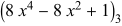 |
| 9 |  |
| 10 |  |
The algebraic order of  is given analytically by
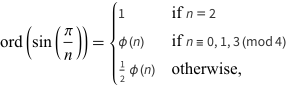 |
(9)
|
where  is the totient function. For
  , 2, ..., this gives the sequence 1, 1, 2, 2, 4, 1, 6, 4,
6, 2, 10, 4, ... (OEIS A055035).
, 2, ..., this gives the sequence 1, 1, 2, 2, 4, 1, 6, 4,
6, 2, 10, 4, ... (OEIS A055035).
The minimal polynomial for  with
with  an odd prime is given by
 |
(10)
|
(Beslin and de Angelis 2004).
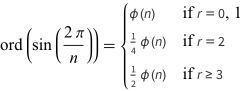
If  and
and  ,
the algebraic order of
,
the algebraic order of  is given by
 |
(11)
|
(Ribenboim 1972, p. 289; Beslin and de Angelis 2004). This gives the sequence 1, 1, 2, 1, 4, 2, 6, 2, 6, 4, 10, 1, ... (OEIS A093819).
The first few analytic values of  are summarized in the following table.
 |  |
| 1 |  |
| 2 | 0 |
| 3 |  |
| 4 |  |
| 5 |  |
| 6 |  |
| 7 |  |
| 8 | 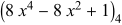 |
| 9 | 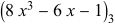 |
| 10 |  |
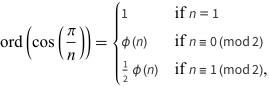
The algebraic order of  is given analytically by
 |
(12)
|
where  is the totient function. For
  , 2, ..., this gives the sequence 1, 1, 1, 2, 2, 2, 3, 4,
3, 4, 5, 4, 6, ... (OEIS A055034; Lehmer 1933,
Watkins and Zeitlin 1993, Surowski and McCombs 2003).
, 2, ..., this gives the sequence 1, 1, 1, 2, 2, 2, 3, 4,
3, 4, 5, 4, 6, ... (OEIS A055034; Lehmer 1933,
Watkins and Zeitlin 1993, Surowski and McCombs 2003).
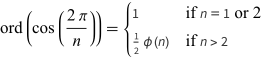
The algebraic order of  is given analytically by
 |
(13)
|
(Ribenboim 1972, p. 289; Beslin and de Angelis 2004) giving the sequence 1, 1, 1, 1, 2, 1, 3, 2, 3, 2, 5, ... (OEIS A023022).
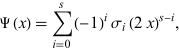
For  with
with  an odd prime, an explicit formula can be given for the
minimal polynomial, namely
an odd prime, an explicit formula can be given for the
minimal polynomial, namely
 |
(14)
|
where
 |  |  |
(15)
|
 |  |  |
(16)
|
 |  |  |
(17)
|
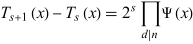
(Surowski and McCombs 2003; correcting the sign in the definition of  ). Watkins and Zeitlin (1993) showed that
 |
(18)
|
for  odd, where
  is a Chebyshev polynomial of the
first kind, and
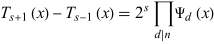
is a Chebyshev polynomial of the
first kind, and
 |
(19)
|
for  even.
even.
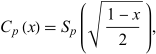
Beslin and de Angelis (2004) give the simpler form
 |
(20)
|
where  is as defined above.
As already noted, a special type of expansion in terms of radicals with real arguments can be obtained if  is a power of two times a product of distinct Fermat primes.
For other values of
is a power of two times a product of distinct Fermat primes.
For other values of  , the situation becomes more complicated. It is now no longer
possible to express trigonometric functions in a form that they are expressed as
real radicals, but a certain minimal representation still exists. The simplest nontrivial
example is for
, the situation becomes more complicated. It is now no longer
possible to express trigonometric functions in a form that they are expressed as
real radicals, but a certain minimal representation still exists. The simplest nontrivial
example is for  .
The exact meaning of "minimal" is rather technical and is related to the
Galois subgroups of certain cyclotomic
polynomials (Weber 1996). As it turns out, for
.
The exact meaning of "minimal" is rather technical and is related to the
Galois subgroups of certain cyclotomic
polynomials (Weber 1996). As it turns out, for  prime, the expansions are especially interesting and difficult,
and higher order Galois group calculations are both
difficult and time-consuming. For example,
prime, the expansions are especially interesting and difficult,
and higher order Galois group calculations are both
difficult and time-consuming. For example,  is a very difficult case and takes a long time to calculate.
Some larger primes are easier again but the complexity grows with the size of the
prime on average.
is a very difficult case and takes a long time to calculate.
Some larger primes are easier again but the complexity grows with the size of the
prime on average.
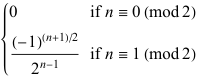
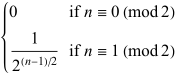
While individual trigonometric functions may require complicated representations at certain angles, there are general formulas for the products of these functions. For example,
 |  |  |
(21)
|
 |  |  |
(22)
|
 |  |  |
(23)
|
 |  |  |
(24)
|
The first few values of the latter for  , 2, ... are therefore 1, 1, 3/4, 1/2, 5/16, 3/16, ... (OEIS
A000265 and A084623).
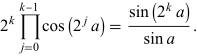
Another example is the general case of Morrie's law,
, 2, ... are therefore 1, 1, 3/4, 1/2, 5/16, 3/16, ... (OEIS
A000265 and A084623).
Another example is the general case of Morrie's law,
 |
(25)
|

 and
and  ." Math. Mag. 77, 146-149, 2004.Carrega,
J. C.
." Math. Mag. 77, 146-149, 2004.Carrega,
J. C.  ." Missouri J. Math. Sci. 15, 4-14,
2003.Tietze, H.
." Missouri J. Math. Sci. 15, 4-14,
2003.Tietze, H.  à la Gauss."
Mathematica Educ. Res. 4, 31-36, 1995.Trott, M. "
à la Gauss."
Mathematica Educ. Res. 4, 31-36, 1995.Trott, M. " à la Gauss."
§1.10.2 in
à la Gauss."
§1.10.2 in  ." Amer. Math. Monthly 100, 471-474,
1993.Weber, A. "Computing Radical Expressions for Roots of Unity."
SIGSAM Bull. 30, 11-20, 1996.Wegner, K. W. "Equations
with Trigonometric Values as Roots." Amer. Math. Monthly 66, 52-53,
1959.
." Amer. Math. Monthly 100, 471-474,
1993.Weber, A. "Computing Radical Expressions for Roots of Unity."
SIGSAM Bull. 30, 11-20, 1996.Wegner, K. W. "Equations
with Trigonometric Values as Roots." Amer. Math. Monthly 66, 52-53,
1959.