


The totient function  ,
also called Euler's totient function, is defined as the number of positive
integers
,
also called Euler's totient function, is defined as the number of positive
integers  that are relatively prime to (i.e., do not contain
any factor in common with)
that are relatively prime to (i.e., do not contain
any factor in common with)  , where 1 is counted as being relatively
prime to all numbers. Since a number less than or equal to and relatively
prime to a given number is called a totative, the
totient function
, where 1 is counted as being relatively
prime to all numbers. Since a number less than or equal to and relatively
prime to a given number is called a totative, the
totient function  can be simply defined as the number of totatives of
 . For example, there are eight totatives
of 24 (1, 5, 7, 11, 13, 17, 19, and 23), so
. For example, there are eight totatives
of 24 (1, 5, 7, 11, 13, 17, 19, and 23), so  .
.
The totient function is implemented in the Wolfram Language as EulerPhi[n].
The number  is called the cototient of
  and gives the number of positive integers
  that have at least one prime factor in common with
  .
.
 is always even
for
is always even
for  .
By convention,
.
By convention,  ,
although the Wolfram Language defines
EulerPhi[0]
equal to 0 for consistency with its FactorInteger[0]
command. The first few values of
,
although the Wolfram Language defines
EulerPhi[0]
equal to 0 for consistency with its FactorInteger[0]
command. The first few values of  for
for  , 2, ... are 1, 1, 2, 2, 4, 2, 6, 4, 6, 4, 10, ... (OEIS
A000010). The totient function is given by
the Möbius transform of 1, 2, 3, 4, ...
(Sloane and Plouffe 1995, p. 22).
, 2, ... are 1, 1, 2, 2, 4, 2, 6, 4, 6, 4, 10, ... (OEIS
A000010). The totient function is given by
the Möbius transform of 1, 2, 3, 4, ...
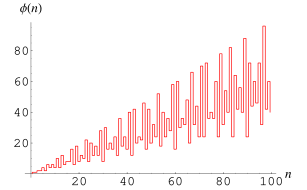
(Sloane and Plouffe 1995, p. 22).  is plotted above for small
  .
.
For a prime  ,
,
 |
(1)
|
since all numbers less than  are relatively prime to
 . If
. If  is a power of a prime,
then the numbers that have a common factor with
is a power of a prime,
then the numbers that have a common factor with  are the multiples of
  :
:  ,
,  , ...,
  . There are
  of these multiples, so the number of factors relatively prime to
  is
is
 |  |  |
(2)
|
 |  |  |
(3)
|
 |  |  |
(4)
|
Now take a general  divisible by
  .
Let
.
Let  be the number of positive integers
  not divisible by
  . As before,
  ,
,  , ...,
  have common factors, so
 |  |  |
(5)
|
 |  |  |
(6)
|
Now let  be some other prime dividing
  . The integers divisible by
  are
are  ,
,  , ...,
  . But these duplicate
  ,
,  , ...,
  . So the number of terms that must be subtracted from
 to obtain
  is
is
 |  |  |
(7)
|
 |  |  |
(8)
|
and
 |  | 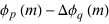 |
(9)
|
 |  | 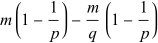 |
(10)
|
 |  | 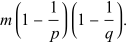 |
(11)
|
By induction, the general case is then
 |  |  |
(12)
|
 |  |  |
(13)
|
where the product runs over all primes  dividing
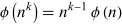
  . An interesting identity relating
  to
to  is given by
 |
(14)
|
(A. Olofsson, pers. comm., Dec. 30, 2004).
Another identity relates the divisors  of
of  to
to  via
via
 |
(15)
|
The totient function is connected to the Möbius function  through the sum
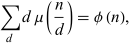 |
(16)
|
where the sum is over the divisors of  , which can be proven by induction on
  and the fact that
  and
and  are multiplicative (Berlekamp 1968, pp. 91-93; van
Lint and Nienhuys 1991, p. 123).
are multiplicative (Berlekamp 1968, pp. 91-93; van
Lint and Nienhuys 1991, p. 123).
The totient function has the Dirichlet generating function
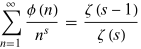 |
(17)
|
for  (Hardy and Wright 1979, p. 250).
The totient function satisfies the inequality
 |
(18)
|
for all  except
  and
and  (Kendall and Osborn 1965; Mitrinović and Sándor 1995, p. 9). Therefore,
the only values of
(Kendall and Osborn 1965; Mitrinović and Sándor 1995, p. 9). Therefore,
the only values of  for which
  are
are  ,
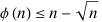
4, and 6. In addition, for composite
,
4, and 6. In addition, for composite  ,
,
 |
(19)
|
(Sierpiński and Schinzel 1988; Mitrinović and Sándor 1995, p. 9).
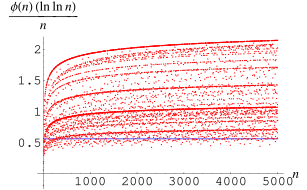
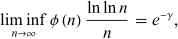
 also satisfies
 |
(20)
|
where  is the Euler-Mascheroni constant. The
values of
is the Euler-Mascheroni constant. The
values of  for which
  are given by 3, 4, 5, 6, 8, 9, 10, 12, 14, 15, 16, 18, 20, 22, ... (OEIS A100966).
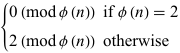
The divisor function satisfies the congruence
 |  |  |
(21)
|
 |  |  |
(22)
|
for all primes  and no composite
with the exception of 4, 6, and 22, where
and no composite
with the exception of 4, 6, and 22, where  is the divisor function.
This fact was proved by Subbarao (1974), despite the implication to the contrary,
"is it true for infinitely many composite
is the divisor function.
This fact was proved by Subbarao (1974), despite the implication to the contrary,
"is it true for infinitely many composite  ?," stated in Guy (1994, p. 92), a query subsequently
removed from Guy (2004, p. 142). No composite
solution is currently known to
?," stated in Guy (1994, p. 92), a query subsequently
removed from Guy (2004, p. 142). No composite
solution is currently known to
 |
(23)
|
(Honsberger 1976, p. 35).
A corollary of the Zsigmondy theorem leads to the following congruence,
 |
(24)
|
(Zsigmondy 1882, Moree 2004, Ruiz 2004ab).
The first few  for which
 |
(25)
|
are given by 1, 3, 15, 104, 164, 194, 255, 495, 584, 975, ... (OEIS A001274), which have common values  , 2, 8, 48, 80, 96, 128, 240, 288, 480, ... (OEIS A003275).
The only  for which
 |
(26)
|
is  ,
giving
,
giving
 |
(27)
|
(Guy 2004, p. 139).
Values of  shared among
  that are close together include
 |  |  |
(28)
|
 |  |  |
(29)
|
 |  |  |
(30)
|
 |  |  |
(31)
|
(Guy 2004, p. 139). McCranie found an arithmetic progression of six numbers with equal totient functions,
 |
(32)
|
as well as other progressions of six numbers starting at 1166400, 1749600, ... (OEIS A050518).
If the Goldbach conjecture is true, then for every positive integer  , there are primes
  and
and  such that
 |
(33)
|
(Guy 2004, p. 160). Erdős asked if this holds for  and
and  not necessarily prime, but this relaxed form remains unproven
(Guy 2004, p. 160).
not necessarily prime, but this relaxed form remains unproven
(Guy 2004, p. 160).
Guy (2004, p. 150) discussed solutions to
 |
(34)
|
where  is the divisor function. F. Helenius has
found 365 such solutions, the first of which are 2, 8, 12, 128, 240, 720, 6912, 32768,
142560, 712800, ... (OEIS A001229).
is the divisor function. F. Helenius has
found 365 such solutions, the first of which are 2, 8, 12, 128, 240, 720, 6912, 32768,
142560, 712800, ... (OEIS A001229).

 for Which
  Divides
  ." Fib. Quart. 27, 285-286, 1989.Conway,
J. H. and Guy, R. K. "Euler's Totient Numbers."
." Fib. Quart. 27, 285-286, 1989.Conway,
J. H. and Guy, R. K. "Euler's Totient Numbers."  Function. Fermat's Theorem Again." §2.4.3 in Supplement
to Ch. 1 in
Function. Fermat's Theorem Again." §2.4.3 in Supplement
to Ch. 1 in  Properly Divide
  ," "Solutions of
  ," "Carmichael's Conjecture,"
"Gaps Between Totatives," "Iterations of
," "Carmichael's Conjecture,"
"Gaps Between Totatives," "Iterations of  and
and  ," "Behavior of
  and
and  ." §B36-B42 in
  -Function." §8 in
  Function." §2.27 in