

The term "polyhedron" has slightly different meanings in geometry, algebraic geometry, and algebraic topology. In geometry, a polyhedron is a three-dimensional solid consisting of a collection of polygons, usually joined at their edges. The word derives from the Greek poly (many) plus the Indo-European hedron (seat). A polyhedron is the three-dimensional version of the more general polytope (in the geometric sense), which can be defined in arbitrary dimension. The plural of polyhedron is "polyhedra" (or sometimes "polyhedrons").
The term "polyhedron" is used somewhat differently in algebraic topology, where it is defined as a space that can be built from such "building blocks" as line segments, triangles, tetrahedra, and their higher dimensional analogs by "gluing them together" along their faces (Munkres 1993, p. 2). More specifically, it can be defined as the underlying space of a simplicial complex (with the additional constraint sometimes imposed that the complex be finite; Munkres 1993, p. 9). In the usual definition, a polyhedron can be viewed as an intersection of half-spaces, while a polytope is a bounded polyhedron.
In the Wolfram Language, Polyhedron[] objects represent filled regions founded by closed surfaces with polygonal faces.
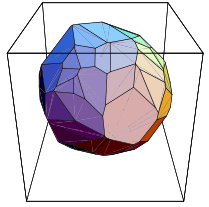
A convex polyhedron can be formally defined as the set of solutions to a system of linear inequalities
 |
where  is a real
  matrix and
  is a real
  -vector. Although usage varies,
most authors additionally require that a solution be bounded for it to define a convex polyhedron. An example of a convex polyhedron
is illustrated above.
-vector. Although usage varies,
most authors additionally require that a solution be bounded for it to define a convex polyhedron. An example of a convex polyhedron
is illustrated above.
The following table lists the name given to a polyhedron having  faces for small
  . When used without qualification for polyhedron for which
symmetric forms exist, the term may mean this particular polyhedron or may mean an
arbitrary
. When used without qualification for polyhedron for which
symmetric forms exist, the term may mean this particular polyhedron or may mean an
arbitrary  -faced
polyhedron, depending on context.
-faced
polyhedron, depending on context.

A polyhedron is said to be regular if its faces and vertex figures are regular (not necessarily convex) polygons (Coxeter 1973, p. 16). Using this definition, there are a total of nine regular polyhedra, five being the convex Platonic solids and four being the concave (stellated) Kepler-Poinsot polyhedra. However, the term "regular polyhedra" is sometimes used to refer exclusively to the Platonic solids (Cromwell 1997, p. 53). The dual polyhedra of the Platonic solids are not new polyhedra, but are themselves Platonic solids.
A convex polyhedron is called semiregular if its faces have a similar arrangement of nonintersecting regular planar convex polygons of two or more different types about each polyhedron vertex (Holden 1991, p. 41). These solids are more commonly called the Archimedean solids, and there are 13 of them. The dual polyhedra of the Archimedean solids are 13 new (and beautiful) solids, sometimes called the Catalan solids.
A quasiregular polyhedron is the solid region interior to two dual regular polyhedra (Coxeter 1973, pp. 17-20). There are only two convex quasiregular polyhedra: the cuboctahedron and icosidodecahedron. There are also infinite families of prisms and antiprisms.
There exist exactly 92 convex polyhedra with regular polygonal faces (and not necessarily equivalent vertices). They are known as the Johnson solids. Polyhedra with identical polyhedron vertices related by a symmetry operation are known as uniform polyhedra. There are 75 such polyhedra in which only two faces may meet at an polyhedron edge, and 76 in which any even number of faces may meet. Of these, 37 were discovered by Badoureau in 1881 and 12 by Coxeter and Miller ca. 1930.
Polyhedra can be superposed on each other (with the sides allowed to pass through each other) to yield additional polyhedron compounds. Those made from regular polyhedra have symmetries which are especially aesthetically pleasing. The graphs corresponding to polyhedra skeletons are called Schlegel graphs.
Behnke et al. (1974) have determined the symmetry groups of all polyhedra symmetric with respect to their polyhedron vertices.
Precomputed polyhedra and their properties are available in the Wolfram Language through PolyhedronData.
